Video
Justina: At any given moment, you have about five litres of blood moving around your body.
Georgina: That is about eight percent of your body weight.
Justina: And all of that blood is kept in motion by a big muscle in your chest cavity: the heart.
Georgina: And that is what we are going to be looking at today: the heart, blood and circulation.
Justina: Let’s take a closer look.The heart is located in the chest cavity.Blood flows around your body in a one-way system that’s controlled by four heart valves, in a process known as double circulation, through pulmonary circulation and systemic circulation.
Georgina: Deoxygenated blood is delivered from the rest of the body into the right atrium, where is passes through the right atrioventricular valve and into the right ventricle.
Justina: From here, it passes through the pulmonary valve, into the pulmonary artery and into the lungs.
Georgina: In the lungs, blood picks up oxygen before being transported back to the heart, via the pulmonary veins, and into the left atrium.This is the pulmonary circulation.
Justina: The blood in the left atrium passes through the left atrioventricular valve, into the left ventricle, then on into the aorta.The aorta is the main artery that distributes the oxygen-rich blood around the rest of the body.This is systemic circulation.Once the body has used the oxygen-rich blood, the deoxygenated blood arrived back in the right atrium and the process starts again.
Georgina: So, why is blood so important?Blood transports and distributes vital substances, such as oxygen, nutrients and heat, around the body.
Justina: It has four main components: red blood cells, white blood cells, platelets and plasma.
Georgina: Red blood cells carry oxygen and give blood its’ red colour.They contain a protein called haemoglobin, that combines with oxygen in the lungs and delivers it to cells around the body.
Justina: White blood cells engulf pathogens and produce antibodies.They are an important part of your body’s immune system.
Georgina: And platelets help your blood clot if you have a scratch or a cut.
Justina: All of these elements are carried in plasma, which makes up about 55 percent of blood volume.Plasma also carried carbon dioxide, urea, hormones, dissolved nutrients and water around the body.
Georgina: All this blood is transported round the body through a complex network of arteries, capillaries and veins.Arteries carry oxygen-rich blood away from the heart, and veins carry deoxygenated blood back toward the heart.
Justina: Veins and arteries are connected by capillaries that run in and around other organs in the body.The walls of capillaries are just one cell thick, which allows the fast exchange of molecules such as oxygen, hormones and nutrients between the blood and the body’s cells.
Georgina: Anything cells produce as waste, like carbon dioxide, moves back into the capillaries to be carried away.There are so many capillaries in a human body that if you laid then end to end, they’d stretch around the world nearly three times.
Justina: Wow!I think I’ll leave them where they are though, thank you!
Georgina: The heart really is so important for life, so looking after it with exercise and a healthy diet is crucial.
Justina: You can say that again.
This video explores how the components of the cardiovascular system work together to transport essential substances around the body. It begins with a visualisation of the structure of the heart, following the pathway of blood as it moves through the heart, travels to the lungs for oxygenation, and returns to the heart for distribution throughout the body.
The video then examines the components of blood – including red blood cells, white blood cells, platelets and plasma – and explains how each supports the transport of vital nutrients and gases. Finally, it describes the different types of blood vessels and how their structures enable efficient circulation around the body.
This short video is from the series Human biology.
Suggested activities
Before watching
The video is a great opportunity for students to consolidate their learning at the end of a topic that looks at the cardiovascular system. You might get students to recall the equation for respiration and make a list of the nutrients they think are needed around the body.
During the video
Depending on the focus of your lesson, you may wish to use only the beginning, middle, or end of the video. Stop the episode at appropriate points to check for understanding, or to ask students to repeat or explain key facts or concepts.
You could also ask students to complete the following activities:
Define the following key terms:
- Pulmonary circulation
- Systemic circulation
- Haemoglobin
You could copy and ask students to complete the table below with details about the different components of the blood and their function.
| Component | Description | Function |
|---|---|---|
| Platelets | Small fragments in the blood | To support blood clotting |
| White blood cells | ||
| Red blood cells | ||
| Plasma |
You could provide a 2D diagram of the heart, along with a list of relevant keywords. Each structure of the heart should have a blank label box. As the video progresses, ask students to label the diagram at their own pace. Pause the video if necessary to support students.
After the video
You might carry out a heart dissection in the classroom. Focus on linking the structures seen in the video to those observed during the dissection. Although valves are not included in the video, challenge students to consider why these adaptations are important.
You could ask students to complete the following questions:
Place the following in the correct order, starting with blood entering the heart via the vena cava (hint: blood leaves the heart through arteries and returns via veins):
a. Aorta
b. Pulmonary veins (be careful)
c. Pulmonary artery (be careful)
d. Vena cava
e. Right atrium
f. Left atrium
g. Right ventricle
h. Left ventricleWhat is the function of white blood cells?
a. To carry oxygen
b. To clot the blood
c. To break down pathogensWhat is the name of the vessel that connects arteries to veins?
a. Platelets
b. Capillaries
c. Systemic circulation
Stretch question
- In the episode, the blood entering the heart via the vena cava was shown as blue. What does this represent?
a. It is not carrying oxygen
b. It has a high concentration of carbon dioxide
c. It has a high water content
Curriculum notes
Suitable for teaching biology at Key Stage 4 and GCSE in England and Northern Ireland, Progression Step 5 and GCSE in Wales and at National 4 and 5 in Scotland.
More videos from this series
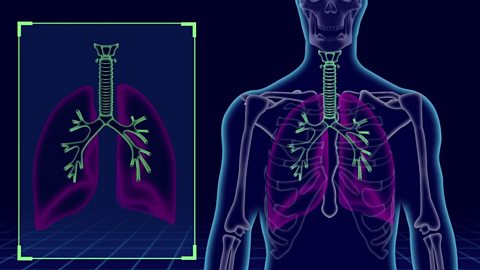
Breathing and gas exchange. video
A description of the process of ventilation and gas exchange and the bodily adaptations that support these processes.
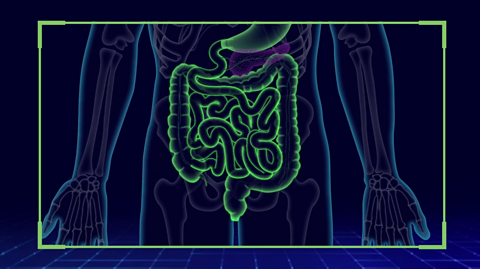
Food and digestion. video
Exploration of the concepts of mechanical digestion, chemical digestion and the adaptations of the digestive system that speed up the process of molecule break down and absorption into the bloodstream in the small intestines.
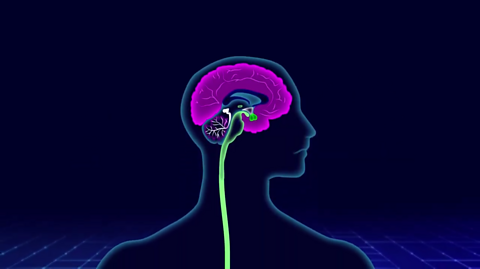
Nervous coordination. video
A description of the role of the nervous system, how it functions, voluntary and involuntary reflexes and the function of specific organs in the nervous system, such as the brain and the eye.
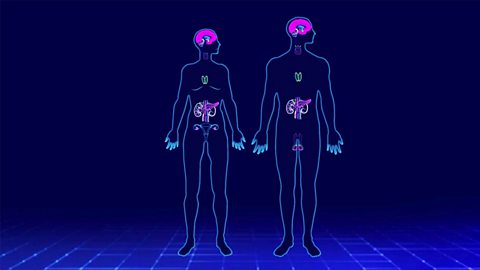
Hormonal coordination and homeostasis. video
A detailed look at the role of hormones in maintaining a constant internal environment in the body by regulating body temperature, metabolism and blood glucose levels.
Excretion. video
A detailed look at the function of the kidneys and the control of water levels in the blood.
Reproduction. video
This animation focuses on sexual reproduction, providing details on the specialised cells, organs and tissues involved in the fertilisation and maturation of an egg.
Inheritance. video
This animation covers a range of topics including developmental genetics and Mendelian inheritance.
Cell division. video
This animation focuses on the different types of cell division, sexual and asexual reproduction.
Immunity and disease. video
This animation explores how viruses and bacteria cause certain communicable diseases to occur, how our bodies protect themselves and how we use modern medicines to treat them.
Bitesize revision links for students
- England and NI: GCSE Biology (Single Science)
- Scotland: National 5 Biology
- Cymraeg: TGAU Bioleg
