Video
ELIZABETH: Going into a rural area with hardly any money, it's not ideal.
NARRATOR: Out of local currency, Elizabeth and Letitia are on a train heading north to their planned homestay.
ELIZABETH: Hiya! And do you know Anshun-xi? Can we get cash there?
MAN: I don't have cash. Let me help you.
ELIZABETH: Oh!
MAN: Let me have a try.
BOTH: Okay. Thank you.
LETITIA: "Let me have a try."
ELIZABETH: How is he gonna get cash? I don't know where he's going. Where could he have gone?
LETITIA: Where did he go?
ELIZABETH: What did he say? "Let me just check"?
LETITIA: Let me try.
ELIZABETH: Let me try.
LETITIA: Oh, he's coming back.
ELIZABETH: Has he got anything on his hand?
LETITIA: I feel like. Oh, my gosh. I see a flash of red. Oh, my gosh.
ELIZABETH: Oh, wow!
LETITIA: Wow! Wow.
ELIZABETH: Okay.
LETITIA: Sorry, sorry. Sorry sorry.
ELIZABETH: We're just very emotional right now.
LETITIA: It's been a long day.
ELIZABETH: How much do you have?
MAN: 350 yuan.
BOTH: 350 yuan?
ELIZABETH: We can give you, um, 40?
MAN: Yeah.
ELIZABETH: Yeah?
MAN: Okay.
ELIZABETH: Oh, xie xie!
LETITIA: Thank you so much!
ELIZABETH: That's so good. I've literally got tears in my eyes!
LETITIA: Literally.
ELIZABETH: This whole day, this is all we wanted.
LETITIA: Innit?! We were able to get some money. Minutes…
ELIZABETH: What are the odds?
LETITIA: …before getting stranded. Yeah, but today we took a risk, you know, and it paid off. It really paid off. It's a good feeling.
BOTH: Back in the race.
NARRATOR: 1100 km from the checkpoint, the sisters have made it to the remote Shuiyuan village…
MS HEI: Hello!
ELIZABETH: Hello!
MS HEI: Welcome my house.
ELIZABETH: Oh, thanks!
NARRATOR: …staying in Ms. Hei's countryside home.
LETITIA: Ooh!
MS HEI: You can…you can eat now. You can eat now.
ELIZABETH: Yeah? Wow.
LETITIA: It's a feast. It's a feast.
MS HEI: Don't be shy.
LETITIA: Thank you.
MS HEI: Don't be shy. Just eat.
LETITIA: Thank you.
LETITIA: Where are you from?
MS HEI: Sichuan.
LETITIA: Oh, Really?
MS HEI: You know?
LETITIA: Yeah!
ELIZABETH: And when did you come here?
MS HEI: This summer. I don't like live in city. I like countryside.
ELIZABETH: Yeah.
MS HEI: The air is more fresh and, uh, and more free. I want to find some new lifestyle.
ELIZABETH: A slow?
MS HEI: Yes.
ELIZABETH: A slow lifestyle compared to the city, yeah? Wow!
LETITIA: Honestly, if this doesn't make you fall in love with China, I don't know what will. The people here are just so hospitable. They really extend their welcome and, yeah, they just share their love so openly. Our lead is pretty much gone. I'm just more worried about being eliminated because sharing this journey with my sister, I feel like we're just getting started to, you know, get to know each other, and I want to continue on that journey.
Download/print a transcript of this episode (pdf).
Video summary
A clip from the BBC series Race Across the World exploring the characteristics of rural and urban areas in China.
Sisters Letitia and Elizabeth stay at someones home in Shuiyuan Village, rural China.
Whilst on the train trying to find where they can get some local currency, a kind passenger helps them which allows them to continue with their journey.
When they reach their accommodation, they are given a warm welcome and traditional Chinese food.
Their host, Miss Hei, had moved from urban to rural China and prefers the cleaner environment and fresh air.
Teacher notes
Download/print the Teacher Notes for this episode (pdf).
Before watching the video
Ask students to make a list of characteristics of rural and urban areas. Can they compare the two. Ask students why some people may want to move away from urban areas. This could lead to a conversation around push and pull factors linked to migration.
Introduce key terms such as:
- Currency: Another word for money.
- Counter-urbanisation: Movement from urban areas to rural areas.
- Push factor: Something negative about where you currently live that pushes you away.
- Pull factor: Something positive about a place you wish to move to that pulls you in.
During the video
You may wish to stop at relevant points during this short film to pose questions and check understanding or wait until the end. Useful questions might include:
- Why do Elizabeth and Letitia need local currency?
- How do you think Elizabeth and Letitia felt after being helped by a stranger?
- What types of food can you see being served?
- Where did Miss Hei originally live?
- Why did Miss Hei move away from Sichuan?
- How does life in rural China compare to urban China?
- How do Elizabeth and Letitia feel about their stay and their hosts?
After watching the video
Using a map, locate Shuiyuan Village. You could use online mapping software to zoom into the region to further understand the landscape and how it is used. Ask students to write a locational description of Shuiyuan and to describe the landscape and what it is used for.
Discuss the key term ‘counter-urbanisation’. Examples in the UK could be looked at and compared with China. Ask students why people may want to migrate from urban to rural areas. A list could be created by students; they can then expand this further with explanations.
Compare Shuiyuan to Sichuan where Miss Hei originally lived. Students could create a table to compare the two locations and what they expect life to be like in each location. You could also ask students where they would prefer to live and why.
Where next?
Migration is not as simple as push and pull factors, there are often barriers which make it challenging for people to move. Lee’s push-pull theory looks at the potential barriers for migration. Students could research this theory and apply it to regions of China. Miss Hei knew why she wanted to leave Sichuan, but for some people it is more challenging.
What barriers do students think there are for people moving from urban to rural China?
Curriculum notes
This clip will be relevant for teaching Geography at KS3 in England and Northern Ireland, Progression Step 4/5 in Wales and 3rd and 4th Level in Scotland.
In the English National Curriculum this film can be used to help teach the following:
- Regions of Asia
- Population and urbanisation
This clip could also be used for GCSE Geography when studying urbanisation and counter-urbanisation.
More videos from this collection
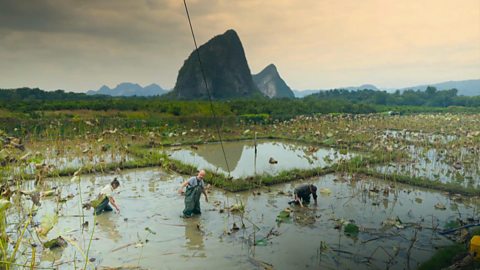
Farming in rural China. video
Yin and Gaz experience farming in rural China, staying on a farm and helping to collect lotus roots used in Chinese cuisine.
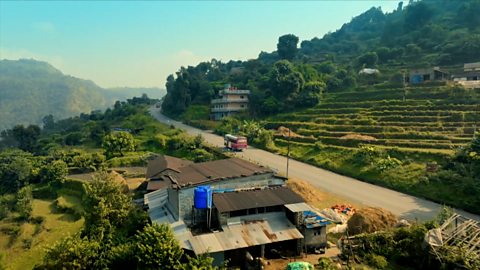
Travelling through China, India and Nepal. video
Brothers Brian and Melvyn plan a route to their checkpoint in a video clip exploring map-reading skills.
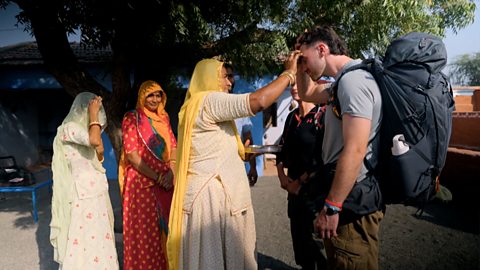
Rural life in India. video
Mother and son, Caroline and Tom, are in Salawas village near Jodhpur in a clip exploring life in rural India.
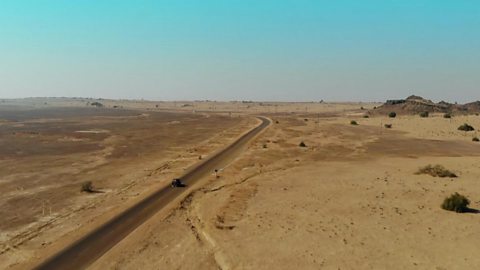
The Great Indian Desert. video
Brothers Brian and Melvyn, and mother and son Caroline and Tom, explore the largest desert in India and the communities that live there.
Comparing China, Nepal and India. video
Fin and Sioned talk about what the Race Across the World experience taught them about the food, landscape and transport of China, Nepal and India.