Video
NARRATOR: Jodhpur, called the Blue City for its houses decorated by the priestly Brahmin caste to distinguish their social superiority. On its outskirts… Salawas village, where Caroline and Tom have arrived.
CAROLINE: Namaste! Namaste! Oh wow!
TOM: Oh, thank you.
NARRATOR: They will work and stay with the Prajapats and their cooperative of 48 families.
TOM: This is so cool! Do you guys live here?
MAN: It's our home. We are 21 members in a house.
TOM: Twenty-one members?
MAN: You will meet all of them. This is my father's turban, ten metres long.
CAROLINE: And why do you wear a turban?
MAN: My father is the boss of the house.
TOM: This is very much a working village. I'm very nervous to try and not break one 'cause I can imagine they're very brittle.
MAN: You need to be very careful.
TOM: This whole village is like an arty village and all the families help to make everything. Like, this-, this is a pottery family so they're making water jugs. And then you've got other, like, carpenter families. And it's just a really nice community with everyone who works together and helps each other out. I've been a-, a labourer on a building site.
MAN: So that means you are actually hard worker.
TOM: I prefer being outside and working, like, with my hands rather than in an office or… Probably similar to everyone in this village.
MAN: We are connected with the nature. More interesting.
TOM: I like it.
MAN: And it's good for the health as well.
TOM: Yes, yeah, yeah.
MAN: It's the whole body moving. For me, my hobby comes in my job.
TOM: Er, that-, that's what I'm looking to find hopefully one day.
NARRATOR: For generations, Mr Prajapat's family have specialised in crafting dhurries, traditional cotton rugs. Once supplying the palaces of maharajas, today their traditional manufacturing method prevails.
CAROLINE: Oh my golly, Thomas.
TOM: Wow, gorgeous!
OLD MAN: Sit. This one. This one and this one.
TOM: There.
CAROLINE: God, you can't even get one strand wrong, can you? It looks so difficult.
TOM: Could I do left?
OLD MAN: No, no, this one.
TOM: Oh. Oh. I don't know if I can do that. Mmm. [chuckles]
Download/print a transcript of this episode (pdf).
Video summary
A clip from the BBC series Race Across the World exploring life in a village in India.
Mother and son, Caroline and Tom are in Salawas village which is near Jodhpur, India. Jodhpur is known as the blue city for its houses which were decorated by the religious Brahmin caste.
They receive a warm welcome to Salawas Village. Whilst there, they work with the Prajapats family and their co-operative of 48 families. Caroline and Tom are surprised to learn that 21 people live in the house and that they will meet the whole family.
They are fascinated to learn more about turbans, the traditional work done in the village and how they make the different products such as the pottery.
The Prajapats family make durrys – traditional cotton rugs. These are woven by hand using traditional methods. Caroline and Tom learn how to make the durrys.
Tom struggles to begin with as he was born with Cerebral Palsy and struggles with his right hand, but he perseveres as he wants to do a good job.
Teacher notes
Download/print the Teacher Notes for this episode (pdf).
Before watching the video
Show students images of Jodhpur and Salawas Village and ask them to describe what they can see in the images. What similarities and differences can they see between the city and the village?
Introduce key terms such as:
- Caste: A class or a group of people. They are hereditary classes of Hindu society
- Co-operative: An organisation which is owned and run jointly by its members, who share the profits and benefits.
- Durrys: Traditional cotton rugs woven by hand.
During the video
You may wish to stop at relevant points during this short film to pose questions and check understanding or wait until the end. Useful questions might include:
- Why are the houses blue?
- Why is the turban important?
- What products are made in the village?
- What does Tom like about the village?
- What do the Prajapats family make?
- Why does Caroline and Tom think the durrys are challenging to make?
- How is life different between the Salawas Village and where you live?
After watching the video
Locate Jodhpur and the Salawas Village on a map. Ask students to write a locational description of both locations. Online mapping could be used to zoom further into the two locations so that students could explore more.
Discuss the different sectors of industry: primary, secondary, tertiary and quaternary. Ask students what type of industry they can see in the clip and why it is so important in India. Discuss with students why they think a range of different products are made in Salawas and why they are still using traditional methods to make their products. Why would this be important to the families living there?
Further research could be done into the products made in the Salawas Village, students could look at different examples and describe the products being made.
Where next?
Students could research further into the Salawas Village, to find out more about the Prajapats’ homestay.
- What is the appeal of staying in this homestay?
- What activities can tourists do there?
- Why could this be seen as a more sustainable form of tourism.
Curriculum notes
This clip will be relevant for teaching Geography at KS3 in England and Northern Ireland, Progression Step 4/5 in Wales and 3rd and 4th Level in Scotland.
In the English National Curriculum this film can be used to help teach the following:
- Types of industry
- Regions of Asia
More videos from this collection
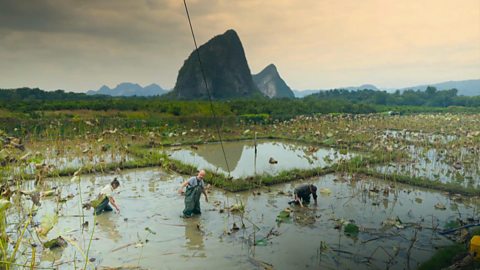
Farming in rural China. video
Yin and Gaz experience farming in rural China, staying on a farm and helping to collect lotus roots used in Chinese cuisine.
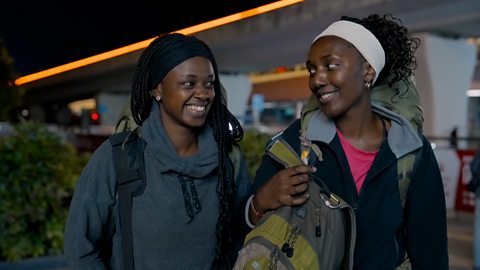
Rural and urban China. video
Sisters Letitia and Elizabeth stay at someones home in Shuiyuan Village, in a clip exploring the characteristics of rural and urban areas in China.
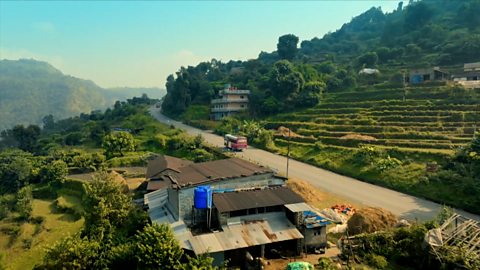
Travelling through China, India and Nepal. video
Brothers Brian and Melvyn plan a route to their checkpoint in a video clip exploring map-reading skills.
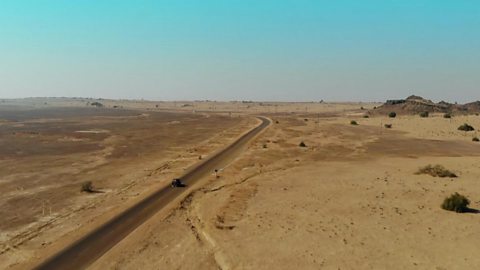
The Great Indian Desert. video
Brothers Brian and Melvyn, and mother and son Caroline and Tom, explore the largest desert in India and the communities that live there.
Comparing China, Nepal and India. video
Fin and Sioned talk about what the Race Across the World experience taught them about the food, landscape and transport of China, Nepal and India.