Video
FIN: I'm Fin.
SIONED: And I'm Sioned. And we travelled together across China…
FIN: Nepal…
SIONED: and India…
FIN: for a BBC show called…
BOTH: "Race Across the World".
FIN: Travelling through three incredibly different countries with amazing food and amazing people. And it was just a mind-blowing experience that I would love to do again. India was definitely the highlight of food for me, I think. The portion sizes they give is incredible, the spices, the-, the flavours. And we had some cake.
SIONED: I love cake for breakfast.
FIN: Have you nearly scoffed it all down already?!
SIONED: The best experience with food for us whilst we were travelling was probably the food with Sunita in the homestay in North India where we had a variety of Punjabi food that she had set up for us.
SUNITA: Cauliflower and potatoes.
SIONED: Lovely.
SUNITA: Just turn your plates and help yourself.
FIN: That's amazing.
SIONED: Perfect, thank you.
SIONED: The culture of eating with our hands was also very interesting.
FIN: The worst experience for food, I think, was eating a-, a chicken foot.
SIONED: This just feels wrong. Urgh.
FIN: Urgh!
SIONED: Oh my gosh, it's so squishy! It's so squishy!
SIONED: I think it comes down to just embracing the culture and the traditions that they have in China. So we wanted to really put ourselves out there and go for it. So that's what we did. The amount of different landscapes we travelled through was so interesting. We travelled through cities, beaches… What else?
FIN: Mountains.
SIONED: Mountains!
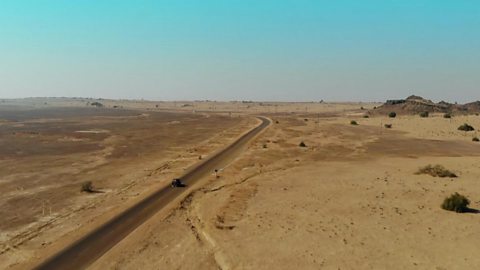
FIN: Even a bit of desert.
SIONED: It was really nice, actually!
FIN: Yeah. And, I mean, in China there was-, we went from cities, we went down to a beach that you would have thought is in, like, Rio de Janeiro or something.
SIONED: And then the weather changes with all these places as well. So we had hot weather, cold weather.
FIN: Yeah, I mean, you'd get on one train, it could be 20 degrees, and then three hours later you get off, you're in a completely different place and it could be 32 degrees. It just changed like that. I mean, in China they had these incredible are they called "Avatar" mountains, are they?
SIONED: Yeah. And you've got rice paddies which was incredible to witness that you've not got at home.
FIN: Yeah, I mean, before I went to India you-, you kind of just think of the cities, the population and everything you see on social media. But it-, it really wasn't that. It was completely different. The north was very busy. As soon as you go down to the south it is a lot quieter. It was just an incredible place.
SIONED: It's a very vast country that has a lot of variety.
FIN: We used a lot of transport. We used cars, trains, buses, tuk-tuks.
FIN: Oh wow, look at the smoke. We wanna go train station. Hold on. It's like an unsafe roller coaster with no lap restraint.
SIONED: I think the main thing that was different to transport in the UK for us is we're used to structure on the roads, so everywhere we go there's constant structure. But this was very different, in India specifically where cars would be driving into each other's lanes. There's no real rules, there's just a constant flow, but somehow it works.
FIN: In China we went on bullet trains that would go 300 plus kilometres an hour and take you to the other side of the country in just a couple of hours. And then we went to Nepal where the roads were-, were bendy.
FIN: This road is absolutely awful.
SIONED: I know. Oh my goodness.
FIN: Wow.
SIONED: Wow.
FIN: Then India, you'd go on a bus that was crammed, people are hanging out the doors, the horn's going, you're-, you're moving different directions, the lights are flashing. What was surprising was the sounds of their horns, the lorry horns. They were incredible.
FIN: Do you know where it is, the buses? [Sioned imitates sound of one of the horns]
SIONED: The sensory differences were a bit overwhelming.
SIONED: Oh my God, it's way too loud. I'm so glad I'm getting out of here.
SIONED: I don't know how to even explain it.
FIN: It hits you. Noise, smell.
SIONED: Yeah.
FIN: Every single one of your senses gets hit with an overload of…
SIONED: Overwhelm.
FIN: Overwhelmed.
SIONED: It's Yeah.
FIN: It's-, it was something that we've never experienced.
FIN: Take a deep breath. Relax. What's wrong?
SIONED: I just want to get out.
FIN: Just fed up? Drained? Okay.
SIONED: I kind of just go quiet. I try to block out the noise, block out any people that's trying to speak to me. I just want to be by myself to try and, like, get back control.
FIN: In the rural areas it's a lot more…breathable. You can breathe. You know what's going on. It's-, it's quiet. You can hear the birds. It's a lot more…
SIONED: Peaceful.
FIN: Peaceful.
FIN & SIONED: Oh wow.
SIONED: This is gorgeous! We have our own little house!
FIN: I think the things that I've taken away from-, from the experience is definitely the kindness of strangers. I-, you know, you don't realise how kind people actually are. They go out their way to help you.
FIN: Do you know where there's a shop that sells, like, chips? Chip…?
MAN: Just a moment.
FIN: Thank you.
MAN: Wait here.
SIONED: Yeah!
FIN: Thank you. Thank you.
MAN: Wait here.
FIN: Thank you.
SIONED: He really wants to help.
FIN: He's-, er, he's very eager to help, isn't he?
SIONED: Yeah.
FIN: Bless him.
SIONED: Aw, he's bought us things!
FIN: Oh my gosh!
SIONED: Aw!
FIN: Oh, thank you so much.
SIONED: Thank you so much. You didn't need to do that.
FIN: How much do we owe you?
MAN: No, no, no, no, no.
FIN: Are you sure?
MAN: Sometimes you get help. Sometimes you don't know the language also.
FIN: Yes, yes, exactly.
MAN: It's very tough.
FIN: Thank you so, so much.
SIONED: Yeah, thank you so much. It'll repay.
MAN: Have fun.
SIONED: Yeah, thank you. Have a good evening. Stop it!
FIN: Oh, bless him. That's actually the… that's the nicest thing someone's actually probably done for us.
SIONED: It's really a universal language to just help people out, but not necessarily through words and through speaking. There's a lot more ways to communicate than you may initially think.
FIN: A stand-out moment for me is when we were on a bus and a very kind man gave us his wife's home-cooked chicken biryani. It just shows the kindness of strangers.
MAN (SUBTITLED): Have it, have it.
FIN: No, it's yours, it's your food.
MAN: No, no, no. I have finished. Here, take it.
FIN: Are you sure? Oh!
SIONED: Aw! Thank you!
FIN: Thank you so much.
SIONED: Aw, he's so sweet!
FIN: He's so nice.
SIONED: I do like a biryani.
FIN: It's so good.
SIONED: A main thing for me that I wanted to get out of travelling was experiencing different cultures, different traditions. And I think we really did get to embrace all of that. And it was amazing to experience that in three different countries all in one trip.
Download/print a transcript of this episode (pdf).
Video summary
A clip from the BBC series Race Across the World comparing the food, landscape and transport of China, Nepal and India.
Fresh from their journey, Fin and Sioned talk about what they learnt along the way and the changes and memories they experienced as they transited through each country.
Teachers please note that Sioned and Fin recount their experiences of food across China, Nepal and India, including eating a chicken foot. This is local cuisine and part of the Race Across the World experience, but some students may be uncomfortable with the associated imagery and we recommend viewing this sequence (about one minute into the film) before sharing with your class.
Teacher notes
Download/print the Teacher Notes for this episode (pdf).
Before watching the video
Locate China, Nepal and India using online mapping.
Ask students what differences they think the differences will be between China, Nepal and India for the following:
- Food
- Landscapes
- Transport
- Sensory differences
- People
Students could create a table with three columns, one for each country to record what they think the differences will be.
During the video
You may wish to stop at relevant points during this short film to pose questions and check understanding or wait until the end. Useful questions might include:
- What did they learn about different food during their experience?
- How did the landscapes change as they moved through the three countries?
- How did the north and south of India differ?
- How was transport different to the UK?
- How did urban and rural areas differ?
- What surprised Fin and Sioned as they were travelling?
After watching the video
Students could plan their own journey across China, Nepal and India, considering how they might travel through all three countries, what challenges they might face along the way – such as the Himalayas and how long it will take to complete their journey. Students could use online maps and travel information or use atlases.
Students could then create their own presentation on how the food, landscape and transport will differ between the three countries. They could research some of the methods of transport that Fin and Sioned discussed, such as tuk-tuks and bullet trains and discuss whether they would also use these forms of transport.
Alternatively, the class could be split into three groups, each one researching a different country. Within each group, students could choose to focus on food, landscapes or transport to help plan the journey. At the end of the lesson the three legs of the journey could be put together. Start and end points from the Race Across the World Series could be used as inspiration.
Where next?
Students could choose three other countries to race between and create their own journey, for example across Oceania or southeast Asia. Students should focus on the transport options and how long it will take to transit between each location. Previous series of Race Across the World could be used as inspiration.
Brochures from travel agents as well as internet research would be useful to complete this task.
Curriculum notes
This clip will be relevant for teaching Geography at KS3 in England and Northern Ireland, Progression Step 4/5 in Wales and 3rd and 4th Level in Scotland.
In the English National Curriculum this film can be used to help teach the following:
- Using maps of the world to focus on Asia – including China and India and their environmental regions.
- The key physical and human characteristics of Asia
- The countries and major cities of Asia
More videos from this collection
Farming in rural China. video
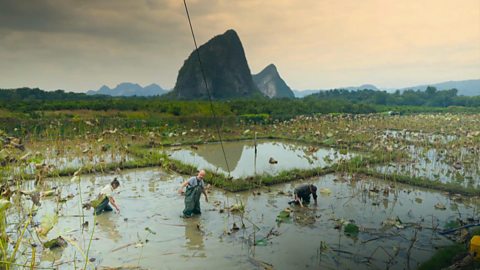
Yin and Gaz experience farming in rural China, staying on a farm and helping to collect lotus roots used in Chinese cuisine.
Rural and urban China. video
Sisters Letitia and Elizabeth stay at someones home in Shuiyuan Village, in a clip exploring the characteristics of rural and urban areas in China.
Travelling through China, India and Nepal. video
Brothers Brian and Melvyn plan a route to their checkpoint in a video clip exploring map-reading skills.
Rural life in India. video
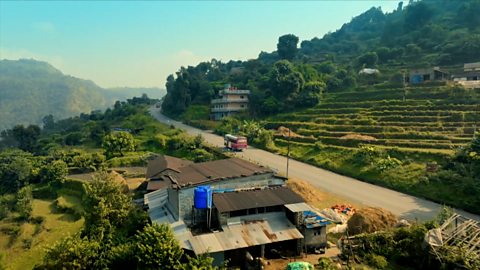
Mother and son, Caroline and Tom, are in Salawas village near Jodhpur in a clip exploring life in rural India.
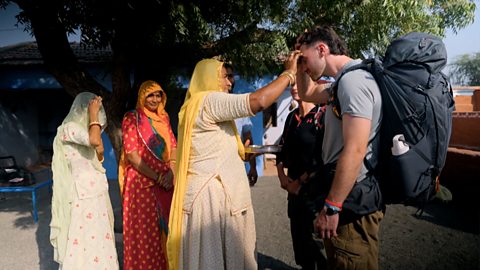
The Great Indian Desert. video
Brothers Brian and Melvyn, and mother and son Caroline and Tom, explore the largest desert in India and the communities that live there.