Video
GAZ: Oh, I think… Oh, I'm in luck. Yeah. Yeah, I got a big one.
NARRATOR: Before making their way to the checkpoint, Yin and Gaz are paying for last night's accommodation…
GAZ: Yay! Gold!
NARRATOR: …digging lotus roots…
GAZ: Our host has just turned up in his jeans and gone straight in.
NARRATOR: …central to Chinese cuisine. Their host, Mr. Lou, will sell this morning's harvest at the local market.
MR LOU: Oh!
GAZ: Woah! That's a - woah! Look at the size of that one. That's a good one.
YIN: This is what I think of rural China. Picturesque scenery, agriculture.
GAZ: Whoops. Careful, careful.
YIN: I keep falling over. Whoops-a-daisy! Rural China is interspersed with industrial China, but then you get rewarded with views like this. You feel like such a small speck when you're surrounded by these magnificent mountains. The abundance of our labour. Ta da! We did all this.
GAZ: This.
YIN: This is the China that I wanted to see. Feel quite honoured to have experienced that and to have experienced it with them as well.
MR LOU: You're wonderful.
GAZ: Thank you, sir!
Download/print a transcript of this episode (pdf).
Video summary
A clip from the BBC series Race Across the World exploring the types of farming in rural China.
Yin and Gaz are in Jiangtou, where they have stayed on a farm.
They are now working on the farm to pay for their accommodation and are looking for lotus roots which are used in Chinese cuisine.
Teacher notes
Download/print the teacher notes for this video (PDF)
Before watching the video
Ask students what types of foods we grow and farm in the UK. Discuss how in other countries, different types of foods are grown and that the farming methods may appear quite unusual compared to our own in the UK.
Ask students if they have tried lotus root before. You could show images of this if they are unsure. You could also ask how they think it is produced.
Introduce key terms such as:
- Rural: Countryside locations with few homes. Usually associated with agriculture.
- Agriculture: The practice of farming, this includes growing food and rearing animals.
During the video
You may wish to stop at relevant points during this short film to pose questions and check understanding or wait until the end. Useful questions might include:
- Describe the landscape shown in the beginning of the clip.
- Why do you think the ground looks like it has flooded?
- What does the lotus root look like?
- What is lotus root used for?
- Why does the farmer sell the lotus root?
- What do you think it would be like to do this type of farming as a job?
- What does Yin think of the landscape?
- How does this landscape compare to what you thought rural China would look like?
After watching the video
Ask students to give a list of words they would use to describe the landscape they could see in the clip. Did the landscape look as the students expected it to do?
Using a map, locate Jiangtou. You could use online mapping software to zoom into the region to further understand the landscape and how it is used. Ask students to write a locational description of Jiangtou and to describe the landscape and what it is used for.
Discuss the different sectors of industry: primary, secondary, tertiary and quaternary. Ask students what type of industry they can see in the clip and why it is so important in China – despite China also being called the ‘workshop of the world’.
Compare Jiangtou to urban areas of China, for example Shenzhen. Students could create a table to compare the two locations and the types of jobs they would expect people to do in each location.
Where next?
Task students with researching different foods grown in China. How does agriculture change across China. Students could create a map to show where different crops are grown, for example rice, wheat and corn.
China also produces about 12 billion tonnes of bananas a year. This may surprise students as they may not associate China with growing bananas. Students could research why China produces so many bananas.
Curriculum notes
This clip will be relevant for teaching Geography at KS3 in England and Northern Ireland, Progression Step 4/5 in Wales and 3rd and 4th Level in Scotland.
In the English National Curriculum this film can be used to help teach the following:
- Types of industry
- Regions of Asia
This clip could also be used for GCSE Geography when studying types of industry and the importance of agriculture.
More videos from this collection
Rural and urban China. video
Sisters Letitia and Elizabeth stay at someones home in Shuiyuan Village, in a clip exploring the characteristics of rural and urban areas in China.

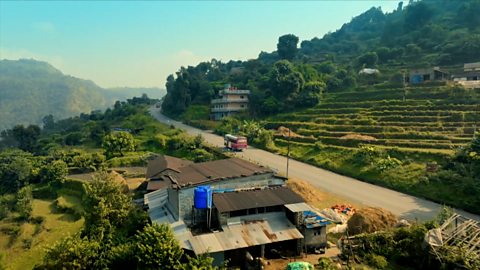
Travelling through China, India and Nepal. video
Brothers Brian and Melvyn plan a route to their checkpoint in a video clip exploring map-reading skills.
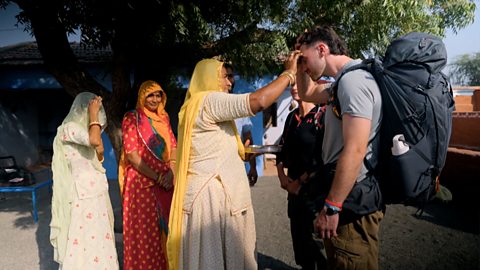
Rural life in India. video
Mother and son, Caroline and Tom, are in Salawas village near Jodhpur in a clip exploring life in rural India.
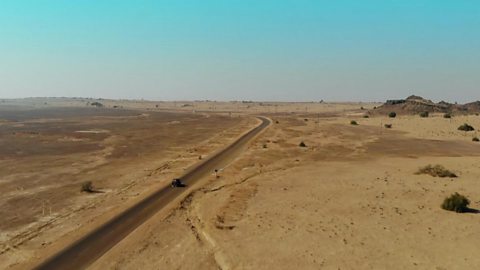
The Great Indian Desert. video
Brothers Brian and Melvyn, and mother and son Caroline and Tom, explore the largest desert in India and the communities that live there.
Comparing China, Nepal and India. video
Fin and Sioned talk about what the Race Across the World experience taught them about the food, landscape and transport of China, Nepal and India.