Video
NARRATOR: Two teams have made it to the largest desert in India… the Thar.
MELVIN: Crikey, some of them are big, aren't they?
BRIAN: Absolutely, yeah. Ideal.
TOM: I mean, the view now is absolutely beautiful.
CAROLINE: It's just beautiful.
TOM: Whoooa!
NARRATOR: Stretching for 200,000 square kilometres across the subcontinent…
TOM: Look!
CAROLINE: Thomas, this is amazing.
NARRATOR: It's a haven for biodiversity, including 141 species of bird and human settlements dating back tens of thousands of years. Today, with over 16 million inhabitants, it's the most densely populated desert in the world, home to the critically endangered Indian wild ass.
CAROLINE: How many do they think are left?
MAN: About 3,000 animals.
TOM: Is that true?
CAROLINE: Three thousand?
MAN: Yeah. And you will not see this animal anywhere in the world.
CAROLINE: Anywhere else?
MAN: And they can go over 70 kilometres an hour.
CAROLINE: Oh my golly!
MAN: They're extremely fast, much faster than a horse.
CAROLINE: Yes! A special moment. Magical. To think they're just truly, truly wild. And here we are in their life and it's just beautiful.
BRIAN: Hello! Aren't you beautiful!
MELVIN: It's an amazing sight, innit?
BRIAN: [whispers] Hello.
NARRATOR: Four hundred and thirty kilometres north of them, in the desert village of Rajpura…
MELVIN: Well, you don't get it any fresher than that, mate, do you?
NARRATOR: Brian and Melvin are on hand at a camel dairy farm.
MELVIN: Mmmm. Oh, that's lovely!
MELVIN: Pull-squeeze, pull-squeeze, yeah? Pull-squeeze.
BRIAN: Squeeze-pull.
MELVIN: No, pull-squeeze, I think.
BRIAN: I think you're getting me, Melv.
MELVIN: I'm not! I'm getting some in the pan. I'm not doing it as well as the other gentlemen but we're getting some.
NARRATOR: The region is home to a community of Raikas, nomadic herders who have been shepherding camels for centuries, a duty believed to have been assigned to them by the Hindu god Lord Shiva.
BRIAN: Come on! Come on! There you go, look. It's a technique.
MELVIN: Yeah, I got twice as much as you did.
BRIAN: Well, I don't think you did.
MELVIN: That's a big turban. Thank you, my friend.
BRIAN: That's good. That's good. Thank you.
Download/print a transcript of this episode (pdf).
Video summary
A clip from the BBC series Race Across the World exploring the communities that live in the Thar Desert in India.
Brothers Brian and Melvyn and mother and son Caroline and Tom have made it to the largest desert in India, the Thar Desert.
In the Thar Desert, a salt marsh known as the Little Rann of Kutch is home to the critically endangered Indian wild ass.
Brian and Melvyn visit a camel dairy farm in Rajpura, a desert village. They learn how to milk the camels with the Raikas, a community of nomadic herders who have been shepherding camels for centuries.
Teacher notes
Download/print the Teacher Notes for this episode (pdf).
Before watching the video
Show students a map of the Thar Desert and ask them to describe what they can see. How does this compare to other deserts around the world?
Ask students about the lifestyle of people living in the desert. Why do they think people would live there and what types of jobs do they think people would be doing?
Introduce key terms such as:
- Biodiversity: The range of wildlife, including plants, animals, birds and insects living in one location.
- Densely populated: Having a high number of people living per square kilometre.
- Salt Marsh: An area in which the ground is saltier than other areas. The are usually coastal, or formal coastal areas. The Little Rann of Kutch used to be part of the Arabian Sea.
- Nomadic: Moving from place to place.
During the video
You may wish to stop at relevant points during this short film to pose questions and check understanding or wait until the end. Useful questions might include:
- What wildlife can be seen in the Thar Desert?
- How big is the Thar Desert?
- How many species of birds live in the Thar Desert?
- How many people live in the Thar Desert?
- Why are the camels important?
- Why might the Raikas have mobile phones?
- How do the Raikas recognise their animals?
After watching the video
Locate the Thar Desert, the Little Rann of Kutch and Rajpura on a map and ask students to describe their locations. Students could compare each location. A topographical map could also be looked at to help students understand the terrain in more detail.
Discuss the different sectors of industry: primary, secondary, tertiary and quaternary. Ask students what type of industry they can see in the clip and why it is so important in India. Discuss with students why they think camel farming is important and why the camel herders are nomadic. How does this lifestyle differ to dairy farming in the UK?
Further research could be carried out into the Raikas and their lifestyle, helping students to understand how they survive living in the extreme landscape of the Thar Desert.
Where next?
The clip mentions the Indian wild ass, a critically endangered animal that lives in the Little Rann of Kutch in the Thar Desert. This location is a wildlife reserve covering almost 5000 square kilometres.
Task students with researching further into the Little Rann of Kutch and the wildlife that lives there. How is it being conserved and why are the animals not found anywhere else?
Curriculum notes
This clip will be relevant for teaching Geography at KS3 in England and Northern Ireland, Progression Step 4/5 in Wales and 3rd and 4th Level in Scotland.
In the English National Curriculum this film can be used to help teach the following:
- Types of industry
- Regions of Asia
More videos from this collection
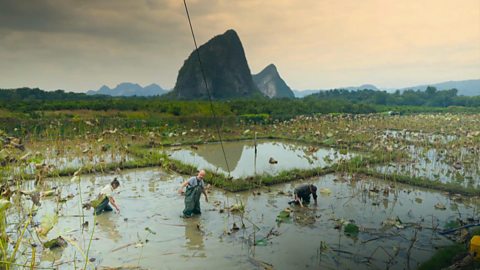
Farming in rural China. video
Yin and Gaz experience farming in rural China, staying on a farm and helping to collect lotus roots used in Chinese cuisine.
Rural and urban China. video
Sisters Letitia and Elizabeth stay at someones home in Shuiyuan Village, in a clip exploring the characteristics of rural and urban areas in China.

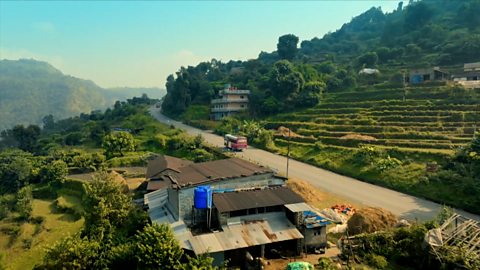
Travelling through China, India and Nepal. video
Brothers Brian and Melvyn plan a route to their checkpoint in a video clip exploring map-reading skills.
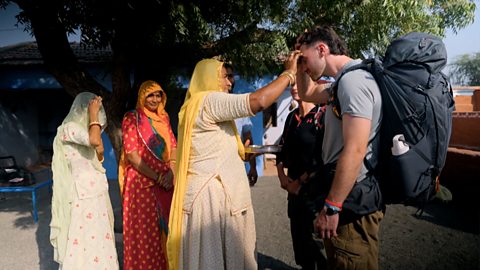
Rural life in India. video
Mother and son, Caroline and Tom, are in Salawas village near Jodhpur in a clip exploring life in rural India.
Comparing China, Nepal and India. video
Fin and Sioned talk about what the Race Across the World experience taught them about the food, landscape and transport of China, Nepal and India.