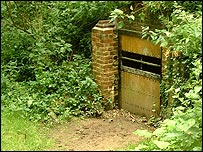
You have now reached stop number six on the history tour of Whitlingham Country Park. The entire landscape has been shaped by centuries of human activity, with most of the 24 hectares of Whitlingham Woods having been sculpted into a series of valleys and pits by the chalk and flint workings. The lime kiln here is one of the best examples remaining in Norfolk. 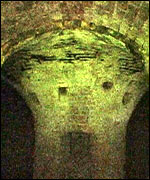
Looking inside the lime kiln. Our video camera shows much more than can be seen by the naked eye |
If you were standing on the site about 120 years ago the valley sides would have been gleaming with white chalk and the smell of acrid fumes from the lime kiln would have filled the air. The lime from this pit would have been taken to the riverside, drawn by ponies, along a tramway. From here it would have been transported by wherry along the River Yare to the cement works at Berney Arms and Burgh Castle. The kiln itself is built in a style unique to East Anglia. Lime was important to the local economy for improving farmland and the sale of lime mortar. Local wildlife
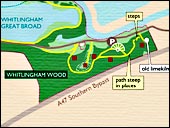
More than a century later, the kiln still has an important role - providing a safe haven for hibernating and roosting bats. This hibernaculum is the perfect home for Daubenton, Natterers and Brown Long-eared bats, just three of the 17 species of bats to be found in the UK. Bats (order chiroptera) are the only mammals capable of true flight and feed on many food sources including insects, small mammals, fish and reptiles. The best time to look out for them is around sunset between May to October as they hibernate in winter when food is scarce. The high concentration of chalky soil might also account for the large numbers of snails in the area surround the lime kiln as it's believed that snails prefer calcium rich and non-acidic soils, such as that found in many parts of Whitlingham Woods. Having viewed the lime kiln, walk back the way you came. Don't go back up the steps, but go through the kissing-gate at the end, cross the road, turn left and walk back along the river. After walking past the wooden sculpture in the small picnic area, go back across the road and into the car park on your left. | 



 PREVIOUS




 Realplayer required