Welcome to the first stop on our history walk around Whitlingham Country Park. This majestic double lime avenue was planted in Victorian times, as a row of trees leading from Crown Point Manor down towards Trowse Newton Hall. Since medieval times it was a county retreat for the Priors of Norwich, leaders of the Benedictine monks at Norwich Cathedral. In 1385 King Edward III and his Queen Philippa arrived in style at Trowse Newton Hall, in a flotilla of decorated rowing boats. After the reformation the hall was passed to the Deans of the cathedral. Later the church rented it out as a tenant farm and in 1766 it was ransacked during the Norwich food riots. The choice of lime trees was purely architectural as they would have very quickly given a tall, bushy growth to give an almost instant avenue effect in their parkland. 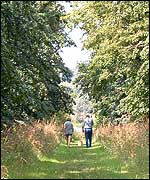
Avenue of lime trees at Whitlingham Country Park |
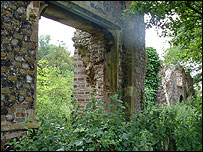
In the late spring and early summertime, the flowers provide a sweet smelling blossom, which the Victorian's would have used as a herbal tea to give a sedative effect. The lime tree avenue isn't particularly good for wildlife, being a hybrid of small leaf lime and another species to make common lime. As you walk to the end of the avenue, you'll see that the long history of Trowse Newton Hall appeared to carry little importance with the Victorians. They ruinated the premises to create a romantic, picturesque gothic feature at the bottom of the lime avenue. The newer brickwork that you can see today, dates from the time of when the hall was knocked down to create the gothic feature. The Victorians got so carried away with the deconstruction, they had to shore it up again afterwards. At the bottom of the lime avenue, go through the kissing gate and turn right. Be careful you are on a road! | 



 PREVIOUS




 Realplayer required