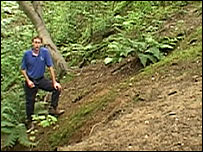
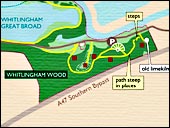
The next part of our walk takes you through the upper levels of Whitlingham Wood. We've come up the hillside, skirting along the edge of the woodland as it runs near the A47. As the path sweeps to the left you will see a sheer drop, also on your left hand side. This is the top of a chalk pit, which was worked until around the 1920s. It's now left a steep hillside with a drop of about 30 metres to the valley floor below. The land now has almost complete coverage from woodland flora, but in years gone by you would have seen the gleaming white sides of the chalk pit. 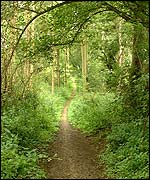
Looking down the slope of the woodland hill path back towards the wildflower meadow |
Woodland flora and fauna As you continue on the woodland path you will see another chalk pit area on your left, which makes for quite an interesting wildlife feature. This part of the wood includes a number of hornbeam trees. On the edge of their natural range (they don't grow any further north than East Anglia and the Midlands), the wood from hornbeams is extremely hard and in the past was used to make coach wheels due to its toughness. The ground base of the former pit makes an ideal climate for trees like Ewe and Birch which require chalky soil, but just a few metres away up the bank to your right, you have giant Scots Pine and Silver Birch which require a really sandy soil in which to live. Archaeological finds The wood and surrounding area have yielded a number of historical finds. This includes a bronze pointed-oval seal dated to the late 13th/14th century, examples of 13th century lead glazed earthenware and a post Medieval lead disc with a cross of Norwich on its face. Follow the path further and you will come to a turning off to the right, marked lime kiln. Take this turning and go down the steps, turn right along the woodland pathway to reach the site of the kiln. | 



 PREVIOUS




 Realplayer required