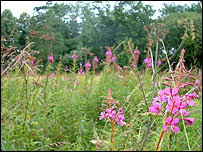
As you leave Whitlingham Wood, you are greeted by a large open meadowland. This is stop number four on our tour. Depending on the time of year, this meadow will either be high with flowers or harvested ready for the next season. The wildflower meadow is maintained by taking a hay cut around the end of July. This has been done for centuries and is how the habitat was originally created. Once the cut is complete, the grass is then raked off the meadow to stop it enriching the soil. If this happened the grass would out-compete the wildflowers which are being maintained in the area. In years gone by, the annual hay cut would have been used for animal feed and bedding through the winter months. Rich in all sorts of plant life, this is a stop on our history walk were you can enjoy the colour of the wildflowers, the insects and a range of bird life. 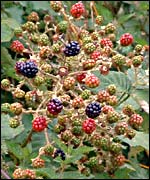
Blackberries grow wild in abundance at the country park |
Rare habitat The wildflower meadow is a really rare habitat. Low nutrient soil types, such as the chalky bolder clay at Whitlingham, shave a much higher diversity of plants, this in turn supports a much richer range of insect life and birdlife that feed on them. In higher nutrient rich soils, similar to that found around Whitlingham Great Broad, large plants like nettle and hogweed can take over and cover the land, not allowing the rarer and much more colourful plants to survive. Open meadows offer great diversity and are full of wildlife, not only with some of our rarest wildflowers but also the butterflies and other insects and birds which are dependant on them. Wildflower meadows are worth saving because they are rich in biodiversity and culture, maintain a link with traditional farming and most importantly are very attractive places to enjoy the countryside. Some of the plants you can see in the Whitlingham wildflower meadow are Black knapweed, once used as a poultice on wounds. Bird's foot trefoil which was made into a restorative tonic and St John's wort, still used today as an anti-depressant. This is the half-way point on our history walk around Whitlingham, so a good point to stop for a rest and take a breather before heading up a slope to the top of the chalk pits. Nearly 98% of Norfolk's meadowland has been lost since around the time of WWII, so it's vital the area is maintained. After taking a rest on the bench (and probably munching a few blackberries), take the pathway next to the seat, heading upwards on a the hard surfaced path - which soon becomes woodland floor. | 



 PREVIOUS




 Realplayer required