Stop number three on our history walk around Whitlingham Country Park takes you onto a tree covered path through Whitlingham Woods. Situated at the lower end of the country park, this area has a history of mining, including flint-knapping from 4000BC, up to the 18th century. Archaeologist have found a number of artefacts in this area, including humanly struck flint flakes and part of a chipped flint axe-head from the Neolithic period, along with a iron-stained flint blade dating back to the Palaeolithic period (500000 BC to 10001 BC). 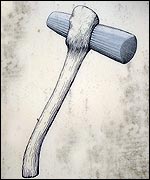
Artists impression of a Neolithic axe |
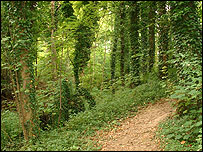
Flint-knapping stopped in the 18th century. Since then this area has been developing from open landscape to the woodland you see today. Woodland nature As nature started to reclaim the land, one of the first species to come in was Sycamore. In itself, this tree is not particular good for wildlife, but as the stems are supporting Ivy there is some cover there for birdlife. On the floor, there's enough light filtering through the trees to support characteristic woodland ground cover. These plants include herb bennet, a plant with small yellow flowers that was once for medicinal purposes and wood avens. Make your way along the edge of Whitlingham Woods. Through the trees you will see the road on your left and heavier woodland planting on your right. Follow the main path, ignoring a few smaller paths that lead off it, and it leads into an open wildflower meadow area. Picture of Neolithic axe reproduced with kind permission of the Norfolk Museums & Archaeological service | 



 PREVIOUS




 Realplayer required