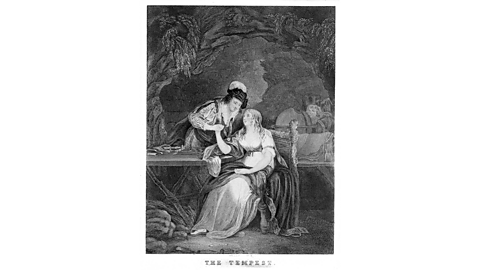
Context relevant to The Tempest
In your controlled assessment it is important you consider the context of The Tempest. References to context should be relevant both to the play and to the argument or theme of your essay. Context should be explored throughout your essay and not simply ‘stuck on’ at the beginning or the end.
Below are several aspects of context which you may wish to consider in the preparation of your essay.
Biographical context
Shakespeare lived from 1564-1616.
He went to a grammar school – a privilege not afforded to all. Here he would have learned about classical literature – evidence of which we can see in the play through the characters of Ariel and through the shipwreck, a A recurring element or symbol in a text (or work of art), the repetition of which contributes to establishing a theme. found in the Classical literature of Virgil’s Aeneid and Homer’s The Odyssey.
The Tempest was written around 1610-1611, near the end of his career. Some critics believe that Prospero giving up magic at the end of the play is symbolic of Shakespeare stepping away from the world of the theatre.
Shakespeare wrote for the King’s Men – this was a popular and prestigious acting company who performed not only for the public but also for the royal court.
Social context
Gender and marriage
This play was written around 1610-1611; at this time there were strict gender roles and men held most of the power (as we see in the characters of Prospero, Antonio, and Alonso). At this time, women could only marry with the approval of their fathers. This is why Prospero tests Ferdinand – to make sure he is a suitable match for Miranda:
All thy vexations
Were but my trials of thy love.
Class context
Society adhered to a hierarchy at the time where the class system was clearly defined. Shakespeare’s play contains nobility, including Prospero, Antonio and the king of Naples, Alonso. This class represented social order and expectation as well as authority.
Another class of characters are the magical beings, including Ariel. These characters show the theme of illusion versus reality and they also demonstrate Prospero’s power.
The play also contains a third class of characters, the colonised characters who are treated as inferior. These highlight themes of colonialism, exploitation, and resistance.
By including different classes in his play, Shakespeare is representing society at that time.
Magic and the supernatural
In the From the time of King James I (1603–1625). English periods traditionally use the Latin version of the monarch’s name. Jacobean literally means “of James". era there was a strong belief in magic and the supernatural. Audiences would have taken Prospero’s magic seriously – it would not have been considered fictional.
Race
Ideas about race in society at the time are represented through the character of Caliban. This reflected English attitudes towards indigenous people, who were generally viewed as uncivilised.
Historical context
Jacobean era
The Tempest was written during the Jacobean era (King James reigned from 1603-1625). This was generally a period of political stability.
The Gunpowder Plot in 1605 meant that issues of loyalty and treason were very topical. Rightful roles were also important. There is evidence of this in how Antonio conspires and succeeds in stealing the dukedom from his brother Prospero before the play opens.
Colonisation
There was significant interest in exploration and colonisation at that time. Britain was expanding into other areas of the world including the Americas and Asia. This meant new trade routes, new lands and exposure to different races of people. Unfortunately, indigenous people in these lands were often treated poorly, subject to forced labour, cultural imposition and attempts at religious conversion.
The poor treatment of indigenous people is reflected in how Prospero treats Caliban.
Inspiration for the plot
Some believe that The Tempest was inspired by a famous historical shipwreck in 1609. The Sea Venture was caught in a hurricane on the way to Virginia and the crew ended up stranded in Bermuda. Their survival was a story of great public interest in England.
Find out more about The Sea Venture and The Tempest.
The Great Chain of Being
This was a belief held by contemporary society. They believed that everything in the universe had a specific place in a hierarchy. This fixation with social order is reflected in the play: after the chaos of the shipwreck, the characters return to Milan and everyone resumes their rightful place.
Literary / theatrical context
Plot and genre
Interestingly, Shakespeare created the plot for The Tempest, unlike many of his other plays where he adapted existing stories.
The Tempest does not fit neatly into one genre; rather it blends various genres within the play:
- romance (shipwrecks, magic, reunions, journey from suffering to healing)
- comedy (misunderstandings, clowns, the drunken subplot, wedding at the end)
- tragedy (betrayal, exile, attempted murder, emotional suffering)
- pastoral (idealised nature and harmony)
Literary influences
Shakespeare may have been influenced by a number of literary works. Virgil’s Aeneid contains a shipwreck and storms. Ovid’s Metamorphoses details transformation, magic, illusion, and reconciliation, which also run throughout The Tempest. Prospero is similar to magicians in Ovid’s work such as Medea and Circe.
Shipwrecks and storms are popular themes in literature, as is the exploration of new worlds; all of these can be seen in The Tempest.
Theatre
The Tempest is a good example of When a play reminds you it is a play. It tells the audience they are watching a performance, rather than trying to create a completely believable “real world”., which is when a play draws attention to the fact that it is a play. This is evident when Prospero breaks the The space that separates performers and audience. If it is ‘broken’, a character acknowledges the audience and may speak to them. at the end of the play and directly addresses the audience.
Theatre was a popular form of entertainment during Shakespeare’s time. All classes of society attended plays. The Tempest contains a mix of social groups, so audience members could identify with different characters, and it explores themes such as power, betrayal and magic – all of which were of great interest to audiences at the time.
Jacobean audiences loved spectacle, so the music, magic, storms and A form of entertainment, which consisted of dancing and acting performed by masked players. Venice was famous for its masqued carnivals. would have been particularly appealing.
At the time, theatres were open‑air and contained a mixture of seating and standing areas. Scenery and props were minimal, so the language had to communicate a strong sense of setting. This is evident in the play where Shakespeare uses strong A metaphor is a word or a phrase used for dramatic effect, to describe something as if it were something else. and vivid imagery – for example, Ferdinand describes the chaos and power of the storm in “All the devils are here”.
When writing, Shakespeare had to be careful not to offend the king, who was his patron.
Actors
It is interesting to note that females were not allowed to act on stage during the Jacobean era. Female roles were played by young males whose voices had not yet broken – which created confusion and required elaborate costuming.
Further study
The study of Shakespeare, controlled assessment guidance. activity
Unit 3 of the CCEA GCSE English Literature qualification is a controlled assessment unit based on the study of a play by William Shakespeare.
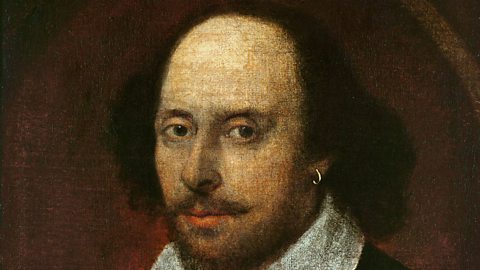
In Our Time - The Tempest. podcast
Melvyn Bragg and his guests discuss Shakespeare's play The Tempest.
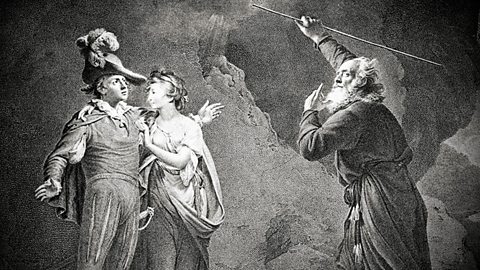
Night Waves. audio
Landmarks: The Tempest - Philip Dodd presents a programme devoted to Shakespeare's The Tempest.
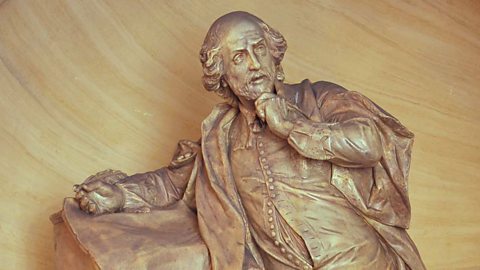
The Tempest performed
Drama on 3 - The Tempest. audio
Shakespeare's play explores the relationship between humanity and the environment.
The Tempest. video
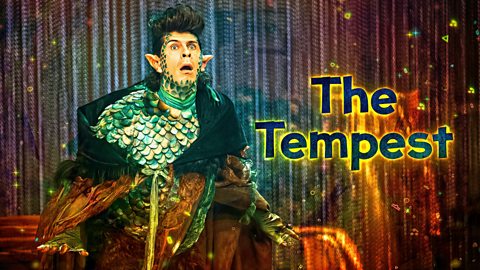
A magic island, a stormy shipwreck and a royal mystery! Patrick Robinson is Prospero as Swashbuckle's Captain Captain helps William Shakespeare stage his play The Tempest.
Shakespeare on 3 - The Tempest. audio
Shakespeare's play of magic, romance and revenge. Broadcast as part of the Shakespeare Unlocked season.
More on The Tempest
Find out more by working through a topic
- count1 of 5
- count2 of 5
- count3 of 5
- count4 of 5