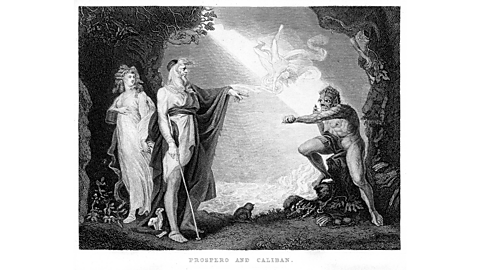
Use of form in The Tempest
The Some poems adopt specific 'forms'. For example, they could be sonnets or narrative poems. Many don’t have an identifiable form. of The Tempest is that of a late Shakespearean romance, a genre that blends elements of A type of drama in which characters undergo suffering or calamity and which usually ends with a death. A sad or catastrophic event causing suffering or death., comedy and magical fantasy. Shakespeare uses this form to explore themes of forgiveness, power and transformation. The form of The Tempest is unlike Shakespeare’s tightly structured tragedies or light‑hearted comedies written earlier in his career. Shakespeare’s romances use unusual events, supernatural forces and symbolic resolutions to guide characters toward reconciliation. The Tempest is an excellent example of this hybrid form; Shakespeare has created a world of both realism and magic which shape the audience’s understanding of human nature.
The play contains moments of tension and potential tragedy, such as Prospero’s usurpation and exile, the threat to his life and the moral corruption of the court at the hands of his brother Antonio. However, Shakespeare avoids the downfall typical of classical tragedy. Instead, he uses these darker elements to portray renewal, reunion and reconciliation. Prospero resembles a tragic The chief character in a novel, film or play. in that he is a noble man wronged by political betrayal – his only In tragedy this refers to a defect in someone's character that leads them to a bad end. was neglect of his dukedom as he studied magic. Through the form of romance, Shakespeare allows Prospero to confront this past, deal with his anger and, in the end, choose mercy and forgiveness over revenge.
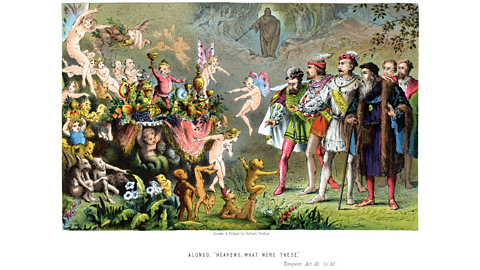
The play also draws on the tradition of the A form of entertainment, which consisted of dancing and acting performed by masked players. Venice was famous for its masqued carnivals.. This was a highly stylised form of court entertainment involving music, dance and elaborate spectacle and was very popular during the From the time of King James I (1603–1625). English periods traditionally use the Latin version of the monarch’s name. Jacobean literally means “of James". era. The masque performed for Ferdinand and Miranda in Act 4, Scene 1, symbolises harmony, divine blessing and the restoration of social order.
Comic elements (particularly the drunken subplot involving Trinculo, Stephano and Caliban) are similar to other Shakespearean comedies. They offer moments of light relief and humour while still exploring more serious topics.
By blending the forms of tragedy, comedy, and the supernatural, Shakespeare created a unique play with an original plot. The new, hybrid form allows a showcase of understanding, reconciliation and hope.
Use of structure in The Tempest
The way the poet has organised the poem on the page eg number of stanzas, lines per stanza, breaks in between lines and stanzas. refers to how the events in the play are ordered and presented. In The Tempest Shakespeare takes his audience on a journey through conflict, magic and eventual reconciliation. Like many of his plays, the action unfolds in a Chronological means following the time order in which events happened. Stories told chronologically start with the earliest event and end with the last. order, with Prospero narrating past events to Miranda. The entire play takes place over a few hours on a remote island; this makes the structure seem tight – perhaps suggesting it is all part of carefully planned events on the part of Prospero.
Shakespeare opens the play “in medias res” (which is Latin for the middle of the action) – a lot has happened in the world of the play before the curtain rises. The audience are thrown into chaos and have to begin to understand the cause of this. The audience learn that Prospero created the storm through magic, illustrating his control. Structurally, the storm acts as a catalyst: it brings all the characters to the island, so the rest of the play can unfold.
Shakespeare then presents three different aspects of the play: Prospero and Miranda (and later her meeting with Ferdinand); the comic A separate storyline or stand of narrative that runs alongside the main plot. with Caliban, Stephano and Trinculo; and the political plot involving Alonso, Antonio and Sebastian. These storylines run Events that happen at the same time or alongside one another., often echoing one another. For example, both Antonio and Stephano attempt to seize power, creating structural balance between serious and comic attempts at rebellion. This parallel structure helps the audience compare different kinds of ambition and corruption.
The masque performed for Ferdinand and Miranda in Act 4 is a key structural moment as it slows the action and symbolises harmony and blessing. Its abrupt ending (when Prospero remembers Caliban’s plot) creates contrast and reminds the audience that order is still fragile.
The resolution of the play brings all characters together. Prospero decides to forgive and not punish, which provides structural closure. Order is restored, which would be pleasing to the Jacobean audience, alongside the marriage of Miranda and Ferdinand and the return to Milan.
Use of language features and dramatic techniques in The Tempest
When studying a play and in preparation for your controlled assessment, you must consider both language features and dramatic techniques. You must consider the effect of these – don’t just identify or name them. Below are some language (or linguistic) features and dramatic techniques that you will come across in The Tempest.
Language features
Imagery
Imagery is language that creates pictures in the audience’s mind. It appeals to the senses (sight, sound, touch, taste, smell). Shakespeare uses several types of imagery in The Tempest, some of which are considered below, along with their effects.
Natural imagery
Shakespeare paints a vivid picture of both the storm and the island through his carefully crafted words. In Act 1, Scene 1, the storm (or tempest) is described as “The sky, it seems, would pour down stinking pitch.” The effect of this is to convey the power of the storm and its chaotic nature.
In Act 3, Scene 2, Caliban describes the sounds of the island:
The isle is full of noises,
Sounds and sweet airs.
Due to the limited staging and sound effects in the Jacobean era, Shakespeare effectively conveys the idyllic sounds of the island through these words.
Supernatural imagery
Maintaining the magical element of the play, Shakespeare uses imagery of the supernatural to illustrate his world. Ariel is described by Prospero as “a spirit too delicate.” The effect of this is to alert the audience to Ariel’s non‑human state. It also suggests lightness, fragility and purity.
On another occasion Prospero shows a darker side to his magic when he uses imagery to threaten. He threatens Caliban with “cramps” and “side‑stitches” which would be caused by spirits. The effect of this is to show a negative aspect of magic which can be used to intimidate and creates a sense of danger in Prospero and on the island.
Later, the audience are told that Ariel appears “like a harpy” to condemn Alonso and Antonio. The effect of this mythological imagery creates fear and guilt and suggests divine judgement – something familiar to a Christian Jacobean audience.
Imagery of the exotic and unfamiliar
Shakespeare was writing at a time when the British Empire was exploring (and colonising) new lands. The island is described as having “lush and lusty grass.” The effect of this imagery is to create an exotic and intriguing landscape.
When Trinculo first sees Caliban he calls him “a strange fish”; Stephano calls Caliban “a monster of the isle”. The effect of these images is to underscore the unfamiliar and highlight themes of misunderstanding and colonisation.
Metaphor
A metaphor is a word or a phrase used for dramatic effect, to describe something as if it were something else. is used to create a vivid image. For example, when Prospero calls Antonio and Alonso’s betrayal “a treacherous army”. The effect of this conveys the depth of the betrayal and has a sense of force.
Personification
A type of imagery in which non-human objects, animals or ideas are given human characteristics. is a form of imagery which gives human qualities to an inanimate object. For example, Ariel describes the sea as if it roared in anger “the fire and cracks / Of sulphurous roaring”. The effect of this is to heighten the drama and power of the storm.
Alliteration
Marked by alliteration - the repetition of a sound at the beginning of consecutive words, such as ‘the big, bold, blue sea' is the repetition of the same letter or sound at the beginning of a series of words. An example of this is in Act 1, scene 2 when Ariel says “Full fathom five thy father lies”. The effect of the repeated ‘f’ sound creates a musical and haunting quality. It emphasises Ariel’s ethereal nature and magical atmosphere.
Prose and verse
Shakespeare wrote his plays in both prose and verse, using each form for a particular reason. Most of Shakespeare’s plays are written in verse, and prose is used strategically.
Use of verse
One ‘iamb’ is a two-beat combination: an unstressed syllable followed by a stressed (emphasised) syllable, making a ‘da-DUM’ pattern, like a heartbeat. Pentameter means five of these two-beat units per line, making ten syllables altogether is unrhymed Lines in a poem that don't rhyme, usually in iambic pentameter - five two-syllable feet per line.. There are ten syllables (or beats) in each line following a pattern of unstressed and stressed syllables (da‑DUM) repeated five times. Iambic pentameter was used as it reflects natural speech but it also gave a sense of authority and elevation to the words.
The effect of iambic pentameter in The Tempest gives the play a formal, elevated tone suitable for the serious topics and nobility it represents. It allows Prospero to sound in control:
Twelve year since, Miranda, twelve year since,
Thy father was the Duke of Milan and
A prince of power.
Rhyming couplets
In poetry, a pair of lines that rhyme and have the same length and metric pattern. are two lines which rhyme. They are often used by Shakespeare to indicate the end of a speech or scene, giving it a sense of completion. In The Tempest, Shakespeare also uses rhyming couplets for magic:
Come unto these yellow sands,
And then take hands.
Curtsied when you have, and kissed,
The wild waves whist…
Use of prose
Shakespeare used Ordinary language both spoken or written; different from poetry (which does not reflect everyday speech patterns). to indicate a lower‑class character, to demonstrate emotional instability and for letters. In The Tempest Shakespeare uses prose in the scene of the drunken subplot (Act 2, Scene 2 and Act 3, Scene 2) illustrating a breakdown of social order.
The effect of this is to create humour and lower the tone. It contrasts with Prospero’s controlled poetic language and demonstrates a social hierarchy.
Dramatic techniques
Remember that plays are written to be performed; therefore you should use the term ‘audience’ and not ‘reader’.
In medias res
This Latin phrase means in the middle of the thing/action. When the play opens the audience are introduced to a powerful storm. The reason for the storm and the back story are only revealed as the story unfolds. The effect of this is to create immediate excitement and tension, as well as revealing Prospero’s power and control.
Dramatic irony
When the audience knows something that the characters don’t. is a technique where the audience knows something important that the characters on stage do not. This creates tension, humour or a sense of inevitability because the audience can see the truth while the characters remain unaware.
For example, the audience knows Prospero caused the storm, but the shipwrecked nobles do not. The effect of this is to create tension, and also demonstrates Prospero’s power and control. As the audience are privy to this information, they may question his motivations and morals.
Breaking the The space that separates performers and audience. If it is ‘broken’, a character acknowledges the audience and may speak to them.
This dramatic technique describes when a character directly addresses the audience. This happens at the end of The Tempest in the Epilogue when Prospero asks the audience for forgiveness and understanding:
As you from crimes would pardoned be,
Let your indulgence set me free.
The effect of this is to directly engage the audience as participants in restoring order. It is sometimes considered Shakespeare’s own farewell to the stage as it is his last solo play.
Comic relief
The play contains some serious topics. However, the inclusion of the characters Stephano and Trinculo provide humour and light relief through drunken antics and misunderstandings. The effect of this is to lighten the tone and contrast to the serious issues of the play.
Music, song and masque
The music in the play has the effect of creating a magical and enchanting atmosphere. Ariel’s songs are some of the most memorable parts of the play, such as “Full fathom five…”, and “Come unto these yellow sands”. The effect of this is again to enhance the magical and dreamlike quality of the island. In the play the music indicates a supernatural presence and can influence characters’ emotions.
The A form of entertainment, which consisted of dancing and acting performed by masked players. Venice was famous for its masqued carnivals.in Act 4, Scene 1 is performed as a celebration of the engagement of Miranda and Ferdinand. The effect of this is to show the creative aspect of Prospero’s magic and also to provide blessing and harmony for the couple.
Soliloquy
A A speech performed by a character, often depicting that person thinking or talking aloud to his or herself. is a speech delivered by a character alone on stage. It reveals their true thoughts, motives, and feelings directly to the audience. As no other character can hear these words, this creates dramatic irony – the audience are privy to information which the other characters are not.
Interestingly, The Tempest contains very few true soliloquies, Shakespeare instead relies more on dialogue, songs, and magical spectacle to present the story. Although Ariel is on stage when Prospero reflects on relinquishing his magic (Act 5, Scene 1), his speech is often treated like a soliloquy. The effect of this is to allow the audience insight into Prospero’s true feelings. Likewise, in Act 3, Scene 2, despite the presence of Stephano and Trinculo, Caliban reveals his true feelings about the island; this could be considered like a soliloquy.
Test your knowledge of Shakespeare's The Tempest
Further study
The study of Shakespeare, controlled assessment guidance. activity
Unit 3 of the CCEA GCSE English Literature qualification is a controlled assessment unit based on the study of a play by William Shakespeare.
In Our Time - The Tempest. podcast
Melvyn Bragg and his guests discuss Shakespeare's play The Tempest.
Night Waves. audio
Landmarks: The Tempest - Philip Dodd presents a programme devoted to Shakespeare's The Tempest.
The Tempest performed
The Tempest. video
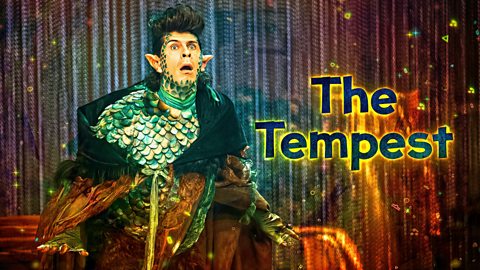
A magic island, a stormy shipwreck and a royal mystery! Patrick Robinson is Prospero as Swashbuckle's Captain Captain helps William Shakespeare stage his play The Tempest.
Drama on 3 - The Tempest. audio
Shakespeare's play explores the relationship between humanity and the environment.
Shakespeare on 3 - The Tempest. audio
Shakespeare's play of magic, romance and revenge. Broadcast as part of the Shakespeare Unlocked season.
More on The Tempest
Find out more by working through a topic
- count5 of 5
- count1 of 5
- count2 of 5
- count3 of 5