Note G: Financing the BBC
This section contains the notes to the consolidated balance sheet that detail the funding of the BBC as well as information on the financial instruments held.
A financial instrument is a contract that results in one entity recording a financial asset (a contractual right to receive financial assets, e.g. cash) in their accounts and another entity recording a financial liability (a contractual obligation to deliver financial assets to another entity).
Risk – Valuation of derivatives and other financial instruments
The valuation of derivative financial instruments can be complex. Most notably the following:
- the BBC holds a series of cash flow swaps where the valuation requires significant estimation with reference to both forward Sterling Overnight Interbank Average (SONIA) and RPI data sets.
- the BBC’s interest in Daunus Limited. Although nothing is recognised for the BBC’s share in this entity in the financial statements at 31 March 2026, a judgement is required in the calculation of its valuation for disclosure purposes within this section.
Where significant estimates/judgements are made, the risk of potential misstatement is also present.
Significant estimate – Valuation of cash flow swaps
The valuation of the BBC’s interest in Daunus Limited and the cash flow swaps requires significant estimation through the use of various market data sets, most notably forward SONIA rates, RPI and discount factors.
Judgement – Impairment of financial assets
Financial assets are assessed at each balance sheet date to determine whether there is any objective evidence of impairment. Judgement is required when determining whether there is objective evidence of impairment, such as significant financial difficulty of the counterparty or breach of contract.
G1 Cash and cash equivalents
Cash and cash equivalents comprise cash balances and call deposits with maturities of less than three months which are readily convertible into cash (short-term deposits).
The Group retains significant cash amounts and cash equivalent balances in instant access accounts in order to manage the variation in cash flows required for its operations.
Cash at bank earns interest at floating rates based on daily bank deposit rates. Short-term deposits earn interest at the respective short-term deposit rates. Interest received is recognised in the consolidated expenditure statement, within financing income (see note C4), in the period in which they are earned.
| 2026 £m | 2025 £m | |
|---|---|---|
Cash at bank, available on-demand | 90 | 115 |
Short-term deposits | 167 | 362 |
Total | 257 | 477 |
Of the total above, £125 million (2025: £369 million) cash and cash equivalents were held by the PSB Group. The remaining balance is held by the Commercial Group.
G2 Borrowings
Borrowing costs directly attributable to the acquisition, construction or production of qualifying assets (those necessarily taking a substantial period of time to get ready for their intended use) are added to the cost of those assets, until such time as the assets are ready for their intended use.
Originated programmes can be qualifying assets, but those necessarily taking a substantial period of time to get ready for broadcast are a small proportion of overall programme investment. Any borrowing costs that could be attributed to those programmes are not significant and, therefore, no borrowing costs are capitalised.
All finance income and other borrowing costs are recognised in income and expense in the period in which they are incurred.
G2.1 Borrowings due within one year
| 2026 £m | 2025 £m | |
|---|---|---|
Bank loan | 5 | 2 |
G2.1 Borrowings due after more than one year
| 2026 £m | 2025 £m | |
|---|---|---|
Bank loan | 582 | 442 |
G2.3 Borrowing facilities
| Facility | Interest rate | Total available at 31 March 2026 £m | Drawn down at 31 March 2026 £m | Total available at 31 March 2025 £m | Drawn down at 31 March 2025 £m | Expiry or review date |
|---|---|---|---|---|---|---|
PSB Group |
|
|
|
|
|
|
Sterling revolving credit facility agreement | SONIA plus the relevant margin; 0.275% up to 1/3 utilisation, 0.425% between 1/3 and 2/3 and 0.575% over 2/3 | 200 | – | 200 | – | March 2029*** |
Uncommitted money market lines (short-term borrowings) | The interest rates on uncommitted money market lines are determined when traded with the bank | 25 | – | 25 | – | Reviewed annually |
GBP overdraft | Bank base rate plus 1.5% | 5 | – | 5 | – | Reviewed annually |
Overdraft* | Bank base rate plus 1% | 1 | – | 1 | – | Reviewed annually |
Repayment grant | Nil | 2 | 2 | – | – | March 2036 |
BBC Commercial Limited | ||||||
Revolving credit facility agreement | SONIA plus the relevant margin; 0.45% up to 1/3 utilisation, 0.6% between 1/3 and 2/3 and 0.75% over 2/3 | 348 | 139 | 348 | – | January 2029** |
Private placement | 5.72% fixed rate | 150 | 150 | 150 | 150 | February 2039 |
Private placement | 5.74% fixed rate | 150 | 150 | 150 | 150 | July 2041 |
Fixed-term loan | SONIA plus 0.9% | 142 | 142 | 142 | 142 | January 2029** |
Uncommitted money market lines | Interest rate determined when traded with the bank | 20 | – | 20 | – | Reviewed annually |
Overdraft or money market lines* | Bank base rate plus 1.5% | 2 | – | 2 | – | Reviewed annually |
BBC Studios Distribution Group | ||||||
Overdraft* | Bank base rate plus 1% if drawn down in sterling. Bank currency overdraft rate plus a 1% margin if drawn down in other currencies | 2 | – | 3 | – | Reviewed annually |
Bank loan | Three-month SONIA plus 2% | 8 | 3 | – | – | May 2027 |
Bank loan | Three-month EURIBOR plus 2% | 5 | 1 | – | – | March 2027 |
Bank loan | Three-month GBP SONIA plus 1.5% | – | – | 1 | 1 | December 2025 |
Bank loan | Three-month GBP SONIA plus 1.5% | – | – | 1 | 1 | September 2026 |
* The base rate used varies according to the currency drawn. GBP drawings are linked to the Bank of England base rate.
** BBC Commercial Limited has two, one-year extension options which, if agreed, will take maturity to January 2030.
*** BBC has one remaining extension option which, if agreed, will take maturity to March 2030.
There have been no defaults or breaches of covenants on these facilities during the year (2025: none).
G3 DCMS borrowing limits
As the BBC is under public sector control via its Royal Charter and governance framework, the BBC forms part of the UK’s National debt. The BBC is subject to two specific limits to its borrowings, as agreed with the DCMS:
- the PSB Group net borrowing limit of £2,200 million is set by the Secretary of State for Culture, Media and Sport in accordance with the Framework Agreement between the BBC and the DCMS. Of this limit, £2,000 million is specifically for leases; and
- under a direction granted by the Secretary of State for Culture, Media and Sport a net borrowing limit of £850 million has been set for the BBC Commercial Group. Of this limit, £200 million is specifically for leases.
The Commercial Group element of the BBC borrowing limit will increase to £950 million on 1 April 2026. Of these limits, £200 million will continue to be specifically for leases.
G3.1 Analysis of net debt for the DCMS borrowing limits
| At 1 April 2025 £m | Cash flows £m | Non-cash changes £m | Exchange £m | At 31 March 2026 £m | |
|---|---|---|---|---|---|
Total cash and cash equivalents | 477 | (218) | – | (2) | 257 |
Loans and loan notes | (444) | (143) | – | – | (587) |
Derivatives associated with borrowings | – | – | 1 | – | 1 |
Obligations under leases | (1,649) | 190 | (168) | – | (1,627) |
Net debt | (1,616) | (171) | (167) | (2) | (1,956) |
Made up of: |
|
|
|
|
|
PSB Group | (1,169) |
|
|
| (1,381) |
Commercial Group* | (447) |
|
|
| (575) |
Net debt | (1,616) |
|
|
| (1,956) |
*Excludes £61 million (2025: £62 million) of lease liabilities held with the PSB Group.
G3.2 Reconciliation of net funds/(debt) to the DCMS borrowing limits
| Public Service Group Net funds/(debt) excluding leases £m | Public Service Group Lease borrowings** £m | Public Service Group Net debt £m | BBC Commercial Group* Net funds/(debt) excluding leases £m | BBC Commercial Group* Lease borrowings** £m | BBC Commercial Group* Net debt £m | |
|---|---|---|---|---|---|---|
2026 |
|
|
|
|
|
|
Net funds/(debt) | 123 | (1,504) | (1,381) | (452) | (123) | (575) |
Net borrowing limit | (200) | (2,000) | (2,200) | (650) | (200) | (850) |
Headroom | 323 | 496 | 819 | 198 | 77 | 275 |
2025 |
|
|
|
|
|
|
Net funds/(debt) | 369 | (1,538) | (1,169) | (336) | (111) | (447) |
Net borrowing limit | (200) | (2,000) | (2,200) | (600) | (200) | (800) |
Headroom | 569 | 462 | 1,031 | 264 | 89 | 353 |
* Under the terms of the DCMS agreement, the BBC Commercial Group must satisfy two financial covenants, which need to be satisfied throughout the respective period. During both the current and prior years, the BBC Commercial Group was in compliance with both these covenants.
** Lease borrowings are net of intra-group lease borrowings as these eliminate on consolidation
G4 Financial instruments
The BBC classifies its financial assets and liabilities into one of the following categories:
- trade and other receivables/payables
- contract assets/liabilities
- cash and cash equivalents
- investments (cash held on long-term deposit)
- borrowings
They principally arise from the provision of goods and services, but also incorporate other types of financial assets/liabilities where the objective is to collect or receive contractual cash flows and the contractual cash flows are solely payments of principal and interest.
For the BBC, this category comprises derivatives. Those positive fair value derivatives are financial assets whilst those negative fair value are financial liabilities.
The BBC does not enter into speculative derivative contracts; however, some derivative financial instruments are used to manage the BBC’s exposure to fluctuations in interest rates (interest rate swaps) and foreign currency exchange rates (foreign currency forward and swap contracts).
Derivative financial instruments, excluding derivatives held as qualifying hedges, are initially recognised at fair value and are subsequently remeasured to fair value at the balance sheet date with movements recorded in the consolidated expenditure statement.
- Interest rate swaps: The fair value is the estimated amount that the BBC would receive or pay to terminate the swap at the balance sheet date, taking into account current interest rates and the creditworthiness of the BBC.
- Foreign currency forward contract rates: The fair value of forward foreign exchange contracts is determined by using the difference between the contract exchange rate and the quoted forward exchange rate at the reporting date from third parties.
- Hybrid contracts: Contains both derivative and non-derivative elements with the effect that some of the cash flows of the combined instrument vary in a way similar to a stand-alone derivative.
Derivatives embedded in hybrid contracts with a financial asset host within the scope of IFRS 9 Financial Instruments are not separated. The entire hybrid contract is classified and subsequently measured as either amortised cost or fair value as appropriate.
Derivatives embedded in hybrid contracts with hosts that are not financial assets within the scope of IFRS 9 (e.g. financial liabilities) are treated as separate derivatives when they meet the definition of a derivative, their risks and characteristics are not closely related to those of the host contracts and the host contracts are not measured at fair value through surplus/deficit.
If the hybrid contract is a quoted financial liability, instead of separating the embedded derivatives, the BBC generally designates the whole hybrid contract at fair value through surplus/deficit.
- Other investments: The BBC has strategic investments in listed and unlisted entities which are not accounted for as subsidiaries, associates or joint ventures. These investments were previously classed as available for sale under IAS 39 Financial Instruments: Recognition and Measurement, and are now held at fair value through surplus/deficit.
Certain derivatives designated as cash flow hedges are recognised at fair value through other comprehensive income.
Where hedge accounting is applied, the BBC has elected to adopt the hedge accounting requirements of IFRS 9 Financial Instruments. The BBC enters into hedge relationships where the critical terms of the hedging instruments and the hedged item match. Hedge effectiveness is determined at the origination of the hedging relationship. Quantitative effectiveness tests are performed at each period end to determine the continuing effectiveness of the relationship. In instances where changes occur to the hedged item which results in the critical terms no longer matching, the hypothetical derivative method is used to assess effectiveness.
The BBC designates certain derivatives as cash flow hedges by documenting the relationship between the hedging instrument and the hedged item, along with the risk management objectives and its strategy for undertaking various hedge transactions. Where the hedge is deemed to have been effective, the effective portion of any changes in the fair value of the derivatives that are designated in the hedge is recognised in other comprehensive income. The accumulated amount in the cash flow hedge reserve is reclassified to profit or loss in the same period as the hedged cash flows affect profit or loss. Any ineffective portion of the hedge is recognised immediately in the consolidated expenditure statement within operating expenditure.
Financial assets are assessed at each balance sheet date to determine whether there is any objective evidence of impairment. Individually significant financial assets are tested for impairment on an individual basis. The remaining financial assets are assessed collectively in groups that share similar credit risk characteristics.
The amount of the loss is measured as the difference between the asset’s carrying amount and the present value of estimated future cash flows discounted at the financial asset’s original effective interest rate. All impairment losses are recognised in the consolidated expenditure statement within other gains and losses.
Derivatives are financial instruments that are usually used to manage risk. Derivative contracts are entered into for a fixed period of time and their value changes during that period in relation to changes in a variable, such as an interest rate, commodity price, credit rating or foreign exchange rate.
The BBC uses the following derivative contracts:
- Forward foreign currency and swap contracts are entered into to fix future currency payments/receipts to a set exchange rate. These could be to cover expected future payments, receipts or specific contracts.
- Interest rate swaps allow the BBC to fix variable interest rates on borrowings to a fixed rate.
- A cash flow swap was entered into for the financing arrangements of London Broadcasting House, exchanging the inflation-linked rent and headlease repurchase payments for a fixed payment schedule out to 2045.
These instruments allow the BBC to manage its liquidity requirements more effectively as the amounts to be paid/received become known.
The following terminology is used throughout this section:
- Counterparty Credit risk: the risk of financial loss to the Group if a customer or counterparty to a financial instrument fails to meet its contractual obligation.
- Fair value: The fair value of an asset is the amount for which the asset could be exchanged between knowledgeable, willing parties in an arm’s length transaction.
- Foreign currency transactions: As these financial statements are prepared in sterling, the BBC’s foreign currency transactions and balances must be translated at appropriate exchange rates, into sterling. This means that variations in exchange rates can cause the valuation of investments to fluctuate, even when there has been no change in the health of the underlying business.
Derivatives are all valued at fair value and movements thereof are recognised as follows:
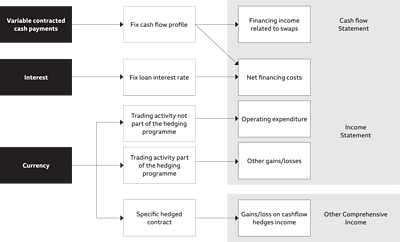
Derivative financial assets/(liabilities) are presented in the consolidated balance sheet as follows:
| 2026 | Non-current assets £m | Current assets £m | Current liabilities £m | Non-current liabilities £m | Total £m |
|---|---|---|---|---|---|
Forward foreign currency contracts | 12 | 14 | (3) | (8) | 15 |
Cash flow swaps | 299 | – | – | (467) | (168) |
Interest rate swaps | 1 | – | – | – | 1 |
Total derivative financial assets/(liabilities) | 312 | 14 | (3) | (475) | (152) |
| 2025 | Non-current assets £m | Current assets £m | Current liabilities £m | Non-current liabilities £m | Total £m |
|---|---|---|---|---|---|
Forward foreign currency contracts | 15 | 16 | (5) | (2) | 24 |
Cash flow swaps | 310 | – | – | (461) | (151) |
Total derivative financial assets/(liabilities) | 325 | 16 | (5) | (463) | (127) |
G4.1 Financial risk management
The BBC’s financial risk management operations are carried out by a BBC Group Treasury function, within parameters defined formally within the policies and procedures manual agreed by the Chief Financial Officer, which has delegated authority from the BBC Board.
The BBC Group Treasury function uses financial instruments to raise finance and to manage financial risk arising from the BBC’s operations in accordance with its objective, which is to protect the cashflows, availability of liquidity, value of financial assets and liabilities in order to deliver the budgeted financial position.
The BBC takes a risk-averse approach to the management of interest rate fluctuations and foreign currency risk and has implemented a hedging policy to minimise volatility in the financial results. A number of the forward foreign currency contracts entered into by the BBC were designated as hedging instruments in effective cash flow hedges. Hedge accounting is only applied where there is appropriate designation and documentation.
The BBC is exposed to the following areas of risk arising from financial instruments:
| Risk | Exposure arising from | Measurement | Management |
|---|---|---|---|
Market risk – currency | Transactions and balances denominated in foreign currencies | Cash flow forecasting | Forward foreign currency contracts |
Market risk – interest rates | Long-term borrowings at variable rates | Projected borrowing requirements | Interest rate swaps |
Liquidity | Borrowings and other financial liabilities | Cash flow forecasting | Monitoring cash flow forecasts and covenant compliance |
Credit | Counterparty default on contractual obligations | Credit ratings and ageing analysis | Monitoring of financial reliability |
Currency risk
Although the BBC is principally a UK-based organisation, some transactions are undertaken in currencies other than sterling.
The BBC’s commercial operations are undertaken in a range of global markets and a significant proportion of Studios Group’s income is generated outside the UK, with resulting foreign exchange risk – principally to the US dollar, the Euro, the Australian dollar and the Canadian dollar. Due to movements in exchange rates, the amount the BBC expects to receive or pay when it enters into a transaction may differ from the amount that it actually receives or pays when it settles the transaction.
The BBC takes a risk averse approach to the management of currency risk and has implemented clear policy parameters for the use of forward foreign currency contracts to minimise volatility in the financial results. A substantial proportion of the BBC’s material net foreign currency exposures are hedged.
The BBC’s main exposure is to US dollars; however, due to the relative size of this exposure in comparison to the BBC’s sterling-denominated business, the BBC does not consider this to be significant to the Group as a whole. The BBC generally enters into forward currency contracts to manage, or hedge, this currency risk. This allows the BBC to reduce risk by settling transactions at known exchange rates.
The overall income or expenditure to be recognised in relation to contracts denominated in foreign currencies (and the related hedges) is therefore largely fixed for the next financial year; however, where these contracts span financial years, the recognition of the fair value of the forward currency contracts results in timing gains or losses in each financial year (unless hedge accounting is applied). These timing gains or losses are as a result of market conditions and not variances in underlying contract value.
As the BBC has mitigated its underlying exposure to currency fluctuations there is no requirement to present sensitivity analysis as any potential variation is insignificant.
At 31 March 2026, the BBC had entered into a net commitment to sell foreign currencies amounting to £673 million (2025: £812 million) that mature in the period through to 2029 in order to fix the sterling cost of revenues through this period (mainly euros and US dollars).
The BBC applies hedge accounting for trades taken out by one of its commercial subsidiaries in respect of their forecast foreign currency transactions. Net losses (before tax and non-controlling interests) recognised in the hedging reserve on forward foreign exchange contracts in hedge relationships in the year to 31 March 2026 were £10 million (2025: £11 million net gains). These amounts are recognised in the consolidated expenditure statement in the period when the hedged forecast transaction impacts the consolidated expenditure statement.
The ineffective portion recognised in operating costs arising from such hedges was immaterial in both the current and prior year.
Depending on how exchange rates and interest rates move between the time the BBC enters into the transaction and at the year-end reporting date, derivatives can either be profitable or loss-making in their own right. However, the rationale in entering into these derivatives is not to profit from currency markets or interest rate fluctuations, but to increase certainty to the BBC’s cash flows. Other than where hedge accounting is applied, the movements relating to these derivatives (i.e. where they are either in profit or loss-making positions) are taken to the BBC’s consolidated expenditure statement for the year.
Interest rate risk
BBC Commercial Group holds certain loan facilities at floating rates of interest and then uses interest rate swaps to manage the BBC’s exposure to interest rate fluctuations; providing greater certainty of cash flows. Interest rate swaps are entered into based on projected borrowing requirements, therefore differences will occur between the notional amount of the swaps and the actual borrowing requirements. By taking out the interest rate swaps the BBC has mitigated underlying exposure to interest rate fluctuations and hence no sensitivity analysis has been presented as any potential variation is insignificant.
Sterling fixed rate borrowings are achieved through fixed rate debt or through interest rate swap transactions on floating rate debt. At the balance sheet date Group borrowings comprised £300 million fixed rate debt (Private Placement maturing February 2039 and July 2041) and £281 million floating rate debt (£142 million Term Loan and £139 million Revolving Credit Facility). At 31 March 2026 the Group held £142 million (notional value) (2025: £170 million) of interest rate swaps and £65 million of cash investments yielding floating interest, giving a total coverage of 73% (2025: 120%) of the current level of variable rate bank loans of £281 million (2025: £142 million). See Note G2.2 for further details.
Other price risk of financial assets
The BBC invests surplus cash in money market funds and money market deposits, therefore it is not subject to other price risks, such as market price risk.
Liquidity risk
Liquidity risk is the risk that the BBC will not be able to meet its financial obligations as they fall due. The BBC is subject to limits on its borrowings set by the Secretary of State for Culture, Media and Sport in accordance with the Agreement between the BBC and the DCMS (see Note G3). In order to comply with these limits, together with the terms of any individual debt instruments, the BBC Group Treasury function manages the BBC’s borrowings by regularly monitoring cash flow forecasts. The BBC holds its surplus liquidity in term deposit accounts and money market funds with highly rated financial institutions.
The BBC’s commitments can be seen on notes F2 and H5.
The bank loans of the BBC’s Commercial Group are subject to debt covenants based on the BBC’s earnings before interest and taxation. The covenants are in respect of net borrowings and net interest coverage. The BBC is active in the monitoring of its debt covenants, which have been met at both 31 March 2026 and 31 March 2025.
The Group utilises non-recourse debt factoring for certain trade receivables in order to improve liquidity by accelerating cash receipts. There is no obligation to repurchase these receivables. More detail can be found in note G5.
The following table sets out the carrying value and the contractual undiscounted cash flows (including interest) of financial liabilities:
| 2026 | Carrying value £m | Total contractual cash flows £m | Less than one year £m | Between one and five years £m | Over five years £m |
|---|---|---|---|---|---|
Non-derivative financial liabilities |
|
|
|
|
|
Trade and other payables | (929) | (930) | (929) | (1) | – |
Bank loans and overdrafts | (587) | (715) | (35) | (96) | (584) |
Obligations under leases | (1,627) | (1,994) | (196) | (699) | (1,099) |
Derivative financial liabilities |
|
|
|
|
|
Forward foreign currency contracts - fair value through surplus/(deficit) | (2) | (2) | (2) | – | – |
Forward foreign currency contracts - fair value through other comprehensive income | (9) | (9) | (1) | (8) | – |
Cash flow swaps | (467) |
|
|
|
|
Inflow |
| 557 | 70 | 297 | 190 |
Outflow |
| (1,461) | (86) | (380) | (995) |
| 2025 | Carrying value £m | Total contractual cash flows £m | Less than one year £m | Between one and five years £m | Over five years £m |
|---|---|---|---|---|---|
Non-derivative financial liabilities |
|
|
|
|
|
Trade and other payables | (935) | (935) | (871) | (64) | – |
Bank loans and overdrafts | (444) | (723) | (27) | (96) | (600) |
Obligations under finance leases | (1,649) | (2,005) | (186) | (691) | (1,128) |
Derivative financial liabilities |
|
|
|
|
|
Forward foreign currency contracts - fair value through surplus/(deficit) | (4) | (4) | (3) | (1) | – |
Forward foreign currency contracts - fair value through other comprehensive income | (3) | (3) | (2) | (1) | – |
Cash flow swaps | (461) |
|
|
|
|
Inflow* |
| 626 | 69 | 291 | 266 |
Outflow* |
| (1,539) | (83) | (364) | (1,092) |
* Comparatives have been re-presented to better reflect the cash inflows and outflows of the swap.
The cash flows above are not considered to be required to settle materially earlier or at a significantly different amount. Covenants are in place across some borrowing facilities (see note G2.3 for further details). There is however a remote chance of these being breached, requiring earlier settlement of the outstanding borrowings.
Counterparty credit risk
Counterparty credit risk is the risk of financial loss to the BBC if a counterparty defaults on its contractual obligation. Default arises when it is determined that a counterparty is unlikely to pay following the evaluation of objective evidence.
Cash and cash equivalents and derivative financial instruments are held only with banks of BBB+ rating and above, with a higher minimum rating required depending upon duration and amount. The Group considers it has appropriately mitigated the risk of any counterparty failing to meet its obligations.
The BBC’s credit risk management policy in relation to other trade receivables involves regularly assessing the credit quality of customers, taking into account several factors such as their financial position and historical performance. The carrying amount of financial assets included in the financial statements represents the BBC’s maximum exposure to credit risk in relation to these assets.
During the year, the Group derecognised trade receivables through non-recourse factoring arrangements. Although the Group has obligations to collect the funds and remit these to the factor there is no ongoing exposure to credit risk in respect of the transferred assets. See note G5 for further details.
G4.2 Fair value of financial instruments
When calculating the fair value of the BBC’s financial instruments (subsequent to the initial recognition), the technique used is determined with reference to the classification in the three-level hierarchy set out below. This disclosure helps to show the level of judgement that the BBC has used in calculating fair values, subsequent to the initial recognition.
Fair value hierarchy levels 1 to 3 are based upon the degree to which the fair value is observable.
- Level 1 fair value measurements are those derived from quoted market prices (unadjusted) in active markets;
- Level 2 fair value measurements are those derived from inputs other than quoted prices included within level 1 that are observable for the asset or liability, either directly (i.e. as prices) or indirectly (i.e. derived from prices); and
- Level 3 fair value measurements are those derived from valuation techniques that include inputs for the asset or liability that are not based on observable market data (unobservable inputs).
No transfers between these categories have occurred during the period.
| Carrying value | Fair value hierarchy for those carried at fair value or at amortised cost where fair value differs | |||||||
|---|---|---|---|---|---|---|---|---|
| 2026 | Amortised cost £m | Fair value through surplus/(deficit) £m | Fair value through other comprehensive income/(loss) £m | Total £m | Level 1 £m | Level 2 £m | Level 3 £m | Total £m |
Cash and cash equivalents | 257 | – | – | 257 |
|
|
|
|
Trade and other receivables | 897 | – | – | 897 | – | – | – | – |
Derivative financial assets: |
|
|
|
|
|
|
|
|
- Forward foreign currency contracts | – | 2 | 24 | 26 | 26 | – | – | 26 |
- Cash flow swaps | – | 299 | – | 299 | – | 299 | – | 299 |
- Interest rate swaps | – | 1 | – | 1 | – | 1 | – | 1 |
Other investments | 7 | – | – | 7 | – | – | 7 | 7 |
Investment properties | 4 | – | – | 4 | – | – | 7 | 7 |
Total financial assets | 1,165 | 302 | 24 | 1,491 | 26 | 300 | 14 | 340 |
|
|
|
|
|
|
|
|
|
Trade and other payables | (929) | – | – | (929) |
|
|
|
|
Bank loans and overdrafts | (587) | – | – | (587) |
|
|
|
|
Derivative financial liabilities: |
|
|
|
|
|
|
|
|
- Forward foreign currency contracts | – | (2) | (9) | (11) | (11) | – | – | (11) |
- Cash flow swaps | – | (467) | – | (467) | – | (467) | – | (467) |
Obligations under leases | (1,627) | – | – | (1,627) | – | – | (1,627) | (1,627) |
Total financial liabilities | (3,143) | (469) | (9) | (3,621) | (11) | (467) | (1,627) | (2,105) |
| Carrying value | Fair value hierarchy for those carried at fair value or at amortised cost where fair value differs | |||||||
|---|---|---|---|---|---|---|---|---|
2025 | Amortised cost £m | Fair value through surplus/(deficit) £m | Fair value through other comprehensive income/(loss) £m | Total £m | Level 1 £m | Level 2 £m | Level 3 £m | Total £m |
Cash and cash equivalents | 477 | – | – | 477 |
|
|
|
|
Trade and other receivables | 952 | 22 | – | 974 | – | 22 | – | 22 |
Derivative financial assets: |
|
|
|
|
|
|
|
|
- Forward foreign currency contracts | – | 1 | 30 | 31 | 31 | – | – | 31 |
- Cash flow swaps | – | 310 | – | 310 | – | 310 | – | 310 |
Other investments | 11 | – | – | 11 | – | – | 11 | 11 |
Investment properties | 4 | – | – | 4 | – | – | 6 | 6 |
Total financial assets | 1,444 | 333 | 30 | 1,807 | 31 | 332 | 17 | 380 |
|
|
|
|
|
|
|
|
|
Trade and other payables | (935) | – | – | (935) |
|
|
|
|
Bank loans and overdrafts | (444) | – | – | (444) |
|
|
|
|
Derivative financial liabilities: |
|
|
|
|
|
|
|
|
- Forward foreign currency contracts | – | (4) | (3) | (7) | (7) | – | – | (7) |
- Cash flow swaps | – | (461) | – | (461) | – | (461) | – | (461) |
Obligations under finance leases | (1,649) | – | – | (1,649) | – | – | (1,649) | (1,649) |
Total financial liabilities | (3,028) | (465) | (3) | (3,496) | (7) | (461) | (1,649) | (2,117) |
Due to their short-term nature, the carrying value of cash and cash equivalents, cash on long-term deposit, short-term bank loans, trade and other receivables and trade and other payables, is approximately equal to their fair value.
Other investments reflect the Group’s other equity investments held.
Level 2 – cash flow swap derivatives
Cash flow swaps represent derivative financial assets of £299 million (2025: £310 million) and derivative financial liabilities of £467 million (2025: £461 million) relating to the financing arrangement of London Broadcasting House. These swaps, which expire between 2033 and 2045, are valued with reference to relevant SONIA yield curves, subject to appropriate credit risk adjustments where necessary, for the discount rates applied and annual inflation (RPI) on the underlying cash flows.
The sensitivities of this valuation to changes in the principal assumptions are set out below:
| Assumption used | Movement | 2026 £m | 2025 £m |
|---|---|---|---|
SONIA | 1% increase | 29 | 30 |
SONIA | 1% decrease | (34) | (35) |
RPI | 1% increase | 25 | 34 |
RPI | 1% decrease | (27) | (32) |
The credit risk adjustment at each reporting date is calculated using a market proxy reflecting movements in comparable credit spreads since inception. This movement is applied to the spread at inception, so that it moves in line with market conditions. At the balance sheet date, a review was performed and a decision was made to replace the previously used index, as a more appropriate market index had been identified.
An adjustment of 221 basis points is applied to a specific leg of the swaps to reflect credit risk as the arrangement with the counterparty is not collateralised. These assumptions and inputs are reviewed on an annual basis, along with the completion of sensitivity analysis. If another adjustment of 213 basis points (an alternative index) had been used to reflect a reasonably possible change based on market movements during the year, then this would result in an increase in the net liability of £3 million.
During 2024/25 an adjustment of 217 basis points is applied to a specific leg of the swaps to reflect credit risk as the arrangement with the counterparty is not collateralised. These assumptions and inputs are reviewed on an annual basis, along with the completion of sensitivity analysis. If another adjustment of 231 basis points (an alternative index) had been used to reflect a reasonably possible change based on market movements during the year, then this would result in a decrease in the net liability of £5 million.
Level 3 financial instruments
The change in fair value of level 3 financial instruments is reconciled as follows:
| 2026 Financial assets £m | 2026 Financial Liabilities £m | 2025 Financial assets £m | 2025 Financial Liabilities £m | |
|---|---|---|---|---|
At 1 April | 17 | (1,649) | 207 | (1,678) |
Payments and settlements | – | 190 | – | 193 |
Unwinding of discount recorded within finance expense | – | (54) | – | (48) |
Transfer to level 2 classification | – | – | (194) | – |
Additions | – | (64) | 4 | (82) |
Disposals | – | 1 | – | 34 |
Change in fair value recorded in other gains and losses | (4) | – | – | – |
Change in fair value | 1 | (51) | – | (68) |
At 31 March | 14 | (1,627) | 17 | (1,649) |
Financial assets
Financial assets includes £7 million (2025: £11 million) unquoted equity investments and the fair value amount of investment property of £7 million (2025: £6 million).
Financial liabilities
Level 3 financial liabilities reflect less than £1 million (2025: less than £1 million) put options held with some of the Group’s associates and joint ventures and finance lease liabilities which primarily relates to the lease of three properties. The vast majority of leases undergo rent reviews on a frequent basis and consequently book value is deemed to also reflect fair value.
The key inputs for the calculation of lease liabilities include the lease payments, lease term (to which judgement is required) and the discount rate. As required under IFRS 16 Leases, the discount rate of a lease is relevant to each specific contract. Once judgement is applied, these inputs typically have little variability and no sensitivity analysis has therefore been provided.
The call option the BBC holds to acquire the remaining shares in Daunus Limited (see page # for further details) is not recognised within the financial statements, nor disclosures above. Management has concluded that recognition is not appropriate due to the significant uncertainty surrounding the circumstances under which the option may be exercised and the complexity involved in determining a reliable valuation of the instrument at this stage.
G5 Trade receivables factoring arrangement
The Group enters into arrangements to factor certain trade receivables in order to manage working capital and liquidity.
Trade receivables are derecognised when substantially all of the risks and rewards of ownership are transferred in accordance with IFRS 9 Financial Instruments.
Transaction costs incurred in relation to the factoring of receivables are recognised within finance costs in the period in which the receivables are derecognised.
During the year, the Group entered into a non‑recourse factoring arrangement with BBC Commercial with a third‑party financial institution (bank) under which selected trade receivables totalling £11 million were sold outright (2025: nil). The BBC continues responsibility for the collection and subsequent remittance of the receivables to the factor who then bears the risk of customer credit default.
The Group has no obligation to repurchase receivables that are not settled by customers and provides no guarantees or other forms of credit enhancement to the factor. Accordingly, the receivables have been derecognised in full.
Financing costs associated with this arrangement were less than £1 million.
Cash proceeds received from the sale of trade receivables under the non‑recourse factoring arrangement are presented within operating cash flows in the statement of cash flows, as they arise from the collection of trade receivables.
