Note B: The BBC's operations, income and expenditure
The BBC Group structure separates its PSB Group activities from the Commercial Group.
The distinction between the segments is important as the BBC must not cross-subsidise its commercial activities through its PSB Group or grant-funded activities.
The PSB Group part of the BBC receives licence fee income for the purpose of making content available for licence fee payers. PSB Group therefore owns many programme titles which have the potential to generate additional income through a more commercial market, for example airing across other platforms, merchandising, etc.
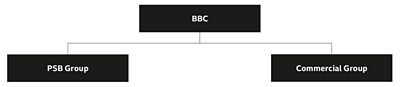
The commercial arm of the BBC Group is used to trade within that commercial market. It is self-funded and operates independently to the PSB arm of the BBC Group. The profits generated are distributed in part back to the PSB Group, through dividends and programme investment, thereby contributing towards the funding of PSB Group activities.
The notes in this section provide information on the performance in the year for each segment of the BBC Group.
The BBC’s operating segments are reported in a manner consistent with the internal reports provided to the BBC Board, who are responsible for making strategic decisions, allocating resources and assessing performance of the operating segments. They are noted as:
PSB Group
PSB Group is responsible for the BBC Public Service activities and provides a wide range of programmes to audiences across the UK on television, radio, digitally and across the world via its World Service provision.
Examples of some of its well known services are: BBC One, BBC Two, BBC Three, BBC Four, BBC Sounds, BBC iPlayer, BBC Radio 1, BBC Radio 2, BBC Radio 3, BBC Radio 4, BBC Radio 5 Live, BBC Radio 6 Music, BBC Radio Asian Network, BBC Sport, BBC Parliament, CBeebies, CBBC, BBC News, BBC Weather
Commercial Group
The Commercial Group is the BBC’s production and distribution business. It creates, invests in, develops, produces, commercialises and distributes content which sits at the heart of the BBC schedule as well as across multiple platforms and around the world, delivering value back to the licence fee consumer through support for programme funding and cash dividends. Examples of some of its well-known brands are: Bluey,Doctor Who, BBC Earth, Hey Duggee, Strictly Come Dancing, Top Gear.
Group adjustments reflect eliminations required for trading activity between the segments detailed above.
Information regarding reporting segment total assets and liabilities, financing income/cost and taxation is not reported to the Board.
Further information on the PSB Group expenditure can be found within the Operations and finances report. Key policies adhered to are:
- Spend by BBC service shows the cost to the licence fee payer of providing the relevant service and therefore excludes any costs funded by a co-producer.
- For BBC Online, the service spend reflects the incremental costs of getting content to audiences unless the content is specifically commissioned for this service.
This means the costs reported against individual services are not necessarily equivalent to the costs which would be incurred by such a service on a stand-alone basis.
The prices charged for the services provided between PSB Group and the Commercial Group are determined on an arm’s length basis in accordance with Ofcom’s Trading and Separation Obligations and the BBC published transfer pricing methodologies.
Also included within this section is additional information to comply with Ofcom’s Commercial and Trading Reporting requirements.
Risk – Income recognition
There is a risk that income is not recognised correctly in line with financial reporting standards. The nature of the risk varies between licence fee income in the public service and commercial income.
The BBC mitigates this risk by ensuring good financial controls are in place, and regularly reviewing material areas or complex judgements relating to income recognition.
Judgement – Income recognition
Income recognition in the BBC’s Commercial Group can be complex with a number of different income streams including sale of content to global broadcasters, subscription income and income from the sale of physical and digital products.
The complexity of individual contractual terms may require the BBC to make judgements in assessing when the criteria for recognising income have been satisfied, particularly whether the BBC has sufficiently fulfilled its obligations under the contract to allow income to be recognised.
B1 Income and operating results
| 2026 | Note | PSB Group £m | Commercial Group £m | Intra-group eliminations £m | Group £m |
|---|---|---|---|---|---|
Licence fee income | 3,879 | – | – | 3,879 | |
Total income from contracts with customers | 202 | 2,145 | (437) | 1,910 | |
Grant income |
| 140 | 6 | – | 146 |
Rental and associated income |
| 21 | 1 | (15) | 7 |
Other income |
| 18 | 3 | (1) | 20 |
Total other income |
| 381 | 2,155 | (453) | 2,083 |
Total income | 4,260 | 2,155 | (453) | 5,962 | |
Depreciation and amortisation | (150) | (298) | 4 | (444) | |
Other operating costs |
| (4,319) | (1,717) | 434 | (5,602) |
Total operating costs | (4,469) | (2,015) | 438 | (6,046) | |
Group operating (deficit)/surplus | (209) | 140 | (15) | (84) | |
Share of results of associates and joint ventures | (13) | – | – | (13) | |
Other gains and losses | (10) | (5) | – | (15) | |
Operating segment result |
| (232) | 135 | (15) | (112) |
Financing income |
|
|
| 99 | |
Financing costs |
|
|
| (90) | |
Net financing income |
|
|
| 9 | |
Deficit before taxation |
|
|
|
| (103) |
Taxation |
|
|
| (18) | |
Deficit for the year |
|
|
|
| (121) |
The tables in this section demonstrate how each of our different operating segments have performed over the past 12 months and how we internally monitor and report our results. The Commercial Group aims to maximise their long-term operating profits to provide commercial returns back to the BBC Group. The PSB Group is closely monitored on its effective use of the licence fee and the public services it provides. Its primary obligation is delivering value for all audiences.
| 2025 | Note | PSB Group £m | Commercial Group £m | Intra-group eliminations £m | Group £m |
|---|---|---|---|---|---|
Licence fee income | 3,843 | – | – | 3,843 | |
Total income from contracts with customers | 221 | 2,152 | (449) | 1,924 | |
Grant income |
| 107 | 1 | – | 108 |
Rental and associated income |
| 15 | 1 | (10) | 6 |
Other income |
| 17 | 1 | 1 | 19 |
Total other income |
| 360 | 2,155 | (458) | 2,057 |
Total income | 4,203 | 2,155 | (458) | 5,900 | |
Depreciation and amortisation | (142) | (304) | 3 | (443) | |
Other operating costs |
| (4,307) | (1,769) | 487 | (5,589) |
Total operating costs | (4,449) | (2,073) | 490 | (6,032) | |
Group operating (deficit)/surplus | (246) | 82 | 32 | (132) | |
Share of results of associates and joint ventures | – | 5 | – | 5 | |
Other gains and losses | 29 | (6) | – | 23 | |
Operating segment result |
| (217) | 81 | 32 | (104) |
Financing income |
|
|
| 62 | |
Financing costs |
|
|
| (81) | |
Net financing expenditure |
|
|
| (19) | |
Deficit before taxation |
|
|
|
| (123) |
Taxation |
|
|
| 11 | |
Deficit for the year |
|
|
|
| (112) |
B2 Licence fee income
📘 Income from television licences represents the value of licences issued in the year, less a deduction for refunds, cancellations and estimated impairment of licence fee sales debt.
The BBC collects the licence fee on behalf of the Government’s consolidated fund. Licence fee income is then drawn down from the consolidated fund by DCMS and passed to the BBC as grant income. Licence fee income is recognised in full at the point the licence comes into force in line with the revenue recognition accounting policy applied in the TV Licence Fee Trust Statement. Accordingly a licence fee receivable/payable is also recognised for those licences paid in arrears/advance, including a receivable/payable with DCMS for licence fee cash transfers not settled by the balance sheet date.
| 2026 Licence fee £ | 2026 Licences in force as at 31 March 000 | 2026 Total income £m | 2025 Licence fee £ | 2025 Licences in force as at 31 March 000 | 2025 Total income £m | |
|---|---|---|---|---|---|---|
Colour | 174.50 | 22,026 | 3,857 | 169.50 | 22,574 | 3,821 |
Monochrome | 58.50 | 3 | – | 57.00 | 3 | – |
Concessionary - Blind | 87.25 | 74 | 6 | 84.75 | 73 | 6 |
Concessionary - Other | 7.50 | 125 | 1 | 7.50 | 122 | 1 |
Quarterly payment scheme premium |
|
| 15 |
|
| 15 |
Total paid-for licences |
| 22,228 | 3,879 |
| 22,772 | 3,843 |
BBC funded* |
| 1,025 | – |
| 1,020 | – |
Total licences/licence fee income |
| 23,253 | 3,879 |
| 23,792 | 3,843 |
* Primarily relates to free licences issued to anyone over 75 who receive Pension Credit. Licence holders who are over 75 and resident in an Accommodation for Residential Care (ARC) scheme or an ARC scheme with Preserved Rights are also eligible for a free licence.
During the year 3 million (2025: 3 million) colour licences were issued under the quarterly payment scheme at a premium of £5 each (2025: £5).
B3 Total contract and other income
Income is measured based on the consideration specified in a contract with a customer and excludes amounts collected on behalf of third parties. Income recognition is based on the delivery of performance obligations and an assessment of when control is transferred to the customer. The complexity of individual contractual terms may require the BBC to make judgements in assessing when the triggers for income recognition have been met, particularly whether the BBC has sufficiently fulfilled its obligations under the contract to allow income to be recognised.
Income is recognised either when the performance obligation in the contract has been performed (‘point in time’ or ‘over time’) as control of the performance obligation is transferred to the customer. A performance obligation must meet one of the three criteria in IFRS 15 Revenue to meet ‘over time’ recognition. The default category, if none of these criteria are met, is ‘point in time’ recognition. Further detail on the category of income recognition for each income stream can be found below.
IFRS 15 provides more comprehensive guidance for contracts to licence intellectual property, or contracts where licence of intellectual property is a significant component. Each performance obligation is identified and evaluated as to whether it represents a right to access the content (income recognised over time) or represents a right to use the content (income recognised at a point in time) and all three of the criteria referred to above must be met to meet the definition of a ‘right to access’ licence. The majority of the Group’s contracts to licence intellectual property have defaulted to a ‘right to use’ licence and the income recognised at a ‘point in time’.
The transaction price, being the amount to which the Group expects to be entitled and has right to under the contract is allocated to the identified performance obligations. Most of the Group’s income is derived from fixed price contracts and therefore the amount of revenue to be earned from each contract is determined by reference to those fixed prices.
The allocation of the transaction price to the performance obligations is at the amount that depicts the consideration to which the Group expects to be entitled to in exchange for goods or services transferred. This is generally done in proportion to the stand-alone selling prices.
The Group’s main sources of contract revenue are recognised as follows:
Content and format sales
Licence fees from programme content and programme formats are recognised on the later of the start of the licence period (taking into account any holdback dates) or when the Group’s performance obligations have been satisfied. For content sales the performance obligation will generally be to deliver the associated programme to the customer, therefore income is recognised ‘episodically’ – on delivery of each episode. For format sales, there are two performance obligations – to provide the format ‘bible’ and in some cases production assistance. Income is allocated to each of these performance obligations based on stand-alone selling prices and recognition at the two separate ‘points in time’. The payment terms are over the term of the contract.
Production income
Production income is recognised either at a point in time, when the performance obligation under the contract has been satisfied (typically upon delivery of the related programme), or over time, as control of the performance obligation transfers to the customer. Where revenue is recognised over time, it is measured based on the stage of completion, which is typically determined by reference to the proportion of the production budget utilised. The payment terms are over the term of the contract.
Subscription fees
Subscription fees on pay channel platforms, from subscriptions to print and online publications and services are recognised as earned, pro-rata over the subscription period. The performance obligation is to provide the subscription service over the period of the contract. This performance obligation meets the definition of ‘right to access’ as the customer simultaneously receives and consumes the benefits as the Group provides the service. Therefore, subscription fee income is recognised ‘over time’. Minimum guarantees related to subscription fee income are recognised pro-rata straight line over the contract life, in line with ‘over time’ recognition. The payment terms are quarterly in arrears.
Advertising income
Advertising income is recognised on transmission or publication of the advertisement. The performance obligation is satisfied at this ‘point in time’ – when each advertisement occurs. The payment terms are over the term of the contract.
Consumer products
Income generated from the sale of consumer products (merchandising) is recognised at the time of delivery. Income from the sale of goods is stated net of deductions for actual and expected returns based on management judgement and historical experience. The performance obligation is delivery of the products and therefore income is recognised at a ‘point in time’. The payment terms are over the term of the contract.
Royalties
Royalty income arising from sales and usage-based royalties are recognised at the later of when the subsequent sales or usage occurs, or the performance obligation has been satisfied except where there is insufficient data to measure this and then royalty income is recognised on a cash basis. The value of income recognised on a cash basis is immaterial to the accounts. Minimum guarantees related to royalty income are recognised on delivery of the completed content to the customer, with any subsequent royalties recognised as earned. Therefore, royalty income is recognised at a ‘point in time’. The payment terms are over the term of the contract.
Grants, other than licence fee income (see note B2), from government departments are recognised as income in the financial year to which they relate. Grants from other public bodies are recognised as income consistently with the related costs, provided that there is reasonable assurance that the BBC will comply with any conditions attached to the grant and that the grant will be received.
Rental income is recognised on a straight-line basis over the term of the lease.
Other income arises from activities such as the sale of goods, provision of services and granting of licences. Income is measured after deductions for value added tax, any other sales taxes, trade discounts and sales between BBC companies.
The recognition point varies depending on the nature of the revenue stream.
B3.1 PSB Group Income
| 2026 External income £m | 2026 Intra-group Income £m | 2026 Total Income £m | 2025 External income £m | 2025 Intra-group Income £m | 2025 Total Income £m | |
|---|---|---|---|---|---|---|
Licence fee income | 3,879 | – | 3,879 | 3,843 | – | 3,843 |
Content and format sales | 6 | 11 | 17 | 6 | 12 | 18 |
Production income | 43 | 6 | 49 | 39 | 5 | 44 |
Royalties | 26 | 40 | 66 | 28 | 48 | 76 |
Advertising income | – | 3 | 3 | 1 | 1 | 2 |
Consumer products | 26 | 1 | 27 | 24 | 1 | 25 |
Other contract income | 7 | 33 | 40 | 22 | 34 | 56 |
Total income from contracts with customers | 108 | 94 | 202 | 120 | 101 | 221 |
Grant income | 140 | – | 140 | 107 | – | 107 |
Rental and associated income | 6 | 15 | 21 | 5 | 10 | 15 |
Other income | 15 | 3 | 18 | 14 | 3 | 17 |
Total other income | 161 | 18 | 179 | 126 | 13 | 139 |
Total income | 4,148 | 112 | 4,260 | 4,089 | 114 | 4,203 |
B3.2 Income from contracts with customers
| 2026 | Note | PSB Group £m | Commercial Group £m | Intra-group eliminations £m | Group £m |
|---|---|---|---|---|---|
Income streams |
|
|
|
|
|
Content and format sales |
| 17 | 366 | (39) | 344 |
Production income |
| 49 | 729 | (321) | 457 |
Royalties |
| 66 | 235 | (40) | 261 |
Advertising income |
| 3 | 288 | (3) | 288 |
Subscription fees |
| – | 453 | – | 453 |
Consumer products |
| 27 | 45 | (1) | 71 |
Other contract income |
| 40 | 29 | (33) | 36 |
| 202 | 2,145 | (437) | 1,910 | |
Timing of transfer of goods and services |
|
|
|
|
|
At a point in time |
| 120 | 1,387 | (398) | 1,109 |
Over time |
| 82 | 758 | (39) | 801 |
| 202 | 2,145 | (437) | 1,910 | |
External revenue by segment |
|
|
|
|
|
Income from contracts with customers |
| 108 | 1,802 | – | 1,910 |
This table details the BBC’s external sources of contract income by operating segment and the timing of how the income is received.
| 2025 | Note | PSB Group £m | Commercial Group £m | Intra-group eliminations £m | Group £m |
|---|---|---|---|---|---|
Income streams |
|
|
|
|
|
Content and format sales |
| 18 | 363 | (37) | 344 |
Production income |
| 44 | 775 | (328) | 491 |
Royalties |
| 76 | 175 | (48) | 203 |
Advertising income |
| 2 | 307 | (1) | 308 |
Subscription fees |
| – | 444 | – | 444 |
Consumer products |
| 25 | 86 | (1) | 110 |
Other contract income |
| 56 | 2 | (34) | 24 |
| 221 | 2,152 | (449) | 1,924 | |
Timing of transfer of goods and services |
|
|
|
|
|
At a point in time |
| 129 | 1,503 | (412) | 1,220 |
Over time |
| 92 | 649 | (37) | 704 |
| 221 | 2,152 | (449) | 1,924 | |
External revenue by segment |
|
|
|
|
|
Income from contracts with customers |
| 120 | 1,804 | – | 1,924 |
B3.3 Transaction price allocated to the remaining performance obligations
The following table includes income expected to be recognised in the future related to the performance obligations that are unsatisfied (or partially unsatisfied) at the reporting date.
Total | 803 | 637 | 335 | 209 |
|---|---|---|---|---|
| 2027 £m | 2028 £m | 2029 £m | Beyond £m | |
Content and format sales | 174 | 253 | 81 | 81 |
Production income | 245 | 44 | 22 | 40 |
Royalties | 7 | – | – | – |
Advertising income | 227 | 215 | 165 | 21 |
Subscription fees | 149 | 125 | 67 | 67 |
Other contract income | 1 | – | – | – |
This table details the amounts still due under contracts that have not yet been fulfilled. This therefore gives an indication of when that income is expected to be recognised in the future.
The BBC applies the practical expedient allowable by paragraph 121 of IFRS 15 and does not disclose information about the remaining performance obligations that have original expected durations of one year or less.
B3.4 Contract costs
The costs of fulfilling contracts do not result in the recognition of a separate asset because:
- such costs are included in the carrying amount of inventory for contracts involving the sale of goods; and
- for service contracts, income is recognised over time by reference to the stage of completion, meaning that control of the asset is transferred to the customer on a continuous basis as work is carried out. Consequently, no asset for work in progress is recognised.
The Group has taken advantage of the practical exemptions:
- not to account for significant financing components where the time difference between receiving consideration and transferring control of goods (or services) to its customer is one year or less; and
- to expense the incremental costs of obtaining a contract when the amortisation period of the asset otherwise recognised would have been one year or less.
There were no capitalised commission fees or any other material contract costs in the current year or prior year.
B4 Geographical location of non-current assets and income
Total | 4,260 | 2,155 | (453) | 5,962 |
|---|---|---|---|---|
| 2026 | PSB Group £m | Commercial Group £m | Intra-group eliminations £m | Group £m |
Non-current assets excluding deferred tax and derivative financial instruments: |
|
|
|
|
UK | 2,247 | 575 | 184 | 3,006 |
America | 7 | 350 | – | 357 |
Australia | – | 36 | – | 36 |
Asia-Pacific (APAC) | 7 | 3 | – | 10 |
Europe, Middle East and Africa (EMEA) | 3 | 13 | – | 16 |
Rest of world | 9 | – | – | 9 |
| 2,273 | 977 | 184 | 3,434 |
Additions included in non-current assets and investments | 63 | 224 | (1) | 286 |
External income: |
|
|
|
|
UK | 4,240 | 761 | (453) | 4,548 |
America | 8 | 850 | – | 858 |
Australia | – | 111 | – | 111 |
Asia-Pacific (APAC) | 2 | 66 | – | 68 |
Europe, Middle East and Africa (EMEA) | 10 | 367 | – | 377 |
| 2025* | PSB Group £m | Commercial Group £m | Intra-group eliminations £m | Group £m |
|---|---|---|---|---|
Non-current assets excluding deferred tax and derivative financial instruments: |
|
|
|
|
UK | 2,305 | 652 | 558 | 3,515 |
America | 8 | 371 | – | 379 |
Australia | – | 30 | – | 30 |
Asia-Pacific (APAC) | 8 | 1 | – | 9 |
Europe, Middle East and Africa (EMEA) | 4 | 12 | – | 16 |
Rest of world | 10 | – | – | 10 |
| 2,335 | 1,066 | 558 | 3,959 |
Additions included in non-current assets and investments | 120 | 326 | (61) | 385 |
External income: |
|
|
|
|
UK | 4,176 | 875 | (458) | 4,593 |
America | 12 | 776 | – | 788 |
Australia | 1 | 129 | – | 130 |
Asia-Pacific (APAC) | 2 | 51 | – | 53 |
Europe, Middle East and Africa (EMEA) | 12 | 324 | – | 336 |
Total | 4,203 | 2,155 | (458) | 5,900 |
* The geographical locations presented have been expanded in the current year to provide more detail to the readers of the accounts. The comparatives have therefore been restated to align with this view.
Non-current assets are the Group’s long-term investments where the full value will not be realised within an accounting year.
The allocation of income and non-current assets to geographical segments is based upon the business region in which the income is generated/assets reside
Further analysis of the Group’s income by product or service line is not provided as this information is not routinely reported to the Board.
B5 Contribution from commercial activities
A dividend of £197 million was declared and paid by BBC Commercial Limited to the PSB Group during the year (2025: £73 million dividend declared and, together with dividends declared in 2023/24, £161 million paid).
During 2024/25:
- BBC Studios declared and paid a dividend of £205 million to BBC Commercial Limited
- BBC Studioworks declared and paid a dividend of £3 million to BBC Commercial Limited
- BBC Global News Holdings Limited declared, and settled via a transfer of assets, a dividend in specie of £2 million to BBC Commercial Limited
The dividends above are not identifiable in the consolidated primary statements as they are eliminated upon consolidation.
B6 Total operating costs
The accounting policies for the sections below are detailed within their respective balance sheet notes with the exception of development and research costs.
Online and TV development spend
📘 Online and TV development spend funds the near-term development of new platforms and services, particularly for BBC Online. This is primarily focused on new features for existing services and also includes related support and overhead costs.
It is distinct from research department costs which is focused on much longer-term research of new technology and standards that benefit the whole industry.
Total operating costs of £6,046 million (2025: £6,032 million) have been arrived at after charging the following items:
| Note | 2026 £m | 2025 £m | |
|---|---|---|---|
Intangible fixed assets, property, plant and equipment and other investments |
|
|
|
Depreciation |
|
|
|
- owned assets | 64 | 66 | |
- leased assets | 107 | 99 | |
Amortisation of intangible fixed assets | 273 | 278 | |
Impairment of property, plant and equipment and right-of-use assets | 14 | – | |
Impairment of other intangible assets | 1 | – | |
|
|
|
|
Programme related assets and other inventories |
|
|
|
Amortisation and broadcasting expenditure from programme-related assets |
| 1,291 | 1,253 |
Write-downs of programme-related assets recognised as an expense |
| 9 | 13 |
|
|
|
|
Other operating costs |
|
|
|
Staff costs | 1,704 | 1,662 | |
Online and TV development |
| 210 | 88 |
Research costs |
| 18 | 21 |
Net exchange differences on settled transactions |
| 6 | 9 |
Expenses relating to short-term leases | 8 | 6 | |
Audit fees (see below) |
| 3 | 3 |
Impairment of trade receivables | 5 | 6 |
Research costs are incurred to explore ideas for new programmes or assets, such as BBC iPlayer. Research costs are where the ideas are generated, some of which are then developed further into a plan or design where the costs are then categorised as development.
The Comptroller and Auditor General (C&AG) is the statutory external auditor for the BBC Group. The National Audit Office (NAO) provided external audit services on behalf of the C&AG for the financial years ended 31 March 2026 and 31 March 2025.
The following table presents the aggregate fees for the external audit (including the audit of pay disclosures and returns for the purposes of whole of government accounts) undertaken by the NAO. As in prior years, the NAO on behalf of the C&AG also audits the TV Licence Fee Trust Statement and provides Value for Money reports on the activities of the BBC to Parliament. These services are funded by Parliament.
No additional services were provided by the C&AG or NAO during 2025/26 or 2024/25.
| 2026 £m | 2025 £m | |
|---|---|---|
For the audit of the BBC's annual accounts | 1 | 1 |
For the audit of subsidiaries of the BBC | 2 | 2 |
Total fees paid | 3 | 3 |
B7 Analysis of total operating costs by commercial activities
| 2026 £m | 2025 £m | |
|---|---|---|
Cost of sales | 1,512 | 1,566 |
Distribution costs | 190 | 192 |
Administration expenses | 313 | 315 |
Total operating costs | 2,015 | 2,073 |
Analysis of total operating costs for the PSB Group can be found within the Operations and finance report.
B8 Commercial EBITDA
The Commercial Group believes that earnings before interest, tax, depreciation and amortisation ('EBITDA') is the non-statutory measure of financial performance that best provides guidance to help understand performance on a comparable basis year-on-year. The intention of this is to illustrate an underlying profitability that can be benchmarked relatively easily and gives a reasonable base from which to link through to cash flow measures.
The Commercial Group defines EBITDA as statutory operating profit, with the following operating expenses added back: depreciation; non-content-related amortisation and impairments; earnout costs and non-cash settled long term incentive plan costs; deal costs; transformational restructuring costs; and other non-recurring exceptional items. In calculating EBITDA, the Commercial Group also offsets costs with creative sector incentive tax credits, which aligns to market practice.
The following table reconciles the EBITDA to the operating profit report:
| 2026 £m | 2025 £m | |
|---|---|---|
Statutory operating profit | 140 | 82 |
Stated before adding back: |
|
|
Operating exceptional items | 16 | 29 |
Share of EBITDA of associates and joint ventures | – | 6 |
Creative sector incentive tax credits | 4 | 6 |
Depreciation, amortisation and impairment* | 107 | 105 |
EBITDA | 267 | 228 |
*Excludes amortisation and impairment relating to programme rights
Operating exceptional items include the following:
| 2026 £m | 2025 £m | |
|---|---|---|
Acquisition related costs | 2 | 8 |
Transformational restructuring costs | 13 | 13 |
Other gains and losses and exceptional items | 1 | 8 |
Total operating exceptional items | 16 | 29 |
