Note E: The assets owned by the BBC
In providing the range of services to audiences, the BBC makes use of a significant number of assets in its operations. This section sets out the owned assets the BBC intends to continue to use, those to be disposed of and any disposals made during the year. See section F for leased (right-of-use) assets held.
Owned assets can be broadly split into the following sections:
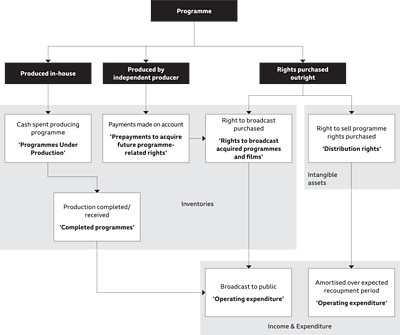
Programme-related assets
Programme assets can be recognised within either inventories or intangible assets as follows:
Risk – Programme assets
There is a risk the accounting for programme assets held on the balance sheet may result in a misstatement due to the significant amount of judgements used in the accounting valuation methodologies.
The changing approach to the way viewers consume BBC content (iPlayer vs linear) also adds risk around the timing of the release of these assets to the consolidated expenditure statement and therefore the carrying value held on the consolidated balance sheet at each year end.
Judgement – Carrying value of programme assets
Judgement is required when assessing whether there is any indication of impairment over the carrying value of programme assets (including distribution rights).
When programmes are available across multiple platforms judgement is also required to determine when the associated cost should be recognised in the consolidated expenditure statement. The BBC's policy is to release programme asset inventory to broadcast expenditure as it is consumed. For the majority of programme types this is estimated to be when first made available and a review is performed at each year end to verify whether this is still appropriate. There are a small number of instances where this basis of recognition wasn’t appropriate to apply.
As viewers consume more content across digital platforms, it’s likely that the release from inventories should change to better reflect the period of consumption rather than just when first made available. The BBC identified in the prior year that Children’s programmes are consumed differently to others and recognition over an estimated average contract length was more appropriate. Although the review performed at 31 March 2026 didn’t identify any further changes required, the BBC is monitoring this very closely to ensure the correct recognition period is maintained.
Estimate – Carrying value of programme assets
Estimation can be required when calculating the carrying value of programme assets (including distribution rights), most significantly when calculating:
- the estimated average marketable life of distribution rights when setting the amortisation profile over these assets
- the estimated consumption patterns for programmes when setting the release of these assets to the consolidated expenditure statement
- the estimated average contract length of Children’s programmes when setting the consumption profile of these assets
- the calculation of any identified impairment over the carrying value of all programme assets (inventories and distribution rights)
Intangible assets
Intangible assets include goodwill, programme rights (see above), software and carrier agreements.
Estimate – Impairment of goodwill
The determination of whether goodwill is impaired requires an estimation of the value in use of the cash-generating units. The value in use calculation requires the entity to estimate the future cash flows expected to arise from the cash-generating unit and a suitable discount rate that reflects current market assessments of the risks specific to the asset and the time value of money, in order to calculate present value.
The estimation process is complex due to the inherent risks and uncertainties associated with long-term forecasting. If different estimates of the projected future cash flows or a different selection of an appropriate discount rate or long-term growth rate were made, these changes could materially alter the projected value of the cash flows of the asset, and as a consequence materially different amounts would be reported in the financial statements.
Property-related assets
Property, plant and equipment, furniture and fittings and assets under construction.
Risk – Complex property transactions
Where there are complex property transactions, there is a risk of misstating carrying values due to the valuation methods used, along with external factors, particularly for the areas such as:
- Accounting for properties under IFRS 16 Leases
- London Broadcasting House refinancing and the treatment of Daunus Ltd
- Other property transactions
Estimate – Capital projects
The BBC is completing a number of capital projects for which amounts have been capitalised on the BBC’s consolidated balance sheet. The capitalised values are based upon estimates regarding the recoverability of these assets, the achievement of project completion, and the assets being used in the manner intended.
Investments
Balances held to represent the BBC’s interest in associates and joint ventures and the results of any sales of operations that have occurred.
Judgement – Classification of investments
The BBC owns numerous investments in other entities and their classification as either subsidiary, associate or joint ventures requires judgement over the control held and consequently how they are accounted for and the valuation attributable to them. Most notable judgement is for Daunus which is described in more detail below.
Estimate – Carrying value of investments
The calculation of the share of results of associates and joint ventures (most notably the BBC’s interest in Daunus Limited) can require a degree of estimation through the alignment of accounting policies, different year-end dates and the application of fair values at the date of acquisition. The BBC’s interest in Daunus Limited (see below) also requires estimation around the use of forward RPI rates.
BBC’s interest in Daunus
In order to facilitate the redevelopment and subsequent financing arrangement relating to London Broadcasting House, the BBC holds two investments in Daunus Limited:
- the issued ordinary A shares (10% of the total share capital), recognised as an equity investment in joint venture; and
- the issued ordinary C shares (a further 10% of the total share capital), which were previously recognised as a long-term interest in the joint venture. Following a detailed review completed during the year, the C shares were reclassified to an equity investment in joint venture, reflecting an updated assessment of their rights and obligations and ensuring their accounting treatment aligns with the substance of the arrangement.
When this structure was established in 2003, the BBC granted a 150-year headlease over London Broadcasting House to Daunus Limited. Daunus subsequently granted a 30-year underlease back to the BBC to enable the continued operation of the property.
Under the contractual arrangements in place, the BBC will have a series of rights when the underlease expires in 2033. At that point, the BBC may either:
- reacquire the headlease from Daunus;
- purchase the shares held by other shareholders on terms consistent with the headlease reacquisition; or
- vacate the property, after which Daunus may sell the property on the open market.
The BBC is currently anticipating reacquiring the property in 2033 and, although decisions around the mechanics of this are still to be determined, has recognised the ongoing value of this property by increasing the right-of-use asset and lease liabilities held for the underlease arrangement by the anticipated repurchase payments. The right-of-use asset at 31 March 2026 was £1,062 million (2025: £1,037 million) and lease liability £922 million (2025: £918 million).
Following the decision point in 2033, any profits generated within Daunus will be distributed to shareholders in accordance with a defined waterfall distribution mechanism. Each class of share is entitled to specified bands of distributable profits, with allocations made strictly in the contractual order set out in the agreements. No dividends or other profit distributions will be made before 2033.
The classification of this investment involves a significant degree of judgement. During the year, the Group performed a comprehensive review of the structure and related contractual rights. Based on this assessment, management concluded that the joint venture classification remains appropriate for the 2026 financial year, reflecting the continuing rights, obligations and level of influence the BBC holds over Daunus.
Further information on this structure is provided in the following notes:
At each balance sheet date, the BBC reviews the carrying amount (net amount held on the consolidated balance sheet) of those assets that are subject to amortisation, to determine whether there is an indication that any of those assets has suffered any impairment loss.
Specific indicators such as restructuring or discontinuation plans, adverse market or talent factors, strategic or commissioning changes, damage, or changes in use are all used to indicate impairment. If any such indication exists, the recoverable amount of the asset is estimated in order to determine the extent of any impairment loss.
For goodwill, the recoverable amount is estimated each year at the same time. The recoverable amount of an asset is the higher of fair value less costs to sell and value in use. For the purposes of impairment testing, assets are grouped at the lowest level at which they generate separately identifiable cash flows (cash-generating units). In assessing value in use, the estimated future cash flows are discounted to their present value using a pre-tax discount rate that reflects current market assessments of the time value of money and the risks specific to the asset for which the estimates of future cash flows have not been adjusted.
An impairment loss is recognised in the consolidated expenditure statement for the amount by which the asset’s carrying amount exceeds its recoverable amount. Where a cash-generating unit is impaired, the impairment loss will first be allocated to reduce goodwill and then to the other assets of the cash-generating unit on a pro-rata basis, except that the carrying amount of any individual asset will not be reduced below its separately identifiable recoverable amount.
Impairment losses in respect of goodwill are not reversed. In respect of assets other than goodwill, an impairment loss is reversed if there has been a change in the estimates used to determine the recoverable amount. An impairment loss is reversed only to the extent that the asset’s carrying amount does not exceed the carrying amount that would have been determined, net of depreciation or amortisation, if no impairment loss has been recognised.
For the purposes of impairment assessment the PSB component as a whole or sub-components within the PSB are not considered cash-generating units due to the statutory service obligations and funding arrangements under the Charter. Value in use assessments are therefore performed based on the cost of replacing the operational capacity provided by assets under review.
The Group tests investment assets for indicators of impairment annually. An impairment loss is recognised in the consolidated expenditure statement for the amount by which the asset’s carrying amount exceeds its recoverable amount. The recoverable amount of the assets are determined from value in use calculations. The key assumptions used for these calculations are those regarding discount rates and growth rates. Management estimates discount rates using post-tax rates that reflect current market assessments of the time value of money and the risks specific to each CGU/asset.
E1 Programme-related assets and other inventories
Programme assets reported as inventory effectively represent the BBC’s right to broadcast. The BBC’s right to sell programme rights are, however, recognised within intangible assets.
Completed originated (those made in-house) programmes and programmes in production are held at cost. Cost includes all direct costs, production overheads and a proportion of other attributable overheads. The proportion of programmes necessarily taking a substantial period of time to produce is small and as such, no borrowing costs are included in cost.
Where, exceptionally, it becomes certain that a programme is unable to be broadcast, the full value of the programme is written off to the consolidated expenditure statement.
Programme development costs are expensed to the consolidated expenditure statement until such time as there is a strong indication that the development work will result in a commissioned programme, when any further costs are recognised as programme-related assets.
Originated programmes that are still in production at the balance sheet date are recognised as programmes in production, except that prepayments to acquire future programme-related rights are shown separately where the BBC has made payments to independent producers, or the holders of certain rights (for example, rights to broadcast sporting events), to receive the programme on completion.
The rights to broadcast acquired programmes and films are recognised at cost. The costs of acquired programmes and films are expensed on first transmission except to the extent that the number of further showings are contractually agreed, when they are expensed according to the expected transmission profile.
Assets and liabilities relating to acquired programmes are recognised at the point of payment or commencement of the licence period, whichever is earlier. Agreements for the future purchase of rights whose licence period has not commenced and where there has been no payment by the balance sheet date are disclosed as purchase commitments.
Where the BBC has invested in independent productions, in addition to broadcasting rights, the BBC may obtain rights to future royalties from the sale of rights associated with the production. These residual interests are recognised initially at cost subject to amortisation as royalties are received, and impaired if anticipated royalties do not materialise.
The BBC’s main purpose is the provision of services for audiences. As a result, the Group’s output primarily includes the production of programmes for broadcast and the sale of rights for others to broadcast. This Note discloses the amounts for those programmes that are in production, completed programmes that are ready for broadcast but not yet aired and rights secured to broadcast programmes produced independently of the BBC. Inventory for the BBC’s commercial activities are also contained in this Note.
| 2026 £m | 2025 £m | |
|---|---|---|
Programme-related assets |
|
|
Rights to broadcast acquired programmes and films | 308 | 267 |
Prepayments to acquire future programme-related rights | 560 | 496 |
Completed programmes | 311 | 231 |
Programmes in production | 185 | 209 |
Total programme-related assets | 1,364 | 1,203 |
Other inventories | 4 | 4 |
Total programme-related assets and other inventories | 1,368 | 1,207 |
E2 Intangible assets
The BBC’s right to sell programme rights (distribution rights) is recognised within intangible assets. Programme assets reported as inventory effectively represent the BBC’s right to broadcast. Programme rights acquired by the Group are either purchased, generated internally or licensed following the payment of an advance on royalties.
Where the Group controls the respective assets and the risks and rewards attached to them, rights are initially recognised at acquisition cost or production cost. The carrying amount is stated at cost less accumulated amortisation and provision for impairment. Amortisation including impairment is charged to the consolidated expenditure statement to match the estimated future economic benefit. This is calculated as the higher of an estimated recoupment profile based on the average historic performance of the overall distribution rights portfolio or the actual recoupment of the specific initial distribution advance.
Where the carrying value of any individual set of rights exceeds management's best estimate of future exploitation revenues, a provision for impairment is recorded in the consolidated expenditure statement immediately. These costs are deferred within current assets and expensed upon recognition of the associated production income. Production income is recognised in accordance with the Group’s income recognition policies.
Expenditure on research activities is written off in the consolidated expenditure statement when incurred. Expenditure on development activities is included on the consolidated balance sheet as an asset only if both of the following conditions are met:
- it is probable that the asset will generate future economic benefits; and
- the development costs of the asset can be measured reliably.
The assets are measured at cost less accumulated amortisation and any accumulated impairment losses. For the PSB Group it is generally unlikely that future economic benefits in the form of cash inflows will be received and as a result, other than assets created for use by the business in delivering its public purposes, development costs are only capitalised by the BBC Group’s commercial businesses.
Other intangible assets
Other intangible assets acquired separately by the BBC are stated at cost less accumulated amortisation and any accumulated impairment losses. The identifiable intangible assets acquired as part of a business combination are shown at fair value at the date of acquisition (in accordance with IFRS 3 Business Combinations) less accumulated amortisation and any accumulated impairment losses.
An annual impairment review is conducted using management’s best estimates of future income exploitation.
Amortisation is charged to the consolidated expenditure statement on a systematic basis over the estimated useful lives of intangible assets, from the date that they are available for use, unless such lives are indefinite. Amortisation methods, useful lives and residual values are reviewed at each balance sheet date and adjusted if appropriate. The useful lives and amortisation methods of other classes of intangible asset are as follows:
| Asset type | Amortisation method | Useful economic life |
|---|---|---|
Software | Straight-line | 2 to 5 years |
Customer relationships | Straight-line | Unexpired term of agreement |
Other intangibles: Licences and trademarks | Straight-line | 30 years or unexpired return |
Other intangibles | Straight-line | 2 to 12 years |
Amortisation, including impairment, of programme rights is charged to the consolidated expenditure statement to match the estimated future economic benefit. Typically the amortisation method is charged based on the higher of recoupment and an estimated useful life of up to 5 years using either the sum of digits or straight line method. This is calculated as the higher of an estimated recoupment profile based on the average historic performance of the overall distribution rights portfolio or the actual recoupment of the specific initial distribution advance. The amortisation policy is reviewed annually by management.
Where the carrying value of any individual set of rights exceeds management's best estimate of future exploitation revenues, a provision for impairment is recorded in the consolidated expenditure statement immediately. For self-produced content, distribution rights exclude co-production costs borne by third parties. These costs are deferred within current assets and expensed upon recognition of the associated production income. Production income is recognised in accordance with the Company’s revenue recognition policies.
| Goodwill £m | Distribution rights £m | Software £m | Customer relationships £m | Other intangibles £m | Total £m | |
|---|---|---|---|---|---|---|
Cost |
|
|
|
|
|
|
At 1 April 2024 | 256 | 2,089 | 330 | 278 | 273 | 3,226 |
Additions | 3 | 197 | 33 | – | 15 | 248 |
Disposals | – | – | (11) | – | (1) | (12) |
Exchange movements | (4) | – | – | – | – | (4) |
At 31 March 2025 | 255 | 2,286 | 352 | 278 | 287 | 3,458 |
Additions | – | 158 | 35 | 7 | – | 200 |
Disposals | – | (2) | (1) | – | – | (3) |
Exchange movements | (1) | – | – | – | (1) | (2) |
At 31 March 2026 | 254 | 2,442 | 386 | 285 | 286 | 3,653 |
Amortisation and impairment |
|
|
|
|
|
|
At 1 April 2024 | 42 | 1,925 | 239 | 43 | 68 | 2,317 |
Charge for the year | – | 199 | 29 | 24 | 26 | 278 |
Impairment | 5 | – | – | – | – | 5 |
Disposals | – | – | (10) | – | – | (10) |
Exchange movements | (1) | – | – | – | – | (1) |
At 31 March 2025 | 46 | 2,124 | 258 | 67 | 94 | 2,589 |
Charge for the year | – | 196 | 31 | 25 | 21 | 273 |
Disposals | – | (1) | – | – | – | (1) |
Impairment | – | – | – | – | 1 | 1 |
Exchange movements | 1 | – | – | – | – | 1 |
At 31 March 2026 | 47 | 2,319 | 289 | 92 | 116 | 2,863 |
Net book value |
|
|
|
|
|
|
At 31 March 2026 | 207 | 123 | 97 | 193 | 170 | 790 |
At 31 March 2025 | 209 | 162 | 94 | 211 | 193 | 869 |
Amortisation is the reduction reflected in the carrying value of the asset as a consequence of the regular use of that asset by the organisation.
Customer relationships refers to intangible assets that are identified as part of an acquisition of a business. This includes customer contracts and carriage agreements with channel networks. These agreements can be secured for a fixed amount of time and are therefore amortised over the individual contract terms on a straight-line basis.
Other intangibles primarily includes intangible assets are identified as part of an acquisition of a business. This includes brands, trademarks and other contract related assets such as content rights, licence agreements and Electronic Programme Guide (EPG) slots.
E3 Goodwill
Goodwill is recorded in the consolidated balance sheet as the difference between the fair value of the consideration transferred by the BBC and the recognised amount of non-controlling interests in the acquiree compared to the fair value of the identifiable assets and liabilities acquired. These are all measured at the date of acquisition.
Where the consideration is less than the net assets acquired, the difference is recognised immediately in the consolidated expenditure statement. Goodwill arising on the acquisition of associates and joint ventures is included in the carrying amount of the associate or joint venture and is tested for impairment as part of the overall balance.
Goodwill is considered to have an indefinite useful economic life but is tested annually for impairment and is therefore measured at cost less any accumulated impairment losses. For the purposes of impairment testing, the goodwill is allocated to cash-generating units on the basis of those expected to benefit from the relevant business combination.
All goodwill is recognised in Studios Group and allocated by cash-generating unit (CGU) as follows:
| 2026 £m | 2025 £m | |
|---|---|---|
BritBox | 176 | 178 |
Production companies | 31 | 31 |
Total | 207 | 209 |
Fair value is the price that would be received to sell an asset or paid to transfer a liability in an orderly transaction between market participants at the measurement date.
The Group tests goodwill for impairment in the accounting period in which a business combination takes place; thereafter annually, or more frequently if there are indications that goodwill might be impaired. The recoverable amounts of the CGUs are determined from value in use calculations.
The key assumptions used for these calculations are those regarding discount rates and growth rates. Cash flow projections are based on a five-year forecast period consistent with the approach applied across all impairment reviews. Management estimates discount rates using post-tax rates that reflect current market assessments of the time value of money and the risks specific to each CGU.
BritBox
The goodwill balance arose as a result of the acquisition of BritBox International on 29 February 2024. The movement from prior year was the result of exchange differences booked. Three CGUs were identified for BritBox. Their cash flow projections used in the recoverable amount calculation are based on the current business plans approved by management, which cover a five-year period, after which cash flows have been extrapolated using the following expected terminal growth and discount rates:
| 2026 Growth rate | 2026 Discount rate | 2025 Growth rate | 2025 Discount rate | |
|---|---|---|---|---|
BritBox US | 2.0% | 9.6% | 3.0% | 9.9% |
BritBox AUS | 5.0% | 13.1% | 1.5% | 13.0% |
Denipurna | 2.0% | 13.8% | 2.9% | 13.7% |
Goodwill balance is supported by management’s projections of the future profitability of the business which is mainly driven by forecast revenue, if forecast subscriber additions was 10% lower than planned or churn rates 10% higher, it would still not result in any impairment of goodwill.
Production companies
The goodwill balance arose as a result of the acquisition of several independent production companies in previous financial years. At 31 March 2026 the largest goodwill balances within independent production companies related to House Productions, Lookout Point and Clerkenwell Films.
The cash flow projections used in determining value in use for the CGUs are based on the current business plans approved by management, which cover a five year period after which cash flows have been extrapolated using an expected long-term growth rate of 1.0% (2025: 1.0%) and a discount rate of 10.6% (2025: 9.2%). As a result of this assessment, management have made the decision to not impair the goodwill balances this year.
E4 Property, plant and equipment
Items of property, plant and equipment are stated at cost less accumulated depreciation and any accumulated impairment losses. Cost includes expenditure that is directly attributable to the acquisition of the asset.
Depreciation is provided to write off the cost of each item of property, plant and equipment, less its estimated residual value, on a straight-line basis over its estimated useful life.
Depreciation methods, estimated useful lives and residual values are reviewed at each reporting date.
The major categories of property, plant and equipment are depreciated as follows:
| Asset category | Depreciation method | Useful economic life |
|---|---|---|
Land and buildings |
|
|
Freehold land | Not depreciated |
|
Freehold buildings | Estimated useful life | 50 years |
Freehold building improvements | Estimated useful life | 10 to 50 years |
Leasehold buildings and improvements | Estimated useful life | Shorter of 50 years or life of lease |
|
|
|
Plant and machinery |
|
|
Computer equipment | Straight-line | 3 to 5 years |
Electrical and mechanical infrastructure | Straight-line | 10 to 25 years |
Other | Straight-line | 3 to 10 years |
|
|
|
Furniture and fittings | Straight-line | 3 to 15 years |
Some assets may have an individual useful economic life outside of the range quoted above where specific circumstances are applied.
| Land and buildings* £m | Plant and machinery £m | Furniture and fittings £m | Assets under construction £m | Total £m | |
|---|---|---|---|---|---|
Cost |
|
|
|
|
|
At 1 April 2024 | 293 | 1,017 | 127 | 62 | 1,499 |
Additions | 9 | 2 | 5 | 75 | 91 |
Reclassification to asset held for sale | (7) | (10) | (2) | – | (19) |
Brought into service | 18 | 51 | 4 | (73) | – |
Disposals | (28) | (138) | (13) | – | (179) |
At 31 March 2025 | 285 | 922 | 121 | 64 | 1,392 |
Additions | – | 2 | 2 | 49 | 53 |
Reclassification to asset held for sale | (1) | (2) | – | – | (3) |
Brought into service | 30 | 28 | – | (58) | – |
Disposals | (12) | (21) | (8) | – | (41) |
At 31 March 2026 | 302 | 929 | 115 | 55 | 1,401 |
Depreciation |
|
|
|
|
|
At 1 April 2024 | 170 | 805 | 96 | – | 1,071 |
Charge for the year | 12 | 45 | 9 | – | 66 |
Reclassification to asset held for sale | (6) | (9) | (2) | – | (17) |
Disposals | (23) | (136) | (13) | – | (172) |
At 31 March 2025 | 153 | 705 | 90 | – | 948 |
Charge for the year | 12 | 45 | 7 | – | 64 |
Reclassification to asset held for sale | – | (1) | – | – | (1) |
Disposals | (8) | (19) | (7) | – | (34) |
Impairment | 1 | 2 | – | – | 3 |
At 31 March 2026 | 158 | 732 | 90 | – | 980 |
Net book value |
|
|
|
|
|
At 31 March 2026 | 144 | 197 | 25 | 55 | 421 |
At 31 March 2025 | 132 | 217 | 31 | 64 | 444 |
* Land and buildings are not separable and therefore reported collectively.
E5 Investment properties (owned)
The majority of investment properties held by the BBC are right-of-use assets (see Note F3 for further details, including the BBC’s accounting policy). One freehold property, with negligible net book value, is however classified as an investment property.
At 31 March 2026, this property was valued at £5 million (2025: £4 million). The valuation of these investment properties was carried out by independent valuers Lambert Smith Hampton, in accordance with the Royal Institution of Chartered Surveyors (RICS) Valuation Professional Standards. In estimating the fair value of the properties, the highest and best use of the properties is their current use.
The property, which is leased out under an operating lease, earned an immaterial amount of rental income and incurred an immaterial amount of direct operating expenditure.
E6 Assets classified as held for sale
Non-current assets are classified as held for sale if their carrying amount will be recovered principally through sale rather than continuing use. They are available for immediate sale and the sale is highly probable, normally within the next 12 months.
| 2026 £m | 2025 £m | |
|---|---|---|
| Property, plant and equipment held for sale | 10 | 6 |
The prior year balance relates to Caversham and Bristol properties. Both property disposals were delayed, now expecting to complete during 2026/27 and therefore remain as held for sale at 31 March 2026. The final part of the Bristol site was reclassified to assets held for sale during the year.
E7 Interests in associates and joint ventures
This Note details the BBC’s share of net assets in associates and joint ventures, along with the impact that they have on the consolidated expenditure statement. Details of significant associates and joint ventures along with principal subsidiary undertakings, including their activities, are provided in Note I1. The Group’s accounting policy for interests in associates and joint ventures can be found in Section A on page 128.
| 2026 £m | 2025 £m | |
|---|---|---|
Interests in associates | 10 | 13 |
Interests in joint ventures | – | – |
Total interests in associates and joint ventures | 10 | 13 |
|
|
|
Share of results of associates | – | 5 |
Share of results of joint ventures | (13) | – |
Total share of results of associates and joint ventures | (13) | 5 |
An associate is an entity that the BBC has significant influence over, but that does not meet the definition of a joint venture or subsidiary. Significant influence is the power to participate in the financial and operating decisions of an entity but is not control or joint control over those policies.
A joint venture is where the BBC has joint control over an entity with another partner(s).
The movements in associates and joint ventures during the year were as follows:
| 2026 Associates £m | 2026 Joint ventures £m | 2026 Total £m | 2025 Associates £m | 2025 Joint ventures £m | 2025 Total £m | |
|---|---|---|---|---|---|---|
At 1 April | 13 | – | 13 | 86 | 14 | 100 |
Additions | – | – | – | 2 | – | 2 |
Disposals | (1) | – | (1) | (67) | – | (67) |
Reclassification | – | 13 | 13 | 1 | (14) | (13) |
Share of results | – | (13) | (13) | 5 | – | 5 |
Dividends receivable | – | – | – | (9) | – | (9) |
Impairment | (2) | – | (2) | (5) | – | (5) |
At 31 March | 10 | – | 10 | 13 | – | 13 |
See Notes C1, C3 and I3 for further details.
Investments in joint ventures primarily relates to the BBC's interest in Daunus Limited. This investment was made in two stages: an initial £10 made on the entity's establishment in 2003, followed by a further 10 shares acquired in 2017 for a consideration of £13 million.
In the prior year, the second investment was reclassified to Other Receivables and measured at a fair value of £22 million in accordance with IFRS 9 Financial Instruments, reflecting management's assessment at that time that it represented a long-term interest in the entity. Following a more comprehensive review in the current year, this reclassification has been reversed, and the investment has been returned to its previous classification as an equity investment in joint venture.
Inline with this reclassification of Daunus described above a total loss of £22 million has been recognised within the consolidated expenditure statement in the current year. £9 million fair value loss has been recognised within Other Gains and Losses (see Note C3) and the remaining £13 million as the BBC’s share of results of this joint venture, as detailed in the table above.
The BBC has not recognised losses in associates and joint ventures beyond those that have been recognised in writing the investment value down to nil under equity accounting.
The Group tests assets for indicators of impairment annually. An impairment loss is recognised in the consolidated expenditure statement for the amount by which the asset’s carrying amount exceeds its recoverable amount.
The recoverable amount of the assets are determined from value in use calculations. The key assumptions used for these calculations are those regarding discount rates and growth rates. Management estimates discount rates and growth rates using post-tax rates that reflect current market assessments of the time value of money and the risks specific to each CGU.
Material associates
The following table presents the Group’s share of material associates during the year:
| Everyone TV 2026 £m | Everyone TV 2025 £m | YouView Limited 2026 £m | YouView Limited 2025 £m | |
|---|---|---|---|---|
Non-current assets | 1 | 2 | 2 | 2 |
Current assets | 28 | 29 | 10 | 9 |
Current liabilities | (27) | (17) | (7) | (8) |
Non-current liabilities | – | – | (61) | (76) |
Net assets/(liabilities) of material associates | 2 | 14 | (56) | (73) |
Group's share of net assets of material associates | – | – | – | – |
|
|
|
|
|
Income | 42 | 50 | 23 | 23 |
Profit/(loss) after tax | – | 4 | (14) | (17) |
Share attributable to other parties | – | (4) | 14 | 17 |
Group's share of results of material associates | – | – | – | – |
Liabilities within YouView primarily relate to borrowings. Non-financial liabilities within this entity are not material.
The BBC’s share of results of immaterial associates was less than £1 million (2025: less than £1 million).
Material joint ventures
The following table presents the Group’s share of material joint ventures during the year:
| Daunus Limited 2026 £m | Daunus Limited 2025 £m | |
|---|---|---|
Non-current assets | 714 | 804 |
Current assets | 55 | 75 |
Current liabilities | (74) | (88) |
Non-current liabilities | (478) | (526) |
Net assets of material joint venture | 217 | 265 |
Group's share of net assets of material joint ventures | – | – |
|
|
|
Income | 73 | 69 |
Profit after tax | 30 | 28 |
Share attributable to other parties | (30) | (28) |
Group's share of results of material joint ventures | – | – |
Liabilities within Daunus Limited primarily relate to borrowings. Non-financial liabilities within this entity are not material. Other material balances within this entity include £33 million (2025: £40 million) interest expense.
The BBC’s share of results of immaterial joint ventures was less than £1 million in both the current and prior year.
Daunus Limited prepares its financial statements to a 30 November accounting reference date and under Financial Reporting Standard 102. Adjustments are therefore made to align the accounting periods and accounting policies (excluding judgements applied) to that of the Group. The Group is unable to receive dividends from Daunus Limited until 2033 due to restrictions mandated within this entity. Also see Note G4 for further details on the BBC’s interest in Daunus Limited.
