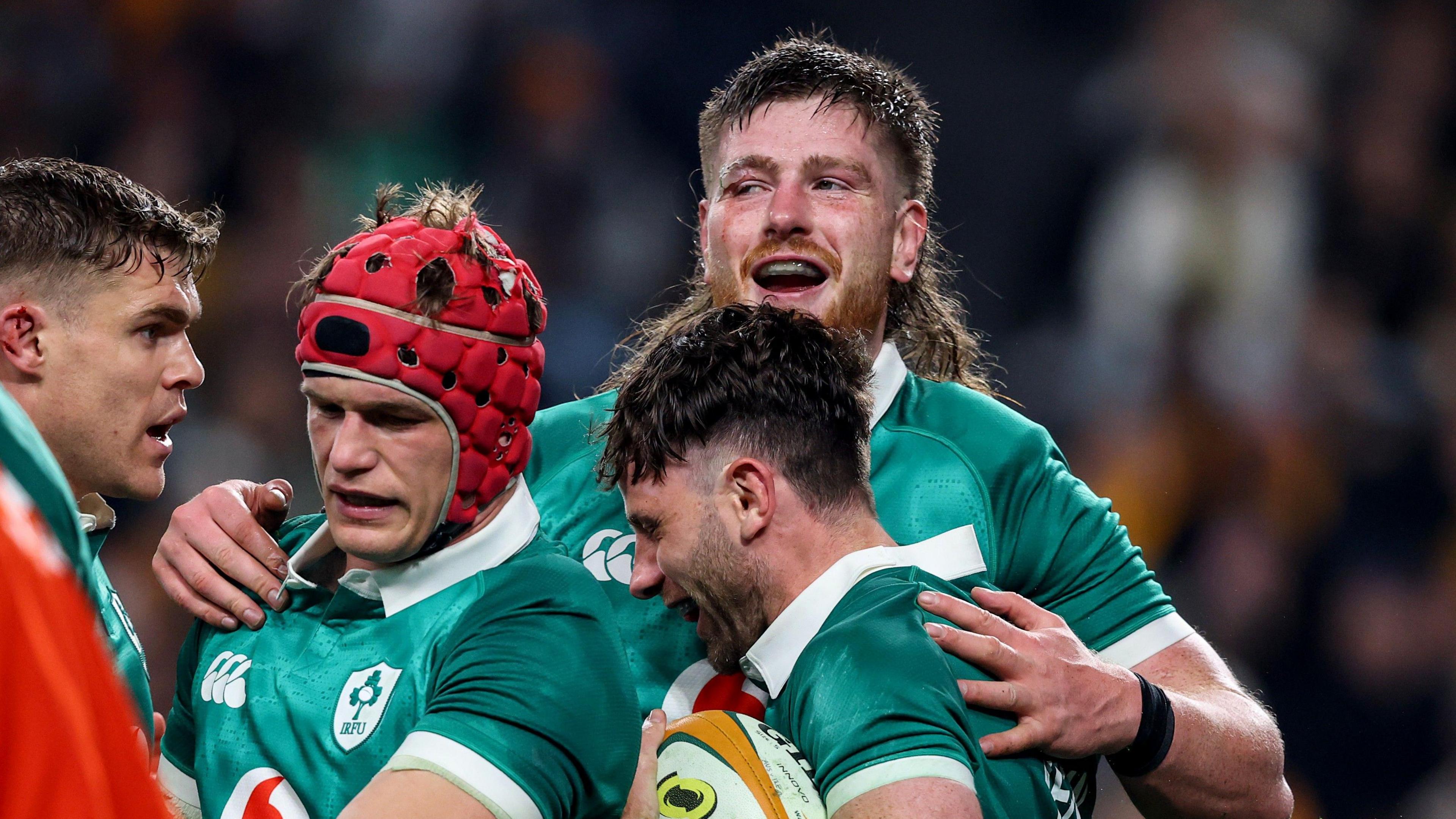
Boks unleash big-game brutality on Borthwick's faltering England
England outclassed by South Africa in Nations Championship
- Published
A century or more ago, Englishmen travelled to South Africa hunting big game.
Steve Borthwick's modern-day tourists came with the same aim. England were looking for a contest that gave a true measure of where they stand against the world's best.
About five minutes into their 45-21 defeat by South Africa in Johannesburg they found it, and found out.
Thomas du Toit had already steamrollered over for one try by then. Jasper Wiese had swept past Alex Coles with a run bristling with evil intent.
But it was the sight of loose-head prop Ox Nche stampeding through Ollie Chessum and Jamie George, with the England defence desperately, vainly backpedalling, that summed up a brutally chastening opening salvo.
Cheslin Kolbe, who jagged off the same foot to ice Owen Farrell's ankles in the 2019 Rugby World Cup final, danced in at the end of that attack.
Kurt-Lee Arendse, the other scrum-capped hot-stepper in the Boks' back three, followed shortly after to make it three South Africa tries in the first 11 minutes.
England were shell-shocked. Never mind the gap, onlookers were marvelling at the sheer chasm in class between the two teams.
And this was a Springbok side that many had expected to start slowly.
South Africa's last meaningful match was in November.
They have a lengthy injury list, with the late withdrawal of captain Siya Kolisi and second row Eben Etzebeth adding to the absence of star fly-half Sacha Feinberg-Mngomezulu and forward mainstays Franco Mostert, Lood de Jager, RG Snyman, Kwagga Smith and Frans Malherbe.
The Springboks didn't even get a chance to press their traditional scrum supremacy until the 21st minute.
But none of it mattered. South Africa were too skilful individually, too connected as a collective for England to make an imprint.
Ellis Genge and George Martin's try-scoring rumbles, which cut the Boks' lead to three at half-time, raised false hopes of an England comeback before the break
The Boks duly restored rugby's new world order after the break.
"The second half was hardly a contest," said former England fly-half Paul Grayson on BBC Radio 5 Live.
"England never got a foothold in the game and because of that their attack was bits and pieces.
"South Africa smashed the door down, rarely played more than a couple of phases but squeezed the life out of England. They were uncomplicated and uncompromising."
Perhaps no side could have matched the double reigning world champions in such brilliantly belligerent mood.
But plenty will feel that England should have been closer to doing so.
Opting for Marcus Smith, an excellent and versatile player, but not a specialist full-back, at 15 after the late withdrawal of George Furbank did not settle the backfield defence.
Tommy Freeman, one of England's best players in the air, remained in his less accustomed outside centre role.
Too often the Boks took to the air and returned with the ball, with the superb Damian Willemse ruling the skies.
England had promised to play 'big', mixing physical bravery with tactical daring. It was there, but only in parts.
All three England tries - concluding with Henry Slade's excellent kamikaze angle into the heart of the Bok defence followed up by a smart mispass to Coles to cross for their final score - showed that intent.
And one early passage of play, with Fin Smith and Ben Earl combining well and Jack van Poortvliet finding his man with a one-handed offload round the back of a tackler, saw them carve through the hosts.
But the attacking ambition and accuracy wavered across the contest.

Alex Coles crossed for England's third try, but they rarely looked like diverting the Springboks from their path to victory
The one constant across England's five-match losing streak though has been indiscipline.
Their Six Nations campaign - a historic low in the tournament - came with a flush of cards.
This time, Freeman and replacement Guy Pepper were dispatched to the sin-bin late on to leave England, gasping at 1,753m above sea level, down to 13 men for the final eight minutes.
Even before that referee James Doleman had awarded a clutch of second-half penalties the hosts' way, with Tom Curry falling foul of a new emphasis on cleaning up the driving maul within a minute of the restart.
Every one of the 13 penalties England conceded sapped their momentum, ceded territory and ratcheted up pressure.
And England are not a good enough side to withstand it.
The question now will be whether they are good enough to defeat Fiji and Argentina over the next two weekends.
South Africa may have been the biggest game of England's summer, but these latter two fixtures are the more revealing tests.
The Springboks are operating at the summit of the sport.
When England descend from altitude, touch down back at Heathrow and face Fiji in Liverpool, they will need to show they can overcome those at a lower level.
If not, and a losing streak of five games extends to six or seven, Borthwick knows that the Rugby Football Union will be asked once more whether they back their man to the World Cup.
"England must beat Fiji next weekend because the storm clouds are gathering again," added Grayson.
On its own, a defeat away to this South Africa - one of the all-time great teams - doesn't prompt that inquest.
Because as Englishmen of old know, when you go big-game hunting, someone usually gets stuffed.
Related topics
- Published4 July