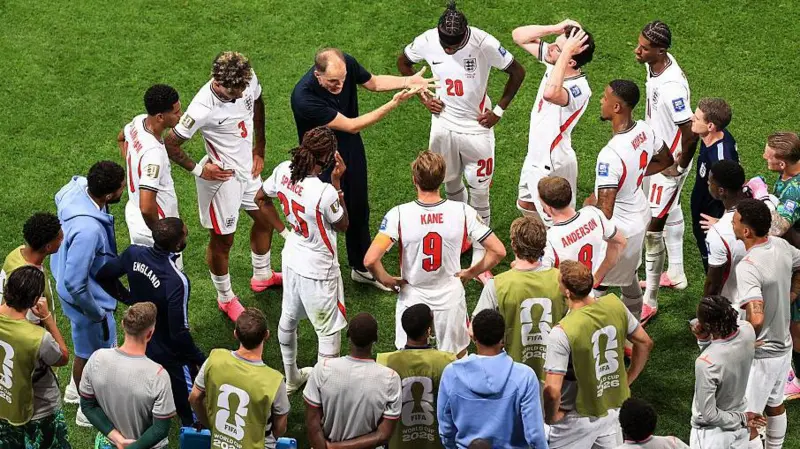
'You can't catch your breath' - how will Azteca altitude impact England?

Mexico have only lost twice in competitive matches at the Estadio Azteca - against Costa Rica in 2001 and Honduras in 2013 - since they began playing matches there in 1966
- Published
Having reached the last 16 of the World Cup by scraping past DR Congo 2-1, one of the biggest dangers facing England in their next match against Mexico is something they can't control - altitude.
The Three Lions will be playing at the iconic Estadio Azteca in Mexico City, 7,220ft (2,240m) above sea level.
It will be England's first game at the stadium since their controversial quarter-final defeat by Argentina at the 1986 World Cup.
At that altitude, the Earth's barometric pressure is lower, making the air thinner and meaning less oxygen is taken into the bloodstream with each breath.
Even for professional footballers, that has a potentially significant impact - increased heart rate, shortness of breath, dehydration, quicker and more intense fatigue.
By contrast, the stadium at the highest altitude in professional English football is West Bromwich Albion's The Hawthorns, which at 551ft (168m) is 14 times closer to sea level than the Azteca.
Opponents Mexico have played all of their matches so far on home soil, and the squad is clearly used to coping with the conditions - they have played 14 games at the Azteca so far in the 2020s, scoring 23 goals and conceding only four.
Their competitive record at the Azteca is 70 wins from 89 games, with 17 draws and only two defeats. They are also unbeaten in 10 World Cup games there.
"As an opponent, you know when you go there, you are going to suffer," says Pavel Pardo, a former Mexico captain who also called the Azteca home when he played for domestic side Club America.
So, what will the altitude feel like for players out on the pitch, how big a difference could it make, and are there any strategies to cope with it?
Azteca altitude 'big disadvantage' for England
'The most demanding place I ever played football'
Not many English players have played at the Azteca since 1986, but even with advances in sports science and smarter preparation, those who have insist the impact is significant.
"It's the most physically demanding place I ever played football," says Nigel Reo-Coker, the former West Ham midfielder who played in the Concacaf Champions League final at the Azteca for Montreal Impact in 2015.
"To come from Europe and play in that altitude is so difficult.
"You cannot catch your breath. The first 45 to 55 minutes you're literally just trying to keep breathing.
"It's about football intelligence – you really have to pick and choose your moments where you exert yourself."
Reo-Coker suggests yoga or pilates can be a big help, while also being aware of how to breathe from your diaphragm.
The thinner air also means the ball can move faster when shot at goal or crossed, impacting how matches play out tactically.
The conditions make it difficult for goalkeepers in particular, who might struggle to deal with the flight of the ball and timing of crosses, according to Jason de Vos, who was both a player and coach for Canada when they played at the Azteca.
"You can legitimately hit a ball and trouble the goalkeeper from 40 yards," says De Vos.
"You realise immediately that the game is going to be much quicker than you thought.
"As a coach, you have to change your tactics and adapt to the altitude. You have to change the fact that you want to press all game – you simply can't do that."

Mexico City and the Azteca sit in a high-altitude valley, surrounded by mountains, thanks to volcanic activity from millions of years ago
'England will likely slow down their playing style'
Ideally, athletes competing at high altitude should spend a week or two living at that level in order to allow their body acclimatise and generate more red blood cells.
But England will only be arriving in Mexico City two days before the match.
"Maximum aerobic capacity at this kind of altitude usually drops around 10%, and that has a knock-on to performance," says Dr. Barney Wainwright, senior research fellow at Leeds Beckett University.
"There will usually be a 15-20% increase in fatigue. For the distance it's possible to cover, we would expect that to drop by 5-10%.
"Players will produce lactate much more quickly, creating an acidity in the muscle which builds fatigue and slows them down.
"Maximum sprint speeds won't be affected, but players will need to wait a bit longer to recover from each one and go again.
"We need oxygen in the brain for perception and decision-making, so particularly in the moments of the game where players are working really hard, that could impact key decisions."
He adds: "England might want to slow things down more to allow the players time to recover between bouts of high intensity play."
Tuchel urges parents to let kids stay up for England game
- Published1 July
Genuine superstar Kane produces his biggest England moment
- Published1 July
In rugby union, England are facing South Africa on Saturday in Johannesburg, at an altitude of 5,751 ft - 1,200 ft lower than the Azteca, and the team have been undertaking altitude preparations including training in the gym while wearing special masks which reduce the flow of oxygen into the body.
But training for their other World Cup matches played much closer to sea level has reduced England's capacity to prepare for the altitude.
"It's damage limitation really," Wainwright adds, who says individual players will react differently and some may struggle to sleep.
"Some might not be affected by it at all, whereas others we can see really struggling, bent over to do a lot of extra breathing.
"I suspect we'll see a lot of substitutes used in the second half."
'Altitude definitely gives Mexico an advantage'
Mexico have won all four of their World Cup matches so far, scoring eight goals and conceding zero.
Their squad arguably possesses less individual talent - only four of their 26 players currently ply their trade in one of Europe's top five leagues.
But they have demonstrated excellent work ethic and resolute tactical strength. Add in the fact that they are used to playing at this altitude, albeit typically against lower quality opposition from across North and Central America, and they are a very dangerous opponent.
"You could tell from the body language of the opponent, especially in the second half because they would be way more tired," Pardo says.
"They lose their breath and you would look at them and think 'ok, we're here, at home with our fans, they are struggling, we can do this.'
- Published12 July