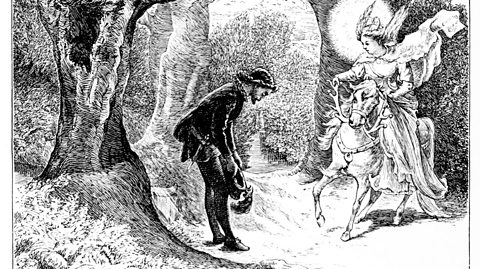
Overview of Composed In August by Robert Burns
- Composed in August by Robert Burns celebrates nature, love, and the harmony to be found in the natural world
- It is a A genre of poetry which focuses on expressing a speaker’s most personal thoughts and emotions. It originated in Ancient Greece and was often set to the music of the lyre, hence the term ‘lyric’. that focuses on the seasonal changes from late summer to autumn.
- Burns depicts the beauty of nature, while criticising how humans disrupt and destroy it, before comparing nature to his feelings for his love, Peggy.
- The speaker's focus changes through the poem's five stanzas:
- describing the beautiful surrounding countryside
- reflecting on the rich variety of birds and their habitats
- contrasting the serenity of the natural world and humanity’s cruelty
- asking Peggy to walk with him in the beautiful surroundings
- expressing the strength of his love for Peggy.
- Burns celebrates the richness of the landscape and the harmony of wildlife and .
Each reader will interpret what a poem means to them in their own way. Everyone's response is different. While Composed In August may draw on Burns' personal and romantic life, the reader can separate the poet from the words of the poem and think about how they contribute to wider themes or feelings.
The key themes of the poem are:
- nature’s beauty and abundance
- human cruelty, power, and vulnerability
- love, connection, and human relationships
- identity, belonging, and place
You can read Composed In August by Robert Burns on the Scottish Poetry Library website.
Context - Robert Burns
Robert Burns is Scotland's national bard. He is celebrated for his poetry and songs, which often focus on universal themes of love and nature. Much was written about his work and personal life, including his romantic life.
Composed In August was written about one of his early love interests, Margaret Thomson (Peggy). Burns met Peggy when he was at school in Kirkoswald, and he described her as 'a charming Filette' and as his 'Deity for six or eight months.'
More reading:
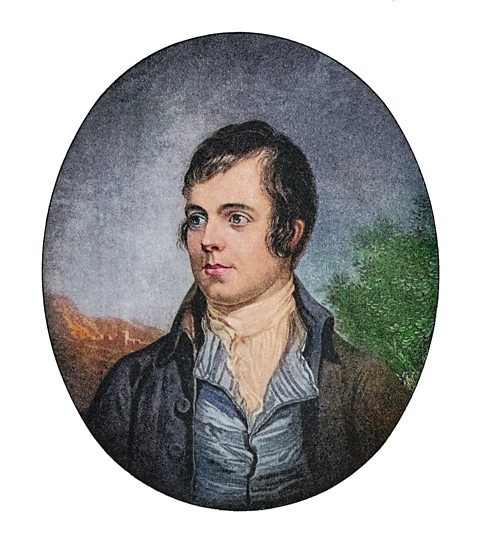 Image source, Getty Images
Form and structure of Composed In August by Robert Burns
'Composed in August' is a In poetry, this means idealising rural life as opposed to life in towns or cities A genre of poetry which focuses on expressing a speaker’s most personal thoughts and emotions. It originated in Ancient Greece and was often set to the music of the lyre, hence the term ‘lyric’. written by Robert Burns in 1783. As with many of Burns' poems, he intended it as a song to be set to music.
The speaker is Burns himself. He expresses his thoughts and feelings on nature, humanity's sometimes destructive relationship with nature, and the strength of his love for the woman he is addressing.
- There are five stanzas, each with eight lines.
- The lines have an A poetic rhythm that alternates between unstressed and stressed syllables. The rhythm is like the da-DUM da-DUM da DUM of a heartbeat. rhythm that lends itself well to music.
- Lines alternate between tetrameter (four beat) and trimeter (three beat).
- There is a consistent ABABCDED rhyme scheme.
- Lines 1, 3, 5 and 7 also feature When a word in the middle of a line rhymes with another at the end of the line (or in the middle of the next)., such as "Now waving grain, wide o'er the plain" which adds to the musical rhythm of the poem.
Narrative
Lyric poems follow a reflective thought process rather than the traditional story arc that would be found in a ballad.
However, this poem does have a subtle narrative arc: The speaker’s walk through nature becomes a walk through the speaker’s feelings.
- Stanza one: The speaker reflects on the change of season from summer to autumn and the beauty of his surroundings.
- Stanza two: He speaks more generally of the rich variety of birds, each with its own habitat.
- Stanza three: He notes the different behaviours of different species, but that all are potential victims of human hunters.
- Stanza four: He returns to thoughts of the nature around him and asks his love, Peggy, to walk with him through these beautiful surroundings.
- Stanza five: He expresses that, though he loves the nature around him, his feelings for Peggy are even stronger.
describing the beautiful surrounding countrysidereflecting on the rich variety of birds and their habitatscontrasting the serenity of the natural world and humanity’s crueltyasking Peggy to walk with him in the beautiful surroundingsexpressing the strength of his love for Peggy.
The first two stanzas create a vivid picture of the Scottish countryside. We are shown the “westlin winds” and “blooming heather”, and He describes the beauty of the crops ripening and the brightness of the moon, which allows him to see his way as he thinks about the woman he loves.
Burns describes a range of native birds in their habitats. He reflects on how each bird has its own place in nature, its own place where it belongs, he creates a sense of harmony: every animal has its own place and purpose.
The second section brings in a contrast to the earlier serenity. Violent human impulses interrupt the pastoral scene and the “slaught’ring guns”, “murd’ring cry”, “flutt’ring, gory pinion” disturb the scene. In this section, Burns’ moral message comes across as he objects to “tyrannic man’s dominion” over nature. This is his happy place, where he finds peace and love, and he does not want violence to disrupt this beauty.
The third section returns to the beauty that he sees. He returns to his feelings for Peggy and how the natural world provides the perfect backdrop for romance. In this final section, the speaker invites Peggy to take a walk with him through the “charms of Nature”.
By returning to this natural beauty, Burns creates a cyclical structure, much like how his love for Peggy is linked to the seasons – full of growth and renewal. Thus, Peggy is elevated, becoming intertwined with the natural world’s most essential joys. The poem ends with a declaration of love - a moment of emotional fulfilment, where love becomes part of the natural harmony Burns has been describing throughout the poem.
The poem moves from Burns observing nature, to criticising human cruelty, to finally celebrating love. He creates the story of a man who, by walking through the countryside, reflects on the world around him. Ultimately, he realises that his deepest joy is not nature itself, but Peggy.
Stanza one
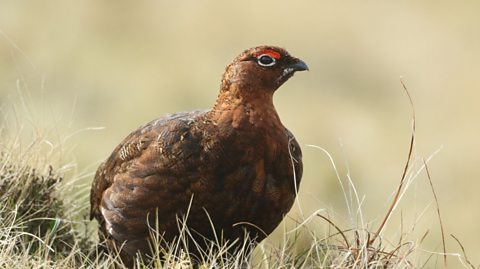 Image source, Getty Images
Lines 1-4
The first stanza confirms when the poem is set (as stated in the title) and where: a pleasant country scene in August.
Now westlin winds and slaught’ring guns
Bring Autumn’s pleasant weather;
The moorcock springs on whirring wings
Amang the blooming heather:
Poetry often uses the concept of wind to symbolise change. Burns’ reference to ‘westerly winds’ suggests a transitional point in the seasons. Summer is ending, and ‘Autumn’s pleasant weather’ creates a positive image of harvest and changing colours.
Tthe mention of ‘slaught’ring guns’ creates a jarring contrast. 12th August marks the start of the grouse hunting season, so this time of year also brings danger and destruction. A figure of speech where a concept is referred to by the name of something closely associated with it. is used to describe ‘slaught’ring guns’: it is not the guns which do the slaughtering, it is the people who are shooting birds for sport.
These gunshots disturb a ‘A (male) red grouse.’ which ‘springs’ suddenly from the undergrowth. The description of the bird is effective: 'springs' shows that it is fast, and we hear the When a word sounds like the word it is describing. For example, ‘buzz’ or ‘hiss’. sound of its quickly beating, ‘whirring wings.’
Image source, Getty ImagesVideo: what is onomatopoeia?
The use of metonymy and onomatopeia in these opening lines create a scene full of life. Brush up on your understanding of onomatopoeia with this short video for Higher English.
What is onomatopoeia? How and why would you use it? Bitesize explains with examples from ‘In the Snack Bar’ by Edwin Morgan.
Onomatopoeia
A word that sounds like what it describes
Think about animal calls
Onomatopoeia helps bring a scene to life.
The sounds of the words help you hear what is going on, making the world the writer has created feel more real.
If you open a comic book, you’ll find onomatopoeia everywhere.
There’s a whole world of sounds from
Ping
Wham
and Ha Ha Ha to Boing
Squelch
Whizz and Scoosh
Onomatopoeia is often used in poetry, too.
Edwin Morgan’s poem 'In The Snack Bar' describes an old, blind man being helped to the toilet.
The poem features plenty of onomatopoeia:
“crunch of spilt sugar…hiss of the coffee-machine…
A cup capsizes…with a dull clatter”
The old man’s disability may turn an everyday sound or experience into something uncomfortable or threatening.
Morgan chooses to use sounds that are harsh - crunch, hiss, clatter
These words emphasise that because the old man cannot see, he relies on his sense of hearing
The onomatopoeia helps us hear the snack bar in the way the old man would.
Why don’t you try adding a little fizz to your writing by using onomatopoeia?
Lines 5-8
Burns continues to create an usually a short poem, in the pastoral tradition, celebrating simple rural life. rural scene by depicting fields of wheat gently ‘waving’ in the wind.
Now waving grain, wide o’er the plain,
Delights the weary farmer;
The mention of the farmer is also idealised: he may be 'weary', but he is happy at how bountiful his harvest is. As summer turns to autumn, there is a sense that the farmer's work is almost done, and soon he will be able to reap the rewards of his efforts. The onset of autumn fits with the time of day, as the speaker next makes clear that it is evening:
And the moon shines bright, as I rove by night,
To muse upon my charmer.
Here the speaker inserts himself into the poem. We are told that he is wandering amid this pastoral scene, thinking about the woman he loves. The word choice of ‘muse’ is effective:
- It means he is thinking deeply and at length.
- It could also be taken to mean that he is thinking out loud, which fits with the reciting or singing of this poem.
- A 'muse' is a person, traditionally a woman, who gives an artist creative inspiration, so the connotation is that Peggy has inspired Burns' poetic work.
Stanza two
Lines 9-16
These lines focus on the different types of birds and the different habitats that provide their homes.
The Partridge loves the fruitful High moorlands or heath.,
The plover loves the mountains;
The A (male) red grouse. haunts the lonely Small wooded valleys, glens or hollows. ,
The soaring Heron the fountains:
Thro’ lofty A small wood or group of trees. the Wood pigeon roves,
The path of man to shun it;
The hazel bush o’erhangs the thrush,
The spreading thorn the A species of small finch..
This stanza is effectively a list: it could be seen that the speaker is noting these different species as he walks through the changing landscape. By identifying a variety of native birds and linking them to their habitats, the speaker displays a deep knowledge of local wildlife.
Each bird is given its own line, suggesting a sense of equality, and creating a feeling of peaceful coexistence: each species has its own place and does not infringe on the others. The rhyme scheme and regular rhythm add to the sense of harmony. Each bird and each line fits with the others. Together they create a unified stanza. Internal rhyme ('groves' and 'roves', and 'bush' and 'thrush') adds to the sense of how suited the birds are to their habitat.
The writer also uses effective language to convey the beauty and majesty of the natural world: the The repetition of the same sounds or consonants in two more words nearby each other. of ‘fruitful fells’. The majesty of the ‘soaring hern’ and the ‘spreading thorn’, the use of 'fountains' rather than reference to rivers or lochs, are all examples of poetic language that adds grandeur and beauty to the description of nature.
Stanza three
Lines 17-20
Thus ev’ry kind their pleasure find,
The savage and the tender;
Some social join, and leagues combine,
Some solitary wander:
Burns often used poetry to create a ‘universal’ reflection. Here he moves from observation of specific birds, to a general reflection on all of nature ('ev'ry kind'). The speaker indicates that, in nature, everything finds its ‘pleasure’ – that every creature finds its mate.
Just as the list of birds have their own distinct habitats, each has its own behaviour. Burns uses the contrast of opposites ('savage' and 'tender', 'social' and 'solitary') to suggest great variety.
By extension, Burns could be reflecting on humanity, and the many different personalities and types of people. Perhaps the speaker in this poem identifies with the idea of a ‘solitary wander’ – he too is ‘roving’ like the birds he describes.
Lines 21-24
Avaunt, away, the cruel sway!
Tyrannic man’s dominion;
The sportsman’s joy, the murd’ring cry,
The flutt’ring, gory pinion!
In a sudden change of tone, the speaker tries to wish away human cruelty. This suggests the 'slaught’ring guns' mentioned in the very first line of the poem. Perhaps the speaker's peaceful reflection has been disturbed by gunfire. The word 'sway' is effective here; it can mean power, referring to human power over nature, but also suggests moving from side to side. This seems a sinister reflection of the gentle 'waving grain' from stanza one.
The idea of the ‘savage’ from the previous lines returns in this section. The speaker rejects the cruelty of the hunters who would disturb the natural order he has just described.
‘Tyrannic man’s dominion’ indicates that he believes ‘man’ is in the wrong here. Tyranny is the unfair, cruel, or oppressive use of power, usually by someone in authority, and this shows that Burns disapproves of the practice. This is a theme he includes in other poems, for example in To a Mouse, where he writes:
I'm truly sorry Man's dominion
Has broken Nature's social union
Hunting animals for sport is something the speaker compares to a crime or a sin, by using the word ‘murd’ring’. The contrast between the ‘sportsman’s joy’ and the ‘murd’ring cry’ indicates that the speaker believes these things to be incompatible. The juxtaposition of opposing ideas ('joy' and 'cry', which suggests sorrow( further indicates his disapproval.
The stanza ends with the horrific image of a dying bird. 'Flutt’ring' shows there is movement, but 'gory' adds a sense of horror, and the use of A figure of speech in which a part is made to represent the whole or vice versa. with a Wing, a single body part, standing in for a whole living bird, creates an upsetting contrast with the beautiful descriptions of birds in stanza two.
Stanza four
Lines 25-32
But, Peggy dear, the ev’ning’s clear,
Thick flies the skimming swallow,
The sky is blue, the fields in view,
All fading – green and yellow:
Come let us stray our gladsome way,
And view the charms of Nature;
The rustling corn, the fruited thorn,
And ilka happy creature.
Beginning this section with ‘but’ indicates a change in direction. Having wished ‘away, the cruel sway’ of shooting for sport, the speaker chooses to focus his attention on 'Peggy dear' and on the ‘charms of Nature’.
The sensory detail in these lines creates a very clear image. He describes the many swallows he sees flying as they migrate at the start of Autumn. The word choice of ‘skimming’ shows their elegant, light touch as they fly low over the fields.
The speaker describes the crops changing colour as they ripen, and we hear the sounds of ‘rustling corn’, adding further sensory layering to the scene. ‘Fruited thorn’ and the ‘green and yellow’ tones indicate the bounty of nature at harvest time, suggesting nature’s plenty. The reference to 'corn' recalls the 'grain' from earlier in the poem, and the 'thorn' was previously mentioned in in stanza two. We have returned to the pastoral scene from earlier, where nature, and humanity, in represented by crops and farming, peacefully coexist.
Every ‘creature’ is described as being happy, creating a truly positive and idyllic scene.
Stanza five
We’ll gently walk, and sweetly talk,
While the silent moon shine clearly;
I’ll grasp thy waist, and, fondly prest,
Swear how I lo’e thee dearly:
Not vernal show’rs to budding flow’rs,
Not Autumn to the farmer,
So dear can be as thou to me,
My fair, my lovely charmer!
In the final stanza, the speaker shifts from describing the present to looking towards the future. The change in tense (shown by the use of 'We'll' and 'I'll') suggests that he is imagining his future.
The speaker envisions a future with Peggy in which they walk together, share intimate moments of physical contact, and he can express his love for her. The reference to the moon echoes the opening – as with seasons and lunar phases, the poem’s structure is cyclical, returning once more to his loving thoughts about Peggy, the “charmer” mentioned in both the first stanza and the last.
Through the use of a poetic apostrophe (not a punctuation mark, but a device where a speaker addresses someone or something not present at the time), the speaker echoes that cyclical structure by referring to the seasons:
'Vernal show’rs' refers to rain in spring. The speaker notes how important these are to the 'budding flow’rs' of summer. Autumn is equally vital to the farmer, as, without the autumn harvest, farmers would be unable to support themselves. Comparing favourably to these, is the speaker's love for Peggy. Even compared to the rain and harvest that flowers and farmers depend on for survival, Peggy's important to the speaker is greater.
Themes and comparisons with other poems in the collection
Nature
In Composed in August, Burns shows that nature is plentiful, serene, and joyful. Every animal has its proper place, and the natural world offers harmony and serves as a source of peace and love.
Of the group of poems on the set text list, this is the only poem where nature is comforting and joyful. Others show it as mystical, indifferent, symbolic, or threatened:
| Thomas the Rhymer | Nature is mysterious – it is not comforting, it is full of enchantment, danger and the unknown. |
| The Bonnie Broukit Bairn | Nature is represented by the vast, indifferent cosmos and through the fragility, yet resilience, of planet Earth. |
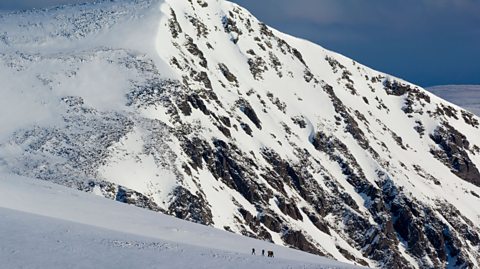
| Summit of Corrie Etchachan | Shepherd presents nature as vast and austere; however, in this poem, personal growth comes from accepting nature’s scale. There is awe and wonder in experiencing Nature up close. |
| Da Clearance | The land is closely tied to the identities of its inhabitants and their sense of belonging, yet it is the scene by human suffering as the people are torn from it. |
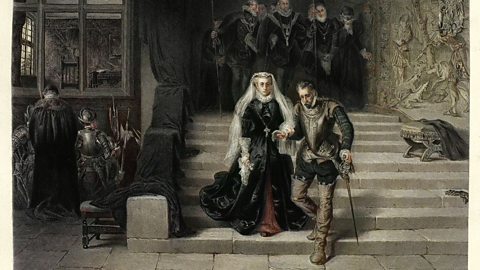
| 33 | This poem uses nature symbolically. The sea and light are used to represent fate, transition and Mary’s approaching mortality. These do not provide her with any comfort. |
Human cruelty and power
In Composed in August, Burns judges the cruelty of hunting, something he sees as needless violence against innocent creatures.
The theme of human cruelty and power is also shown in the other poems:
| Thomas the Rhymer | Human vulnerability is central as Thomas is powerless in the face of authority. In this case, the power is not human but comes from a supernatural source. |
| The Bonnie Broukit Bairn | Cruelty comes from an indifferent universe, representing an indifferent ruling class. Despite Earth being the vulnerable child and the godlike celestial bodies appearing to hold the power, we are told that Earth’s capacity to overwhelm the others with its tears suggests that humanity, in fact, holds the bulk of the power, if only it would use it. |
| Summit of Corrie Etchachan | This poem doesn’t feature any human cruelty, but power and vulnerability are clear: humanity is vulnerable in its smallness compared to the vast power of nature. |
| Da Clearance | The cruelty is political and economic as innocent families are systemically and deliberately harmed by landlords who evict them from their homes. |
| 33 | This poem demonstrates historical cruelty, and Mary is vulnerable to betrayal, imprisonment and execution. The power balance is against her, bringing about her downfall. |
Love, connection, and human relationships
Composed in August, the poem is the most joyful, connecting love to the landscape's joyful, natural beauty.
The theme of love is also shown in the other poems:
| Thomas the Rhymer | Thomas faces a perilous, supernatural love that offers no comfort. Unlike the harmony depicted by Burns, in this poem, love (or infatuation) results in a loss of agency, imprisonment, and silence. |
| The Bonnie Broukit Bairn | This poem is significant for its absence of love and connection. The neglect of Earth is key, as is the indifference of the planes. |
| Summit of Corrie Etchachan | This poem shows a connection between humanity and the landscape – there are no human relationships, except for how a person can develop their relationship with themselves by engaging in the climb. |
| Da Clearance | This poem features communal and familial love through the descriptions of shared suffering, through memory, and through community identity. |
Identity, belonging, and place
Composed in August highlights the link between identity, belonging and place. Having a personal connection with nature and your environment is presented as harmonious.
The theme of identity is also shown in different ways in the other poems:
| Thomas the Rhymer | Thomas is silenced by his interactions with the supernatural, and his identity is virtually swallowed by the Queen of Elfland. |
| The Bonnie Broukit Bairn | This poem looks at the Earth and the problems it faces: the indifference of the ruling class, the suffering and neglect of the vulnerable. If Earth can find its shared humanity, it will overcome these obstacles. |
| Summit of Corrie Etchachan | Personal identity is shaped by the intensity of the climb, the connection to the landscape, and the exploration of the self that comes with the experience. |
| Da Clearance | This poem ties personal and community identity to the land and heritage, which are under threat due to the clearances by landlords. |
| 33 | Mary’s royal identity means nothing. The natural metaphors, the sea and light, echo her fate as she walks towards death. |
Revise Composed in August by Robert Burns
Check your understanding of the poem Composed in August by Robert Burns with this interactive quiz for Higher English.
More on Higher Poetry collection
Find out more by working through a topic
- count3 of 7
- count4 of 7
- count5 of 7
- count6 of 7