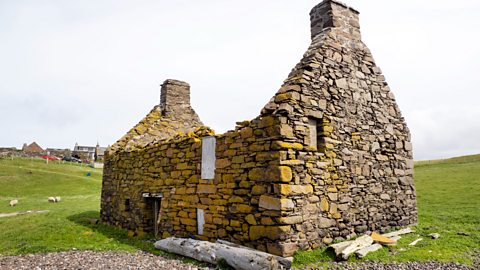
Overview of Thomas The Rhymer
- Thomas the Rhymer is a well-known tale in Scottish folklore.
- It takes the form of a ballad, a narrative poem which would be memorised and sung as part of the oral tradition.
- It's steady rhythm, rhyme and simple language make it easy to remember and understand.
- The title character in enchanted by the Queen of Elfland, who takes him away for seven years.
- The poem warns of the dangers of desire and that too much knowledge or truth can be a burden.
This poem has themes of:
- power, control, and human vulnerability
- nature and landscape
- transformation and identity
You can read Thomas the Rhymer on the Scottish Poetry Library website.
Context
Thomas the Rhymer tells the story of a real person - Thomas of Erceldoune, who lived in the 13th century. He was also known as 'True Thomas' and supposedly had the gift of prophecy and was unable to tell a lie.
The poem provides a mythical backstory for how he acquired this gift, blending folklore, supernatural elements, and a moral warning. Much as he might have had a remarkable gift, ordinary folk were to be discouraged from pursuing the supernatural instead of the godly.
The story can be seen as a warning against idleness. It begins with Thomas lazing around, when he sees a beautiful woman, who he attempts to charm. She is the Queen of Elfland and she lures him away from all that is normal to the otherworldly Elfland. Thomas is told he must stay there for seven years and must never speak a word while he is there, or he will never be able to return home.
He spends his seven years there, serving the Fairy Queen, and (presumably) returns home at the end of his time, having been given the gift of truth.
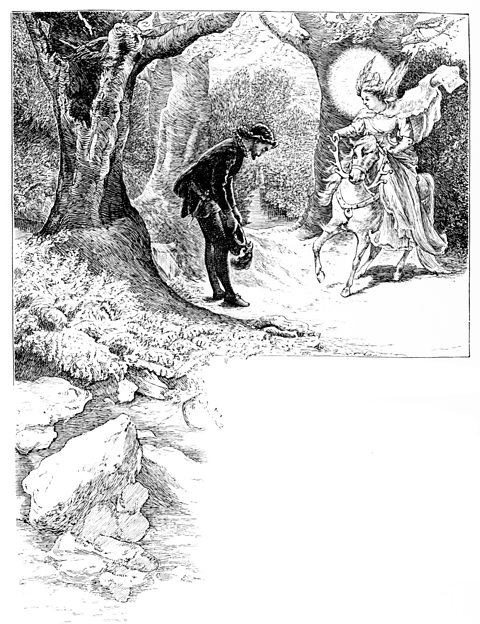
Form and structure of Thomas the Rhymer
Thomas the Rhymer is an example of a traditional Scottish ballad.
What is a ballad?
A ballad is a A narrative poem tells a story. Narrative poems do not have to follow rhythmic patterns.. It is more often used for emotional impact than for historical or factual accuracy and covers themes of love, tragedy, adventure and supernatural encounters.
As ballads were passed along orally, being sung to entertain and inform, the language was usually rhythmic and straightforward, using formulaic language to help people remember the songs and stories.
The balladeer, the singer of the song, usually adopts an impersonal narrative point of view, appearing to be detached from the events. The narrative voice seems to be retelling events without personal commentary.
Ballads often feature the use of direct speech, seeming to quote those involved in the events depicted. This adds realism and creates drama and tension for the audience.
'Thomas the Rhymer' features many elements that are typical of a ballad:
- It is written in A stanza containing four lines..
- It has an ABCB rhyme scheme.
- Generally, it has an A poetic rhythm that alternates between unstressed and stressed syllables. The rhythm is like the da-DUM da-DUM da DUM of a heartbeat. rhythm that mimics the patterns of normal speech.
- The narrative voice is an impersonal observer who does not take part in the story.
- The story is partly told through direct speech, which helps to drive the plot and creates a sense of immediacy.
- The language is simple and accessible: the piece must be easily remembered, performed and understood.
- There is a focus on the supernatural, in this case, on the tale of Thomas’s enchantment by the Queen of Elfland.
Narrative
The poem has a strong linear narrative, following Thomas through his encounter with the Queen of Elfland and their journey into a supernatural world. Thomas is tempted, taken and transformed by his encounter with the supernatural. We see the trickery of the bargain he strikes, the journey to Elfland and the dangers of idleness, being swayed by beauty, and taking risks with the supernatural world. Thomas loses his agency and suffers lasting consequences of crossing into another world.
The poem has eighteen stanzas, covering each step in the narrative:
- Stanza 1: ‘True Thomas’ is identified, lazing on a slope when he is drawn to an approaching beautiful woman.
- Stanza 2 : The woman is described as well-dressed in rich fabrics, riding a well-groomed horse. She is framed as a wealthy woman.
- Stanza 3: Thomas bows to her and praises her beauty and nobility.
- Stanza 4: The woman states that she is the Queen of Elfland, come to seek out Thomas. The reader begins to wonder what her intentions are.
- Stanza 5: The queen dares Thomas to kiss her to prove himself to her.
- Stanza 6: Thomas sees this as his fate and takes the chance of kissing her.
- Stanza 7: This stanza shows the dark side of the bargain. Thomas is enchanted and must go with her and stay in Elfland for seven years.
- Stanza 8: Thomas mounts the queen's horse and the journey to Elfland begins.
- Stanza 9: They journey far at great speed, leaving the living world, arriving in a desert land. This creates a sense of anxiety and concern for Thomas’s safety.
- Stanza 10: The queen tells Thomas to rest while she shows him three wonders.
- Stanza 11: The first of these wonders is the thorny, difficult path to righteousness, which few people choose to take.
- Stanza 12: The second wonder is the easy path to wickedness, which many people mistakenly take.
- Stanza 13: The third wonder is the little-known. alternative path to Elfland. Neither good nor evil, Elfland is an unknown quantity, a route to an unknown destiny.
- Stanza 14: A further unhappy condition of this trip to Elfland becomes clear: Thomas will be unable to speak at all while he is there, or he will never be able to go back to his home. This is a warning to never trust supernatural beings.
- Stanza 15: Their journey continues through an unfamiliar, eerie landscape, disconcerting and devoid of sun or moon.
- Stanza 16: Elfland is shown to be a frightening place. They must wade through rivers of blood shed from the human world through the darkness towards Elfland. |
-Stanza 17: Thomas and the queen arrive in a garden where, in a gesture symbolic of the Garden of Eden, the queen offers Thomas an apple. This enables him to speak only the truth. The poem does not describe Thomas’s time in Elfland in any detail, adding to the mystery and secrecy surrounding the fairy realm. | - Stanza 18: In this final stanza, we see Thomas has become part of Elfland, wearing clothes which link him to the ueqen – he is changed by the experience. He has stayed there for seven years but the ending is abrupt and makes us wonder what happened next for Thomas. We can only assume that he returns home and becomes known as the ‘True Thomas’ legend of his time. |
The narrator of the tale is not an active participant in the story. Their role is to report what has happened and share the cautionary tale without judgement. The storyteller isn’t there to judge or to moralise: the listener/reader is left to draw their own conclusions about what happened, why it happened and the message the story has to teach.
Stanzas 1 - 3: Thomas greets a fine lady
Stanza 1: Lines 1–4
True Thomas lay on Huntlie bank,
A An unusual or wondrous sight he spied wi’ his e’e.
And there he saw a ladye bright
Come riding down by the Eildon Tree.
The poem starts by introducing our main character, ‘True Thomas’, who lying idle on the ‘Huntlie bank’.
“Huntlie bank” is thought to be a real location, related to Huntleyburn House, near Melrose and the Eildon Hills. This was where Thomas Erceldoune, the man considered to be the inspiration for this legend, came from.
At the start of the ballad, Thomas is relaxed, and the tone is calm. He is lounging in the countryside, until he sees a An unusual or wondrous sight, a term often associated with the supernatural.
He sees a ‘layde bright’, who he feels an immediate attraction to.
She is riding down by the 'Eildon Tree'. This was a legendary tree in this area, likely a hawthorn. The hawthorn has a long tradition in Scottish myth and legend as a gateway to the other world, growing at Located at or on a boundary or threshold. such as wells, crossroads and ancient boundaries. As a link between the human realm and the world of elves or fairies, the hawthorn is considered to be beautiful and dangerous in equal measure.
Although Thomas is unaware, the identification of the woman as a 'ferlie' and a link between her and the 'Eildon Tree' suggest to the listener that there is something supernatural and dangerous about her.
Stanza 2: Lines 5–8
Her shirt was o’ the grass-green silk.
Her mantle o’ the velvet fyne;
At A Scots word meaning each or every.A Scots word meaning a strand, tuft or lock of hair. of her horse’s mane
Hung fifty siller bells and nine.
The second stanza provides a description of the woman. Her clothes are expensive, made of ‘fyne’ velvet and silk, and her horse wears fifty-nine silver bells hung in its mane. Together these create an image of wealth and splendour.
However, the symbolism of the colours she wears would again suggest to listeners that there is something suspicious about her: 'grass-green' suggests both nature and the unnatural, as green is associated with elves and fairies…
Stanza 3: Lines 9–12
True Thomas, he pull’d aff his cap
And A Scots word meaning to bow, bend or stoop. low down to his knee;
All hail, thou mighty Queen of Heaven!
For thy peer on earth I never did see.
Thomas behaves with An informal code of conduct expected of knights in the medieval period. Knights were expected to be brave and honest, to protect the weak, and to treat women with politeness, courtesy and respect. ; he treats the lady with the respect due to an aristocratic woman, by bowing and taking off his hat.
He then goes a step beyond what is respectful and dignified. In the role of romantic hero, Thomas ‘hails’ the lady, calling her the ‘mighty Queen of Heaven’. His hyperbolic description shows he believes she is more beautiful than anyone else – he has never seen another like her ('peer on earth').
This is a perceptive comment that suggest Thomas subconsciously recognises that she is not of this world. Because he has no other frame of reference than Heaven, he assumes this is where she has come from. This poem challenges the rigid beliefs of Christianity by providing a mythological alternative. This otherworldly attraction, along with her beauty and wealth, lures Thomas into danger. It is a warning not to be seduced by the unknown.
Stanzas 4 - 5: The Queen of Elfland sets her challenge
Stanza 4: Lines 13–16
O no, O no, Thomas, she said,
That name does not belang to me;
I am but the Queen of fair Elfland
That am hither come to visit thee.
In this stanza, the woman identifies herself and her intention: she is the ‘Queen of fair Elfland’, a place of myth and legend, and she has come to visit Thomas.
This is a turning point for Thomas: now he knows her supernatural nature, he can choose to escape. His choice not to is presumably because he is so taken by her beauty. This will have significant consequences for him.
Stanza 5: Lines 17–20
Harp and carp, Thomas, she said,
Harp and carp along wi’ me,
And if ye dare to kiss my lips,
Sure of your bodie I will be.
The queen seems to recognise Thomas as a poet or performer, shown by her repeated calls for him to 'harp and carp' (to play the harp and sing) with her.
A common element of ballas, particularly those which feature the supernatural, is the dangerous bargain which is offered to the human character. The Queen of Elfland asking Thomas to kiss her so that she can be ‘sure’ of him. Neither Thomas nor the audience is yet aware of the potential consequences of this dare.
Kissing is often symbolic in fairy and folk tales: In both 'Sleeping Beauty' and 'The Princess and the Frog', a kiss is able to end a spell or enchantment. Here the opposite happens. By kissing the queen, Thomas falls under her spell.
Before their use in fairy tales, folklore used kisses to symbolise the transfer of life force, a blessing or protection, or, as in this case, the sealing of a pact. Like the kiss between a newly-wed bride and groom, which confirms their bond, this kiss ties Thomas to the queen. Thomas, however, does not yet realise the significance of the kiss, which carries echoes of ancient ritual meaning. He unwittingly seals his fate because of his thoughtless admiration of beauty.
Stanzas 6 - 7: Thomas makes his choice and is enchanted
Stanza 6: Lines 21–24
Betide me weal, betide me woe,
That weird shall never daunton me,
Syne he has kissed her rosy lips
All underneath the Eildon Tree.
This stanza gives the first instance of Thomas’s speech since Stanza 2; it is also the last time we hear him speak. T
homas bravely exclaims that, whether it brings him a good thing (‘weal’) or a bad thing (‘woe’) he is not afraid or daunted by the prospect. His behaviour is unquestionably reckless at this point – he has made a decision to kiss the Queen of Elfland, despite inevitably being aware that this is very risky.
It is possible, however, that his decision was not a free choice: the word ‘weird’ didn’t mean then what it does now – it means your fate or destiny. Perhaps, due to some supernatural intervention, Thomas’s free will has been taken away. He certainly feels fated that he must kiss her under the tree which represents the border between worlds.
Stanza 7: Lines 25–28
Now ye maun go wi’ me, she said,
True Thomas, ye maun go wi’ me;
And ye maun serve me seven years
Thro’ weal or woe, as may chance to be.
It is immediately clear in this stanza that Thomas’s fate has been sealed. That kiss has transformed him into the lady’s captive; it has taken him across the boundary into the supernatural realm and has stolen his free will and his voice. He no longer has a choice: he ‘maun’ (must) go with the Queen, to ‘serve’ for seven years as her captive.
Using repetition that is common in ballads, she repeats what he 'maun' (must) do, and repeats his own word back to him. She makes it clear that his time with her may provide ‘weal or woe’. The suggestion is that his time in her world will neither be all good or all bad. This fits with the upcoming imagery of the three paths.
This changes the tone of the ballad: no longer relaxed, a sense of danger emerges. The hidden warnings are no longer hidden, and Thomas is now in supernatural danger. The gender roles of the time are used to create a further warning: the power of women to tempt a man, to remove him from reality and to remove his agency is a stereotypical and outdated representation of gender, where men were supposed to be the ones in charge and women with power were seen as somehow unnatural.
Stanzas 8 - 10: The journey to another world
Stanza 8: Lines 29–32
She mounted on her milk-white steed,
She’s ta’en True Thomas up behind;
And aye whene’er her bridle rung
The steed flew swifter than the wind.
Stanza eight uses colour imagery again when describing the ‘milk-white’ horse the Queen rides. The colour white is generally associated with innocence and purity. Here this is a possible second meaning.
SInce ancient times, white horses have symbolised power, danger, and the presence of another unseen world or realm. In Scottish folklore, white horses frequently belong to fairy queens, supernatural warriors, gods or spirits. The person riding them is usually not of the human world.
Because they appear at important moments, white horses often signal the unfolding of a prophecy, a moment of significant, irreversible change or the arrival of your destiny.
It is clear that the queen is in control here. In a reversal of imagery from chivalry, Thomas sits behind her, while she holds the reins. The listener is told the horse ‘flew swifter than the wind’. While the simile 'like the wind' is commonly used to describe horses, in this case, it is intended to emphasise the magical nature of the creature.
Stanza 9: Lines 33–36
O they rade on, and farther on —
The steed gaed swifter than the wind —
Until they reach’d a desert wide
And living land was left behind.
The repetition in 'rade on, and farther on’, and second mention that the horse is 'swifter than the wind' stresses that this is a journey of great distance. This suggests just how separate and different Elfland is from the world we know. They reach a ‘desert wide’ which is far from the ‘living land’‘left behind’. In contrast with the 'living land', a 'desert' is a bleak and inhospitable place, traditionally seen as devoid of life.
We are not given any further detail: this is an unknown and unknowable place which the audience can only infer is another transitional location in their journey.
Stanza 10: Lines 37–40
Light down, light down now, True Thomas,
And lean your head upon my knee;
Abide and rest a little space
And I will shew you ferlies three.
Although the audience is given no indication of the length of time this journey has taken, it has clearly been a difficult path. Thomas is told to get down from the horse and to rest upon the Queen’s lap. Repetition is used again to coax him to her and the queen promises to show him three An unusual or wondrous sight, repeating the word first used in stanza one in relation to the queen.
Video: What is repetition?
The ballad form often incorporates repetition as it makes pieces easier to sing, and remember.
Brush up on your understanding of repetition with this short Higher English revision video.
What is repetition? How and why would you use it?
Repetition, repetition, repetition!
Repeating words or phrases can really, really help make an idea more memorable. Really!
“The soup was stirred and stirred until it thickened”
If we say “the soup was stirred until it thickened”, it just gives us the facts.
Adding some repetition tells us more. Repeating the word ‘stirred’ suggests just how much time and effort has gone into the cooking.
In his most famous speech, Martin Luther King repeats “I have a dream”
“I have a dream that my four little children will one day live in a nation where they will not be judged by the color of their skin but by the content of their character. I have a dream today… I have a dream that one day every hill and mountain shall be made low”
Every repetition of this line builds on the one that has come before, reinforcing his passion and emphasising each point he makes.
Repetition can also be effective in poetry.
In his poem Visiting Hour, Norman MacCaig writes about going to see his sick wife in hospital. As he walks through the corridor he writes:
“I will not feel, I will not feel, until I have to.”
MacCaig is determined not to let his feelings overcome him. The repetition helps tell us how hard he is trying to remain numb.
Why not try adding repetition to your writing?
If you like it, you can use it again, and again, and again.
Stanzas 11 - 13: The three paths
Stanza 11: Lines 41–44
O see ye not yon narrow road
So thick beset with thorns and briers?
That is the path of righteousness,
Though after it but few enquires.
A common teaching in Christianity is that there are two pathways in life – one that is easy to navigate and the other that is challenging. The first path is shown to Thomas, and it represents the ‘path of righteousness’ – the difficult road a person has to take to live a good and just life. It is ‘narrow’ because there are strict limits on what you can do if you intend to follow a righteous path, and the ‘thorns and briars’ add to the difficulty – it is not taken by many people due to the difficulty of the road, a moral judgement on the tendency of humanity to slip into immoral behaviour.
Stanza 12: Lines 45–48
And see ye not that A Scots variation of the word broad., braid road
That lies across that lily leven?
That is the path of wickedness,
Though some call it the road to Heaven.
The second path, recognisable in Christian teaching, is the ‘path of wickedness’ – a road that seems wide and easy. The ‘leven’, or meadow, that the road traverses is full of lilies, creating an attractive picture, and the broad road suggests it is easy to travel. The ballad comments on human nature, noting that it is easy and attractive to do the wrong things, and that this is the choice that the majority take.
The comment that 'some call it the road to Heaven' could be noting that some enjoy the wickedness they choose, and that often bad choices are hidden in attractive packages. This reminds the listener of Thomas mistaking the Queen of Elfland for the 'Queen of Heaven': he was fooled by the woman's beauty, just as this attractive road fools many people travelling through life.
Stanza 13: Lines 49–52
And see not ye that bonny road
That winds about the fernie brae?
That is the road to fair Elfland,
Where thou and I this night maun gae.
However, the Queen of Elfland offers a third way, beyond the binary Christian choice between good and evil: it is a grey area, neither good nor wicked.
As a mythological figure, the Queen plans to take neither of these traditional paths. Her third path is ‘bonny’ and weaves around a 'fernie brae' - a fern-covered hill. Ferns can symbolise new life or even magic. This green hill seems related to the queen's green clothing and the path related to nature. The ballad could be suggesting that the natural world exists separately from human, Christian concepts of good and evil.
The queen tells Thomas that ‘thou and I this night maun gae’. As before this is something that 'must' be done, showing this is not a choice but a command. She uses the informal ‘thou’ form to address Thomas, presenting herself in a superior role to him: you would only use this form with someone you were familiar with or who was of lower status than you.
Stanzas 14: Thomas is silenced
Stanza 14: Lines 53–56
But Thomas, ye maun hold your tongue
Whatever ye may hear or see,
For if you speak word in Elflyn land
Ye’ll ne’er get back to your ain countrie.
Stanza fourteen adds detail to the conditions that Thomas finds himself in. Once he enters this land, he must stay silent, regardless of what he hears or sees. If he utters even one word, he will never be able to return home.
In many Celtic traditions, speech has power. By forbidding Thomas to speak, the Queen is asserting her power and dictating that Thomas must follow her rules.
It also means that Thomas has no way to reassert his agency or regain any control over his situation. Silence keeps him in a passive state. If speech is powerful, the Queen is unwilling to allow Thomas any power.
As with the nature of the third path to Elfland, the ballad does not specify if the deal Thomas finds himself part of is good or bad. The listener can reach their own conclusion about whether being able to visit this other world is worth the price of silence.
Stanzas 15 - 16: The journey to Elfland
Stanza 15: Lines 57–60
O they rade on, and farther on,
And they waded through rivers aboon the knee,
And they saw neither sun nor moon
But they heard the roaring of the sea.
The queen and Thomas set off again on their journey. Stanza fifteen begins by repeating the first line of Stanza 9. As before this is a long journey but this time the landscape they travel through is described. It seems perilous, as they are forced to wade through deep rivers.
They are in a world that seems completely alien, without the reassuring presence of the sun and moon, which normally provide light, and which can guide us. The absence establishes this as a timeless place – there is no way to mark the passage of hours, or the cycle of days and nights.
Only the rushing noise of the ‘roaring’ sea seems familiar. In Celtic folklore, the sea is another threshold between the human world and the otherworld, between the known and the unknown. This suggests that Thomas and Elfland itself are close to our reality but very different from it. The otherworld is as ancient and different as the sea. It is powerful, dangerous and disorientating.
Stanza 16: Lines 61–64
It was mirk, mirk night and there was nae stern light
And they waded through red blude to the knee;
For a’ the blude that’s shed on earth
Rins through the springs o’ that countrie.
There is further darkness and danger to follow on this journey. The repetition of ‘mirk’ emphasises just how dark the place is, and there was not a single source of light to illuminate their way. One of the most disconcerting images is of the two wading through rivers of blood, which, as we are told in the closing couplet, comes from earth: all the blood spilt there runs through Elfland.
The meaning here is twofold:
- there was too much bloodshed in medieval Scotland - wars and conflict were rife.
- humanity's savagery bleeds into everything and negatively affects the world, with far-reaching impact.
Although the otherworld and Elfland seem dark and dangerous, we are perhaps left questioning if that is necessarily the case, or if it humanity's action that has made it this way.
Stanza 17: the garden and apple
Stanza 17: Lines 65–68
Syne they came on to a garden green
And she pu’d an apple frae a tree;
Take this for thy wages, True Thomas,
It will give thee the tongue that can never lie.
This is perhaps the most obvious reflection of biblical teachings. In the Book of Genesis, Adam and Eve live innocently in the Garden of Eden, until a serpent tempts Eve to eat a fruit of the Tree of Knowledge. Eve offers the fruit to Adam. The knowledge they gain brings them a sense of shame, and God expels them from Eden for their sin.
The 'garden green' represents the Garden of Eden, and the apple suggests the fruit of the Tree of Knowledge. The Queen of Elfland is symbolically linked to Eve – she is a temptress who leads Thomas astray; she picks the apple and changes the fate of ‘True Thomas’.
Both Eve and the Queen of Elfland are considered seductive women who transgress against society’s expectations and cause the downfall of man. The Queen of Elfland picks the apple as ‘wages’ for Thomas, which could be read as another biblical allusion. If the apple suggests temptation and sin, it being offered as wages suggests the phrase 'the wages of sin is death' from the book of Romans: by taking the apple as payment Thomas could be bringing about his own rejection of Christianity and his spiritual death.
Symbolically paying Thomas with the apple gives him the gift of truth. This again links to Adam and Eve and the truth about good and evil that eating fruit from the Tree of Knowledge gave them. In the case of Thomas he is gifted with:
the tongue that can never lie
This is why, in future, Thomas is called ‘True Thomas’, and he is often presented as a prophet in the other traditional stories and poems he appears in. There is some debate about whether being unable to lie is actually a good thing: is it a blessing or a punishment?
Stanza 18: Thomas is transformed
Stanza 18: Lines 69–72
He has gotten a coat of the even cloth
And a pair of shoes of velvet green;
And till seven years were gane and past
True Thomas on earth was never seen.
At the end of the poem, Thomas appears to have assimilated into the customs of Elfland.
He is dressed like the Queen of Elfland was in Stanza 2, wearing rich clothing and green velvet shoes, showing his new closeness to nature and the supernatural world he inhabits.
There is no indication of how Thomas’s story ends. It seems that until ‘seven years were gane and past’ Thomas has been missing from the earthly realm. It is unclear what has happened to Thomas, but it suggests he is seen again only after those seven years had passed. This implies he kept his part of the bargain, and did not speak during his time in Elfland.
The ending is so sudden and unexplained that we are left with many questions about what happened to Thomas and what the long-term consequences were for him.
Themes and comparisons with other poems in the collection
Power, control, and human vulnerability
In Thomas the Rhymer, Thomas,is powerless in the face of the supernatural power and control of the Queen of Elfland. He loses his own control, being swayed by her beauty and, as a result, is tempted, taken and transformed by supernatural forces beyond his control.
The themes of power, control, and human vulnerability are also shown in the other poems:
| Composed in August | The cruelty of the hunters demonstrates man's violent power over the animals, This is in contrast to the rest of the poem, which emphasises the beauty and harmony of how man and Nature should live together. |
| Bonnie Broukit Bairn | Earth, representing the working class and vulnerable members of society, is insignificant in the face of the cosmos. However, should Earth decide to rise up or show how it feels, it would have the power to overwhelm those seemingly powerful, controlling figures. |
| Summit of Corrie Etchachan | This poem shows how the speaker is dwarfed by the sheer scale of the mountain. The speaker’s vulnerability in the face of nature's insurmountable power prompts reflection. |
| Da Clearance | Vulnerable and innocent communities are overwhelmed by the power of the landlords who evict them unfairly. Control is solely in the hand of the landowners and families are powerless against them. |
| 33 | This describes how Mary Queen of Scots, despite being a Queen, was vulnerable to betrayal and has fallen from her position of power. |
Nature and landscape
Thomas the Rhymer shows that nature is dual natured: it is both beautiful and dangerous.
The Eildon Tree is a border between humanity and the supernatural and the pathways to heaven, hell and Elfland use the landscape to show the different choices which face humans in their pursuit of moral goodness.
The themes of nature and landscape are also shown in the other poems:
| Composed in August | Nature is mostly harmonious, verdant, and abundant – it is a source of joy and a place to love. However, duality also exists here, as there is danger in this landscape, brought by humanity’s cruelty. |
| Bonnie Broukit Bairn | Nature is depicted by the celestial bodies which, apart from Earth, are vast and indifferent. They represent world leaders, and in comparison, Earth is insignificant. Earth is described as beautiful but neglected, symbolising how little care is shown to the environment. However, if Earth were to weep, there would be far-reaching consequences — illustrating how natural disasters could alter the planet, and also how, if people were to rise up, they would be powerful against those who neglect them. |
| Summit of Corrie Etchachan | This poem emphasises the majestic scale of nature and how spiritually elevating it can be to reflect upon the power of nature. |
| Da Clearance | Communities are bound to nature as it is a source of stability, family and identity. The land they live on is precious to them, and they belong on it. However, it does not belong to them and as a result, their safety is threatened. |
| 33 | Nature appears in the form of symbols: the sea and light are used to demonstrate themes of fate and mortality. |
Transformation and identity
In Thomas the Rhymer, Thomas is transformed by his time in Elfland. He has returned, permanently altered, having been given the “gift of truth” after his seven years in Elfland. He has been silenced and has his agency removed and is permanently altered.
The themes of transformation and identity are also shown in the other poems:
| Composed in August | This poem shows how the speaker’s identity is shaped by love and nature, which is only heightened by the contrasting exposure to human cruelty in the middle of the poem. |
| Bonnie Broukit Bairn | This poem uses identity symbolically: the planets are identified as having human characteristics in order to show how society is controlled by uncaring elites who neglect the vulnerable. |
| Summit of Corrie Etchachan | By facing the immensity of the Summit of Corrie Etchachan, the speaker’s identity is shaped through reflection and their connection to the vast landscape. |
| Da Clearance | Through the process of clearing the land for sheep, community identity is threatened by the landlord’s displacement of the community and the loss of their homes and land. |
| 33 | Mary’s identity is connected to her destiny and her ultimate death. The poem explores how a woman like Mary becomes a symbol; how her real voice is lost and overshadowed by the stories told about her. This poem seeks to give Mary an identity. |
Revise Thomas the Rhymer by Anonymous
Revise Thomas the Rhymer by anonymous with this interactive quiz for Higher English
More on Higher Poetry collection
Find out more by working through a topic
- count7 of 7

- count1 of 7

- count2 of 7
- count3 of 7