Overview of Summit of Corrie Etchachan by Nan Shepherd
- Summit of Corrie Etchachan by Nan Shepherd is a poem describing a climb to the Cairngorm plateau and Corrie Etchachan.
- The Cairngorm plateau is a large, flat area some 1000 metres above sea level.
- It has weather, plants and wildlife usually found in the Arctic and can be an inhospitable, desolate environment, as described in this poem.
- The poet compares this mysterious environment with the human mind.
This poem has themes of:
- the duality of human experience
- journey and achievement
- nature and place
You can read Summit of Corrie Etchachan by Nan Shepherd on the Scottish Poetry Library website.
Context
Nan Shepherd (1893 - 1981) was a Scottish writer who focused very much on the outdoors and the natural world, often finding philosophical meaning and an understanding of self through being outdoors in Scotland. She wrote prose and poetry as well as a memoir about her experiences hill-walking in Scotland called The Living Mountain.
In The Living Mountain she talks about climbing to Loch Etchachan, which is a loch within Corrie Etchachan. A corrie, from the Gaelic ‘coire’ meaning ‘cauldron’, is a steep-sided, armchair-shaped hollow in the side of a mountain, carved by the head of a glacier.
Corrie Etchachan is part of the Cairngorm plateau. The Cairngorm plateau is a large, flat area some 1000 metres above sea level and one of the highest areas of land in the UK. Although it is home to a number of plant and animal species, the climate is extreme and the landscape can appear lifeless and forbidding. Above the plateau are the higher peaks of the Cairngorms, including Ben Macdui, the second highest mountain in Britain.
The poem, then, describes the climb to the plateau and to Corrie Etchachan. We usually use the word ‘summit’ to refer to the peak of a mountain but here the destination of the climb is a hollow surrounded by mountains, other than the typical steep point with views of the countryside all round. Shepherd uses that difference to contemplate both this mountaineering challenge, and that of the mind, turning more philosophical and universal as the poem goes on.
Learn more about corries and Scottish landscape:
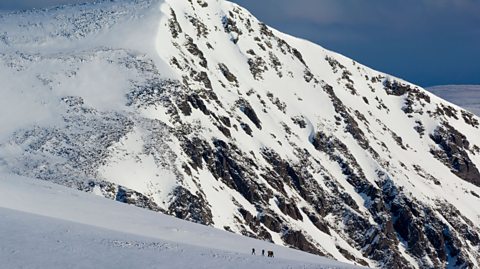 Image source, Alamy Images
Form and structure
- The poem is fourteen lines long.
- It is written in free verse - it has no regular rhyme scheme or rhythm. This matches the changing thoughts of the speaker as they climb the mountain, and the unpredictability of the landscape and journey.
There are definite stages to the poem's structure:
- The speaker recalls the effort of climbing up to this point
- The speaker contemplates their surroundings on reaching the plateau
- the speaker reflects, comparing a physical challenge to a mental one, and the corrie landscape with the landscape of the human mind.
Lines 1-5
The poem starts with the word ‘But’ - suggesting we are joining the speaker mid-thought, part of the way through their climb.
But in the climbing ecstasy of thought,
The continuous verb ‘climbing’ again suggests an ongoing action or movement, in this case an ascent up a difficult slope. 'Climbing' is also used in reference to 'ecstasy', describing heightening emotion. This is a sort of The use of two different meanings of a verb (or other word) to modify two different words, establishing a connection between them. , in this case connecting the physical climb and increasing sense of joy that the speaker is feeling.
The use of 'ecstasy' could relate to the speaker's physical and mental state. On one hand, strenuous activity is said to release endorphins in the body which can give people a feeling of euphoria. It could also suggest that, as the speaker climbs the mountain, their happiness and sense of achievement is increasing.
'Ecstasy' also suggests the idea of the The impact that art, nature or beauty can have on an individual.. This is the concept, explored by Romantic poets such as Keats and Wordsworth, that being in the natural world can create feelings of awe and wonder, that lead one to reflect deeply on their own place in the greater scheme of existence. This foreshadows the reflective thoughts that come later in the poem.
Ere consummation, ere the final peak,
Using the archaic, almost biblical form ‘ere’ instead of ‘before’, and repeating it, makes this sound like an incantation. The word ‘consummation’, meaning completion, is usually used in reference to sexual intercourse which gives a different connotation to the ‘climbing ecstasy’ in the previous line. This double entendre continues with ‘final peak’, which could refer to the mountain, or again to sexual climax. By linking mountain climbing, sex and the thoughts of the speaker, Shepherd suggests there is something very powerful in this experience.
Come hours like this. Behind, the long defile,
In the third line, we pivot to a negative description of the hard climb that has gone before this ‘ecstasy’. The speaker reminds us that it have been ‘hours’ of ‘long’ slog. The earlier description of joy has been the exceptional moment, contrasting with the long effort involved in reaching this point. Highlighted by enjambment, a defile is a long narrow gorge between two mountains. The word ‘defile’ is more commonly used as a verb, meaning to spoil something or make it impure. Again this archaic, biblical word suggests overcoming something unclean or immoral.
The phrase continues into lines four and five, giving a detailed description of the landscape. The length of the phrase reflects the long climb to the summit.
The steep rock-path, alongside which, from underSnow-caves, sharp-corniced, tumble the ice-cold waters.
The poet uses The repeated use of the ‘s’ sound in the beginning, middle or end of nearby words. (a form of alliteration) and The repetition of vowel sounds in a series of two or more words. to build up a bit of rhythm which is then released with 'tumble the ice-cold waters".
- 'Steep rock-path" sounds severe and hard to climb
- ‘Snow-caves’ sounds almost mythical
- ‘Sharp-corniced’ alludes perhaps to ice features in the cave and sounds sinister and threatening.
- The ‘waters’ are ‘ice-cold’, which again suggests danger and discomfort.
- The ‘tumble’ of the waters makes them sound almost solid, stressing how cold and close to freezing they are.
This sums up the physicality of the journey the climber has taken, which has been hard but also beautiful. There is playfulness and layers of meaning and reference throughout this first section of the poem.
Video: What is alliteration?
Shepherd uses sibilance and alliteration in her descriptions of the landscape.
Brush up on your knowledge of alliteration with this short video for Higher English.
What is alliteration? How and why would you use it?
Alliteration
A series of words beginning with the same consonant, used to emphasise a point or create a mood.
Tongue twisters are an obvious example:
Peter Piper picked a peck of pickled peppers.
Try saying that ten times fast!
Using alliteration with certain letters can really build a mood, like how the W s in ‘whispering wind’ create a setting that is soft and airy, or the harsh R’s in ‘raging river rapids’ help us picture the fast-flowing and ruthless water.
Alliteration can get your point across by appealing to a reader’s sense of hearing.
“The bass notes boomed into his very bones”
Here, the alliteration of the letter “B” mimics the deep sound of the bass and emphasises the volume of the music. The repeated ‘B’ sound suggests a musical rhythm we can feel when we read the sentence.
In the poem ‘My Rival’s House’ by Liz Lochhead, whose name is also alliterative, the speaker is visiting her new lover’s mother for the first time.
She is served tea with: “Silver sugar-tongs and silver salver”
Lochhead’s mother-in-law is trying to intimidate her by serving tea on decorative silverware.
The repetition of the letter S almost sounds like the hiss of a snake, suggesting the threat that lies underneath the shiny surface of this seemingly harmless scenario.
Try topping off your text with the terrific technique that is alliteration!
Lines 6-11
The next section of the poem celebrates the climber reaching their goal – in this case the floor of the corrie and the loch it contains.
And now, here, at the corrie’s summit, no peak,
The word ‘summit’ is slightly misleading as it’s not the top of the mountain ('no peak'), but the top of this section of the plateau and the end of their climb. This is their summit - their top level of achievement.
No vision of the blue world, far, unattainable,
The ‘blue world’ refers to the view from a more typical ‘peak’. It suggests being surrounded by the sky but might make the reader think of the Earth, the blue planet, seen from space. This could be an allusion to how high up one feels on top of a mountain and how much one can see from there.
The words ‘far’ and ‘unattainable’ emphasise how distant a climber feels on a high peak from the land below - ‘unattainable’ is particularly ironic as that is probably how most of us feel about a high mountain peak when viewed from the blue world below.
But this grey plateau, rock-strewn, vast, silent,
The speaker then reflects on the view from their summit. Starting the line with 'But' links back to the start of the poem, and the feeling of ecstasy described there.
The phrase ‘this grey plateau’ deliberately echoes the structure of ‘the blue world’ in the previous line. This emphasises the contrast.
This 'rock-strewn, vast, silent' landscape seems desolate and lifeless. It perhaps brings to mind the surface of the moon or a dead planet, in contrast to the view of Earth.
The dark loch, the toiling crags, the snow;
The mention of the loch reminds us this is Scotland but ‘dark’ suggests mystery, possibly alluding to the dangers of lochs in folklore. Lochs like this were said to have kelpies who would drag you down into their depths, and drown you.
There follows interesting Personification is when a writer gives human characteristics to something that isn’t human. of the craggy rocks, perhaps it is imagined they have climbed here too, or that it takes great effort for them to stand tall here. This mirrors the human effort described earlier.
The word ‘toiling’ again suggests hardship, adding to the picture of an unforgiving landscape. The word choice ‘snow’ is simple and unadorned but it adds to the monochrome picture of black, white and grey, and the unforgiving cold and hardship.
A mountain shut within itself, yet a world,
‘A mountain shut within itself’ alludes to the strange landscape and the feature of the corrie. This hollow in the side of the mountain, surrounded by rocky walls is almost the opposite of an exposed, pointed mountain top. The corrie is closed off, private, separate. In The Living Mountain, Nan Shepherd describes her feelings on discovering this:
‘The end of a climb meant for me always the opening of a spacious view over the world: that was the moment of glory. But to toil upwards, feel the gradient slacken and the top approach, as one does at the end of the Etchachan ascent, and then find no spaciousness for reward, but an interior – that astounded me … a mountain has an inside’ – The Living Mountain
This is what the speaker is describing in this part of the poem. Although the space is enclosed, and only known to someone who climbs up there, it is also huge enough to be considered 'a world'. To the speaker, the surroundings are comparable to the whole concept of 'immensity', as if merely describing them as 'immense' would not fully capture their scale and significance to the speaker.
Lines 11-14
In the second part of line eleven, Shepherd turns to the main theme of the poem.
So may the mind achieve,
The speaker compares the human mind to this unearthly landscape. Placing the word ‘achieve’ at the end of the line for emphasis, we are reminded of the reward for all the climbers' hard work. The message appears to be that, just as the effort of climbing ends with a feeling of ecstasy and wonder, so too can intellectual effort allow you to see and appreciate things that others cannot.
To reinforce this connection, line twelve we have the second use of the word ‘toiling’. It is placed at the start of a line and after the word ‘achieve’, suggesting success built on effort. Like the ‘toiling crags’ above, perhaps this is long lasting and momentous.
Just as the view from this mountain summit is very different from the view seen from a mountain peak, the poet is clear that mental effort will bring 'no vision of the infinite'. The phrase echoes the earlier line, 'No vision of the blue world, far, unattainable'.
But a vast, dark and inscrutable sense / Of its own terror…
The word ‘But’ is a turning point. This is the third use of ‘But’ to start a line in the poem, and it links back to the initial feeling of ecstasy, and to the speaker observing the grey plateau around them. Intellectual effort brings both euphoria and a sense of awe.
Line thirteen repeats the words ‘vast’ and ‘dark’ that described the summit of the corrie. .The view brings a sense that is ‘inscrutable’. This means that something is ‘difficult to understand’ or ‘mysterious’, suggesting that the process of thought and reflection will never bring full understanding…
Of its own terror, its own glory and power.
The poem finishes with a powerful last line, repeating ‘its own’ to perhaps remind the reader we are talking about the mind’s achievements, and the feeling or ‘sense’ this creates in a person, after all the hard work. Again, we are reminded of the summit of the climb, in the chosen words
- ‘terror’
- ‘glory’
- ‘power’
These are all huge words with real significance and gravitas but they reveal the mixed emotions around climbing the mountain, or achieving something difficult in one’s life or ‘mind’. The words are also imbued with the awe of the sublime, the connection between being out in nature and feeling this overwhelming sense of wonder and connection.
This last line draws together the different aspects and stages of the poem, from the climb and its unexpected summit to a more philosophical comparison with intellectual achievements and the rewards of inner reflection.
Themes and comparisons with other poems in the collection
The duality of human experience
The human experience in this poem is the realisation that comes towards the end of the poem, that life is a mixture of darkness and light, good and bad, hard work and reward, but this train of thought is sparked by the walk up the mountain.
The stages of the poem make sense in that Shepherd first pays attention to the climb itself and the surroundings. Straight away we are aware of the dual nature of this activity as:
- there is ‘ecstasy’ but it is ‘long’
- it takes ‘hours’ the climb is ‘steep’
The middle section of the poem deals with the achievement of reaching the destination but again there are mixed feelings as it is not what is expected:
- ‘no peak’
- ‘a mountain shut within itself’
The terrain is harsh but spectacular:
- ‘vast’
- ‘immensity’
- ‘rock-strewn’
- ‘toiling’
Shepherd puts this experience together with the duality of life experience and how difficult it can be to achieve anything, but that the end result is worth it. The mind is also ‘toiling’ without a clear reward like the view at the top of a mountain – ‘no vision of the infinite’ – and it can seem ‘dark’ and ‘inscrutable’, so difficult to understand. The final words are all extreme words but conflicting, perhaps like life and human experience itself:
- ‘terror’
- ‘glory’
- ‘power’
The theme of duality is also shown in the other poems:
| Thomas the Rhymer | We see contrasting images of beautiful countryside with desert and ‘red blude to the knee’. The real location of the opening gives way to Elfland, a magical realm where entirely different rules apply. |
| Composed in August | A clear contrast is made in between the idyllic walk with a loved one and the ‘murder’ of innocent birds in shooting season. |
| The Bonnie Broukit Bairn | The speaker contrasts the beauty of the galaxy with neglect on Earth, showing that humanity has much to offer but is currently suffering under the rule of the elites. |
| 33 | The metaphor of light and dark is used throughout this poem, highlighting Mary's previous power, where she now has none, and the obvious duality of life and death. |
| Da Clearance | The contrast between the crofting community and firstly, the landlord's men, who speak in English and act with force is clear. Secondly, the state of the land in the final stanza, which is overgrown and unloved after the people have been cleared, creates a direct comparison with the previous idyll. |
Nature and place
This poem has a very specific setting on the Cairngorm Plateau. The geographical feature of the corrie in the high plateau intrigues the poet. The descriptions of the place are very vivid -
- ‘dark loch’
- ‘toiling crags’
- ‘A mountain shut within itself’
However, they are also unromantic:
- ‘grey plateau’
- ‘rock-strewn’
- ‘no vision of the blue world’
But we still get the impression that this place, and the act of getting there, are special to the poet:
- ‘climbing ecstasy’
- ‘consummation’
- ‘yet a world’
At least part of what is special about all of this is being out in nature and the beauty and grandeur of this:
- ‘immensity’
- ‘snow-caves, sharp corniced’
- ‘vast’
We get a clear impression of the nature and the place and Shepherd’s relationship with it and her enthusiasm for it is both tangible and inspiring.
The themes of nature and place are also shown in the other poems:
| Da Clearance | There is also a real, clear place – a rural crofting community - described very vividly both when it was vibrantly occupied, and now it is desolate and overgrown. |
| Composed in August | This describes a rural walk in nature, in a place clearly known to Burns. He focuses particularly on the birds which occupy the area, and the cruelty of the hunters disrupting this idyllic scene. |
| Thomas the Rhymer | Again, we are presented with a real location and in contrast to this, a fairytale or magical realm. Nature is not to be trusted in this poem - as the very environment around us may be enchanting. |
| The Bonnie Broukit Bairn | The place is our planet, Earth, and how it fits into our galaxy, provoking us perhaps to think about taking better care of it. |
Humanity
Perhaps the clearest comparison to all other poems in this collection is that they all comment on humanity, particularly the idea of taking wider, more universal significance from a very individual experience.
In Summit of Corrie Etchachan it is the personal experience of climbing in nature and discovering a surprising ‘summit’ and considering how this is similar to achievements of the mind and how they can be equally surprising and profound.
The theme of humanity is also shown in the other poems:
| Da Clearance and 33 | Although these poems are written about real historical events, the poems expand to comment on wider issues of religion, power, greed and loss. |
| Composed In August | Burns describes his own experience of walking in nature, but muses on the universal effect of humans on the natural world. |
| Thomas the Rhymer | The folkloric story in the ballad isn't a personal story - it's a story that will be shared in a community, with wider comments on morality and religion. |
| The Bonnie Broukit Bairn | MacDiarmid deals only with the universal, by using the planets to discuss big themes such as power, class and morality. However, he does this by likening the Earth to a beautiful, but neglected, child. Personifying the Earth as a small child in this way makes the universal feel very small and personal at the same time. |
Power and morality
The moral message in Summit of Corrie Etchachan is that hard work and toil, whether physical or philosophical, will yield a great reward.
The themes of power and morality are also shown in the other poems:
| The Bonnie Broukit Bairn | We see the planets as the Roman gods they are named after, to emphasise their awesome power. Earth, like the tenants in Da Clearance, is presented in contrast as vulnerable. |
| 33 | Mary's power, her throne and title, are no use to her now as she has been sentenced to death. The poem references her previous power and status and how she has fallen to this desperate point. |
| Thomas the Rhymer | The power here is magical - the Queen of Elfland and the laws of that realm hold so much power over Thomas. However, the decisions to doff his cap and kiss her are his, and he gives his power up willingly. |
| Composed in August | The cruelty of the hunters demonstrates man's violent power over the animals, This is in contrast to the rest of the poem, which emphasises the beauty and harmony of how man and Nature should live together. |
| Da Clearance | The historical event of the Clearances showed the abuse of power by the landlords over their tenants. |
Revise Summit of Corrie Etchachan by Nan Shepherd
Revise Summit of Corrie Etchachan by Nan Shepherd with this interactive quiz for Higher English
More on Higher Poetry collection
Find out more by working through a topic
- count5 of 7
- count6 of 7
- count7 of 7

- count1 of 7