Overview of The Bonnie Broukit Bairn by Hugh MacDiarmid
- The Bonnie Broukit Bairn is a A genre of poetry which focuses on expressing a speaker’s most personal thoughts and emotions. It originated in Ancient Greece and was often set to the music of the lyre, hence the term ‘lyric’. written by Hugh MacDiarmid in 1925.
- MacDiarmid was a Scottish poet, journalist, essayist and political figure.
- In this poem, the speaker looks at the sky and observes planets and the moon, viewing them as aristocratic, self-absorbed figures.
- This poem does not have a conventional narrative. It presents a moment rather than a sequence of events.
Each reader will interpret what a poem means to them in their own way. Everyone's response is different. While The Bonnie Broukit Bairn may reflect Hugh MacDiarmid's personal beliefs, the reader can separate the poet from the words of the poem and think about how they contribute to wider themes or feelings.
The poem explores themes of:
- the insignificance of humanity compared to larger forces
- the limits of human understanding
- innocence versus harsh reality
You can read The Bonnie Broukit Bairn by Hugh MacDiarmid on the Scottish Poetry Library website.
Context
Hugh MacDiarmid published this poem after World War I. Having served in the Royal Army Medical Corps, MacDiarmid had seen much of the horror and futility of war, and this impacted:
- his outlook on life
- his personal philosophy
- his political views
He believed that the world needed radical change, that Scotland should be an independent country, and that socialism was a solution to the world’s political problems.
MacDiarmid also believed that Scottish culture, identity, and language should be championed. He believed in the importance of Scotland's unique voice being represented broadly in the literary world.
He was an integral part of the A literary movement of the early to mid-20th century that revived Scottish literature through modernism, political nationalism, and the use of Scots., and he believed that the Scots language was a pathway to national confidence. He wrote predominantly in the A variety of Scots dialect, usually from the Scottish lowlands. It is also known as literary Scots. dialect of Scots, which was part of what MacDiarmid called 'synthetic Scots'. He often borrowing words from dictionaries and older literary works, an act he saw as reviving the language. Often he would mix the two, creating a lively combination of The language or dialect spoken by the ordinary people of a country or region. language, and words the reader would likely have to look up to understand their meaning.
MacDiarmid was also a European modernist and believed that Scotland must not only focus on its roots and culture but also be modern, revolutionary and outward-looking.
The Bonnie Broukit Bairn can be seen to represent a number of MacDiarmid's beliefs and concerns:
- it presents the effects of war
- it mourns for lost innocence
- it critiques the elites who he believes are disconnected from the horror of war, and the damage inflicted on the world by world leaders
- it stresses the power of ordinary people to rise up and 'drown' or overthrow these elites.
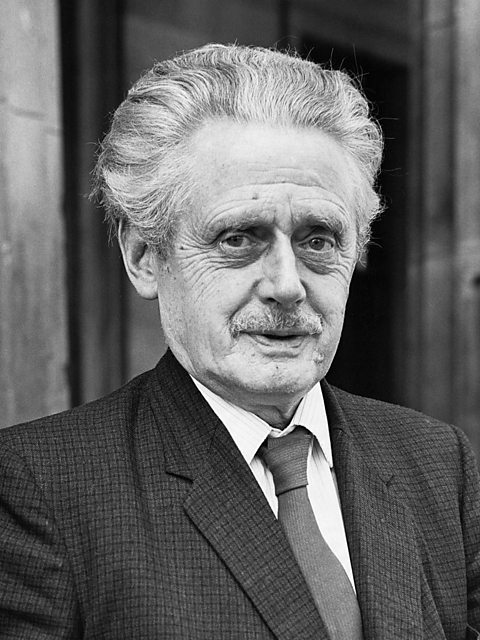 Image source, Getty Images
Narrative
 Image source, Getty Images
As this poem is a A genre of poetry which focuses on expressing a speaker’s most personal thoughts and emotions. It originated in Ancient Greece and was often set to the music of the lyre, hence the term ‘lyric’., it is an expression of feelings, or ideas, rather than a sequence of events.
This poem does not have a conventional narrative: it does not tell a story, show characters or events developing, nor does it have a conventional beginning, middle, or ending.
Instead, it is essentially a cosmic observation in which a speaker looks at Mars, Venus, and the moon, viewing them as aristocratic, self-absorbed figures. The speaker presents them as indifferent to the vulnerability of planet Earth. This perspective is what drives the poem.
The poem moves through a range of ideas:
- describing the glamorous, careless planets
- dismissing their empty, vacuous talk
- a direct address to Earth
- a final emotional moment with a defiant ending
MacDiarmid rejects conventional narrative structures in order to achieve his philosophical purpose. His focus moves us away from plot and towards thought. This reflects MacDiarmid’s modernist interest in ideas rather than events.
Image source, Getty ImagesLines 1-3
Mars is braw in crammasy,
Venus in a green silk goun,
The auld mune shak’s her gowden feathers,
Mars and Venus are two of the planets that are easiest to see with the naked eye. Along with the moon they are among the brightest objects in the night sky.
These celestial bodies are observed from below, emphasising their assumed superior, godlike status. They are described as being richly dressed and possibly imperious or regal in the night sky.
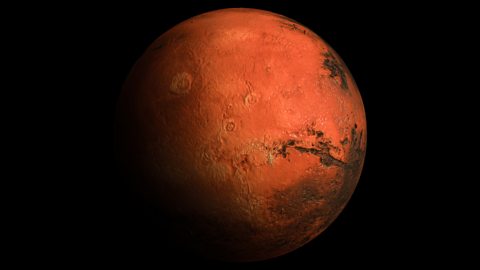 Image source, Getty Images
Mars
The first sentence is a strong declaration. MacDiarmid’s Personification is when a writer gives human characteristics to something that isn’t human. compares the planet to the Roman ‘god of war’ it is named after, giving it the same characteristics.
The planet is personified as wearing crimson and looking fine. The choice of 'crimson' rather than red creates a great sense of grandeur. Crimson was historically considered a regal colour and was often used in royal clothing and religious robes. The colour is also associated with high status, wealth, and luxury.
More broadly, red is associated with anger, danger, and warfare, linking to the mythology and features of the god Mars. The god’s traits (strength, aggression, masculine drive, and military power) are transferred onto the planet itself.
The word ‘braw,’ is emphasised through the use of The repeated use of the ‘s’ sound in the beginning, middle or end of nearby words. at either side of it in "Mars" and "cramassy". This short word starting with a Plosive sounds are made by suddenly releasing air that has been blocked by various parts of the mouth. The sounds /b/, /d/, /t/, /p/, /k/ and /g/ are all plosives. 'b' sound, is emphasised by its position in the middle of the line, and by the contrast with the softer sounds around it. The Scots word and the planet's grandeur are highlighted at the same time.
Image source, Getty ImagesVenus
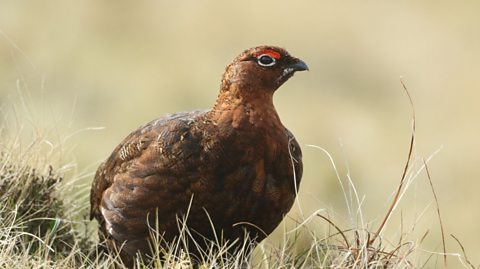
The second celestial body referenced is the planet (and Roman goddess) Venus, who is dressed in green silk. Although not scientifically accurate, the use of ‘green’ to describe Venus’s colour is significant. While Venus is actually yellowish-white in colour, this characterisation adds symbolic meaning: green has connotations of both money and envy. The silk she wears, as a rich, expensive and possibly decadent fabric, highlights her alluring, elegant and luxurious appearance. This continues to reinforce the speaker's portrayal of these planets as being aloof, aristocratic figures, unconcerned with the vulnerable Earth.
The moon
The moon, in keeping with historical and cultural precedents, is portrayed as a female character. She is depicted as an older woman wearing golden feathers, ostentatiously shaking them. These ‘gowden feathers’ continue the idea of wealth and aristocracy… Gold is, of course, synonymous with wealth and status, and feathers would be worn as a deliberate display of fashion, luxury and display.
Video - What is personification?
The speaker Personification is when a writer gives human characteristics to something that isn’t human. the planets, Mars and Venus, by describing them dressed in ‘crammasy’ and ‘green silk’ clothing.
Brush up on your understanding of personification with this short Higher English revision video.
What is personification? How and why would you use it? Bitesize explains with examples from ‘Home’ by Iain Crichton Smith.
Personification
Giving an inanimate object human feelings or actions.
“The thirsty flowers seemed to reach out and beg for water.”
The flowers can’t actually move or beg, but by personifying them, their need is made more human and understandable.
As well as actions, like moving or speaking, personification can also attribute a human feeling to an object.
“The apple sat, proud as punch, at the top of the fruit bowl”
The personification of the ‘proud’ apple, and its prominent position in the fruit bowl makes it seem more appealing.
Without the personification, this would just be a description of a lifeless scene.
Describing objects as if they are people is a way to make sentences more exciting.
In Iain Crichton Smith’s short story ‘Home’, he uses personification to describe how a street has changed:
“Instead of small shops, supermarkets were springing up, flexing their huge muscles”
The personification here tells us that the supermarkets are an intimidating addition to the town.
Their “huge muscles” represent their wealth and the power that these big businesses have over smaller rivals, and the fact they are “flexing” tells us they are flaunting this power, or showing off.
The personification paints a striking image, and means the writer can avoid a long explanation of business economics.
Why don’t you try bringing your writing to life with personification?
It can really make it sing!
Lines 4-6
Their starry talk’s a wheen o’ blethers,
Nane for thee a thochtie sparin’
Earth, thou bonnie broukit bairn!
After the first three lines, which seem to praise and celebrate the planets, the fourth line punctures their self-importance immediately. Their ‘talk’ is described as being ‘starry’, which has multiple :
- being related to the stars
- their celebrity
- being pretentious, inflated and idealistic
- not rooted in reality
- meaningless chatter
This is further emphasised by their conversations being described as ‘a wheen o’ blethers’ – a lot of nonsense. These planets are brash, aloof and ostentatious. Their shallow conversations contain nothing of meaning or significance. None of these personalities spares any thought for Earth. It seems significant that Scots words are used to mock these bodies.
The speaker then shifts focus to Earth. Rather than observing and judging, as he did with the planets, the speaker uses A direct address to an inanimate object, abstract concept, a god, or a person who has died. It is similar to personification, as it involves treating an inanimate object or idea as if it was a human capable of understanding. to speak to Earth. This suggests a sense of equality that ties in with MacDairmid's socialist beliefs. It could be that the Earth stands in for ordinary, working class people, and the poet is speaking to them while judging the upper classes.
Addressing the Earth, the speaker calls it the ‘bonnie broukit bairn’ of the poem's title.
- the word ‘bonnie’ is affectionately used in Scots to suggest goodness, charm, or spirit
- the word ‘broukit’ means soiled, dirty, or blackened with soot, possibly neglected.
- ‘bairn’ is a Scots, and Northern English, term for child.
The speaker's use of contrast is effective in To place two or more ideas/images close together to create further meaning for an audience. beauty and grandeur of the planets with neglect of Earth. It suggests that humanity has much to offer but is currently suffering under the rule of the elites.
This also mirrors MacDiarmid's views of Scotland – as a ‘bonnie’ but neglected part of the United Kingdom, largely ignored by those who watch over us: governments; the aristocracy and the monarchy. The speaker concludes this with an exclamation to emphasise their condemnation of this neglect and to rebuke the planets for their lack of care and appreciation.
Lines 7-8
In the final two lines, the speaker creates a twist, where Earth’s power is acknowledged. This is introduced with an emphatic ‘But’. This indicates the contrast to come.
– But greet, an’ in your tears ye’ll drown
The haill clanjamfrie!
Despite being the lowliest of the planets discussed, Earth’s impact could be massive if it chose to 'greet', to cry the tears it is entitled to. The tears of the Earth will ‘drown’ the others, overwhelming the god-like, upper-class characters. ‘Clanjamfrie’ is a Scots word meaning a crowd of people or a collection of worthless items/junk. This To place two or more ideas/images close together to create further meaning for an audience. is a strong statement which shows that the Earth is resilient and strong.
These final lines act like a call to action; the speaker suggests the Earth could respond to its neglect by expressing its hurt. Written in 1925, so soon after world events like the Easter Rising in Ireland, and the Russian Revolution, this could be read as MacDiarmid's call for some type of revolution.
Themes and comparisons with other poems in the collection
The significance of humanity
In The Bonnie Broukit Bairn, MacDiarmid sets the vulnerable child, Earth, against the haughty, indifferent celestial bodies of the cosmos, showing Earth to be tiny and fragile:
Earth, thou bonnie broukit bairn!
However, in its humanity, it is also shown to have the power to overthrow those larger forces.
in your tears ye’ll drown / The haill clanjamfrie!
The relative significance of humanity is also shown in the other poems:
| Thomas the Rhymer | Thomas is the vulnerable one, powerless in the face of the magic of the Fairy Queen. His power is futile against a supernatural force which he cannot comprehend. |
| Composed in August | Robert Burns shows humanity to be but a small part of the natural order of the world. Nature is gentle and abundant, and humans are simply a small part of that harmony. |
| Summit of Corrie Etchachan | In Summit of Corrie Etchachan the mountain completely dwarfs the human being. This formidable landscape once again demonstrates how small and humble humanity is compared to the mountain's vastness. |
| Da Clearance | The lives of the human inhabitants of the landscape are shaped by forces beyond their control – forces which are both historical and economic. In the face of this, the people who live there are extremely vulnerable to displacement. |
| 33 | MacGillivray shows that human existence is fragile. In this case, unseen political forces and what feels like fate bring Mary to her inevitable death. The poem focuses on the dread of death, and as the ship moves with unstoppable force, Mary’s fearful vision highlights how inescapable her fate is. |
The limits of human understanding
In The Bonnie Broukit Bairn, the planets, as representatives of the upper class, demonstrate their inability to understand the plight of the workers and those who suffer at war.
Nane for thee a thochtie sparin’
The neglect is a warning about what will happen if more care is not taken - we must understand more about the most vulnerable among us.
The limit of human understanding is also shown in the other poems:
| Thomas the Rhymer | Thomas is unable to understand the risk he takes when doffing his cap to the Queen of Elfland, and the danger he faces by taking the kiss that will bring him into seven years of silence in Elfland. |
| Composed in August | Burns demonstrates an evident knowledge of the land and its inhabitants, but nature still inspires wonder in him. He contrasts this wonder with the cruelty that humanity, in its ignorance, can bring upon the natural world. |
| Summit of Corrie Etchachan | This poem shows that the mountain is unknowable. It can only be understood by experiencing it, and by experiencing the mountain, you can learn about yourself. |
| Da Clearance | The people in the village cannot understand why this change happens to them as they are displaced from their homes to make way for sheep. |
| 33 | This poem has a fragmented style, conveying a dream-like blurring of reality and Mary’s limited understanding of her fate and impending death. |
Innocence versus harsh reality
In The Bonnie Broukit Bairn, the innocent child is contrasted with the harsh realities of a cold and indifferent universe.
Earth, thou bonnie broukit bairn!
The theme of innocence versus harsh reality is also shown in the other poems:
| Thomas the Rhymer | Thomas begins as an innocent, but his innocence is manipulated by the supernatural world. |
| Composed in August | Burns presents an innocent joy, rooted in the natural world. This is a positive experience, marred by the harsh reality of the cruelty of hunting. |
| Summit of Corrie Etchachan | The speaker’s openness to learning about themselves through their experience of the mountain is portrayed with innocence and wonder. This is juxtaposed with the hard climb, which shows the reality. |
| Da Clearance | The people who live in the communities affected by the clearance are the innocents in this poem, faced with the harsh reality of displacement and loss at the hands of external forces. |
| 33 | Mary’s innocence is the focus of this poem, as shown through her questioning and emotional intensity. She is facing the harsh reality of her death. |
Revise The Bonnie Broukit Bairn by Hugh MacDiarmid
Revise The Bonnie Broukit Bairn by Hugh MacDiarmid with this interactive quiz for Higher English.
More on Higher Poetry collection
Find out more by working through a topic
- count2 of 7
- count3 of 7
- count4 of 7

- count5 of 7