How did the Olympic Games begin?
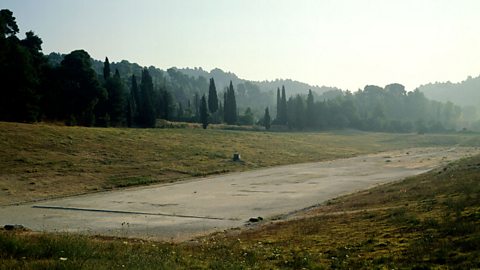
The Olympic Games began more than 2,700 years ago in Olympia, Greece, as part of a festival to honour the Greek god Zeus.
Athletes from different city-states came together to compete in running, wrestling and other events.
The Games were not only sporting contests but also religious celebrations, showing the importance of both fitness and faith in Greek life.
Every four years, around 50,000 people came from all over the Greek world to watch and take part.
Important words for the ancient Greeks
| Keyword | Definition |
|---|---|
| Olympia | The sacred site in southern Greece where the Olympic Games were held. |
| Zeus | King of the Greek gods; the Games were held in his honour. |
| Stadion | The first running race in the Olympics, about 200 metres long. |
| Pentathlon | An Olympic event with five parts: running, jumping, discus, javelin and wrestling. |
| Olive wreath | The crown made of olive leaves given to winners at Olympia. |
| Truce | A peace agreement so athletes could travel safely to Olympia from the Games. |
| Festival | A celebration that mixed sports, sacrifices and religious rituals. |
| City-state | An independent Greek community, such as Athens or Sparta whose athletes competed. |
When were the first Olympic Games?
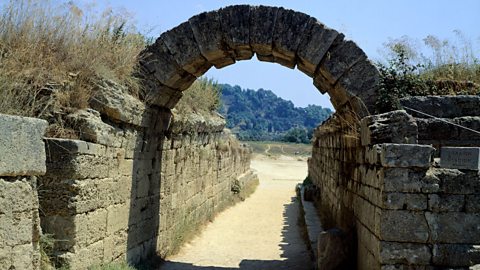
The first Olympic Games were held in 776BC in Olympia, a special site dedicated to the god Zeus.
They were both a religious festival and sporting competition, bringing people together from across Greece.
Athletes competed to honour the gods, show their strength and win glory for their city-states. Each city-state was a small, independent community in Ancient Greece with its own laws and leaders.
There were no gold, silver and bronze medals. Winners were given a wreath of leaves and a hero's welcome back home. Athletes competed for the glory of their city and winners were seen as being favoured by the gods.
A truce for the sacred games
Before the Games began, messengers were sent out to announce a 'sacred truce' or a peace. This meant that any fighting in areas on the way to the site of the Games was called off, so that people could travel safely to Olympia.
The entire Games were dedicated to Zeus. Visitors flocked to see the Temple of Zeus. Inside stood a huge gold and ivory statue of the king of the gods himself.
The main event at the Olympics was not a sporting event, but a sacrifice. On the third day of the games, 100 oxen were sacrificed and burnt on the Altar of Zeus.
This altar was not made from stone. Instead it was made from the leftover ash of all the sacrificed oxen. By around AD200, the mound of ash stood six meters high!
Preparing for the Games
Athletes would practise before the Games. For events that required a lot of space, such as the javelin, discus and running they would use an area called a gymnasium. At a palaestra they could practise events such as boxing or wrestling.
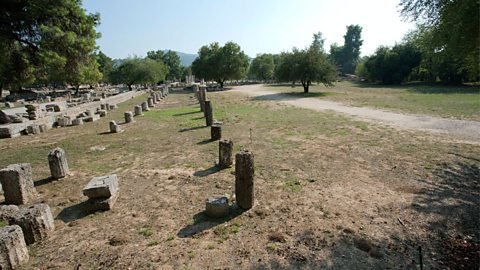
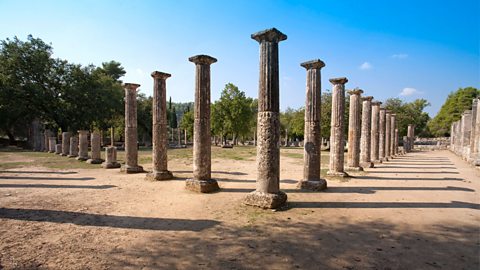
Watch: What was it like to attend the Olympics?
The ancient Olympics wasn't just about the sport, it was a religious festival too. Find out what it was like to visit the ancient games.
Olympia was not only a centre of sport but of culture, politics, and religion.
This was a man’s world. Women were forbidden from coming here on pain of death. And inside the stadium the athletes would stand naked before all of Greece and the gods.
Here they competed not for money but to honour Zeus, the most powerful god of all.
Every four summers, for over a thousand years, tens of thousands of Greeks would come to the games from across the Mediterranean, all converging on Olympia to experience the greatest spectacle of the ancient world.
We can’t be certain of what people saw when they came to this valley five hundred years before the birth of Christ but from fragments of written evidence, experts have been able to construct some idea of what would have happened once they arrived.
Even returning champions would have had to fight for space amongst the diplomats, philosophers and the thousands of spectators who descended upon Olympia.
For the athletes this was a time to concentrate and prepare for competition. And many young challengers would have sought support from the gods.
Local priests acted as judges, taking up special positions in the judges’ stand while the sun-scorched banks filled with expectant crowds. Just like today, before being called to compete, the waiting Pentathletes would have prepared mentally as well as physically.
The athletes knew that only five events separated them from immortal fame.
What events were there in the first Olympic Games?
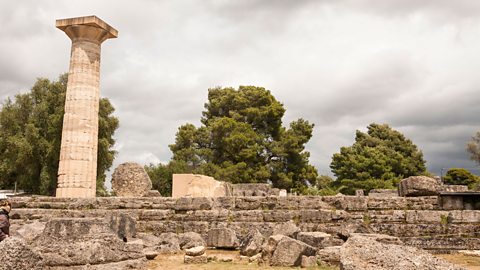
The earliest event at the Games was a short running race called the stade, about 200 metres long.
Other races were later added, including longer distance runs and races where athletes wore armour.
Athletes also competed in wrestling and an event called the pentathlon, which combined running,jumping,discus and javelin.
Chariot racing and boxing were introduced in later centuries, making the Games larger and more varied.
Women at Olympia
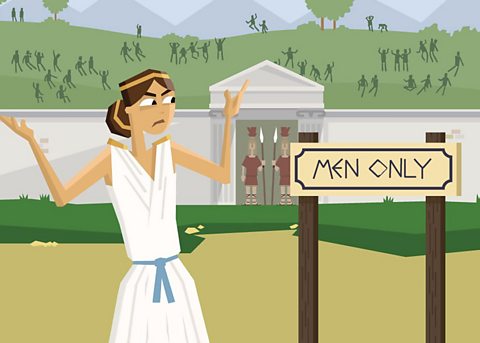
Historians disagree about whether women were allowed at the ancient Olympic Games.
Some say that no women were allowed to be there at all, except for the Priestess of Demeter. Other historians believe that married women were not allowed to watch or take part in the Games, but that young, unmarried girls and the Priestess of Demeter could watch.
However, historians do know that women could still own horses that took part in the chariot races at the Olympics.
Princess Cynisca of Sparta was the first female chariot owner to win a race at the event. Her chariot, pulled by a team of horses and driven by a man, competed against horse teams owned by men.
There was also a separate Games for women where some women could watch and compete in the events. It was called the Heraean Games. At these games women were also given olive wreaths when they won.
Think like a historian

Have a look at the thinking points below and think about your answer to each question. You could even write them down on a piece of paper or discuss them with somebody else if you want to.
Why was it significant that the Games were held in Olympia and dedicated to Zeus?
How did the Olympic truce affect life in Greece?
What does the prize of an olive wreath tell us about Greek values?
In what ways did the Games bring unity between different city-states and how did they also show rivalry?
How have the Games changed from ancient times to today and what has stayed the same?
Did you think about how Olympia, where the Games was held was sacred to the god Zeus? So holding the Games there made them both a religious and sporting event.
Did you remember that the truce meant athletes and spectators travel safely? This showed how important the Games were to each of the city-states.
Perhaps you thought about how the olive wreath was a simple prize. Perhaps it showed that honour mattered more than money.
Maybe you remembered that the Games brought Greeks together in shared worship and competition, even though the city-states still fought for glory in each event.
Today’s Olympic Games are different from the early Olympic Games. They now include more events and people representing nations across the world can compete. However, the idea of gathering peacefully every four years has continued since the Games began.
Activities
Activity 1: Olympic sport events
Click on the athletes below to find out more about some of the sporting events at the ancient games.
Activity 2: Quiz – Olympic Games
Let's find out what you know about the Olympic Games in this quiz.
Grown-ups corner
Are you a parent, carer or teacher?
Take a look at some of the links below on KS2 History which are packed full of knowledge, videos, quizzes and activities.
Ancient Greeks: The Argo Odyssey
Bitesize: KS2 History
Ancient Greece: The Olympic Games
BBC Bitesize for Teachers
What games did the Maya play?
KS2 History
Horrible Histories: Raid and Trade game! game
Play Horrible Histories: Raid and Trade KS2 History
More on Ancient Greece
Find out more by working through a topic
- count4 of 15
- count5 of 15
- count6 of 15