Why was ancient Greek culture so significant?
From beautiful temples and exciting festivals to famous myths and clever inventions, the Greeks left behind ideas that shaped the way we live today.
Their love of art, learning and stories helped build one of the most important cultures in history.
Important words for the ancient Greeks
| Keyword | Definition |
|---|---|
| Ceremony | A special event or ritual held to honour a god or celebrate something important. |
| Courtyard | An open space in the middle of a house where families cooked, worked and relaxed. |
| Craftsman | A worker skilled at making things by hand, such as pottery, tools or jewellery. |
| Festival | A large celebration often with music, dances, parades and sometimes competitions. |
| Flute | A wind instrument. Greek musicians played wood or bone flutes at festivals and ceremonies. |
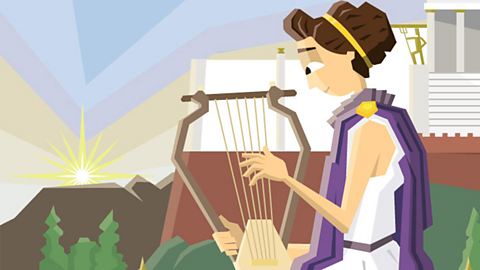
| Lyre | Common in ancient Greece it is a small string instrument played by plucking the strings. |
| Myth | Made up stories, used to explain events or ideas from early history. They often feature gods or the supernatural. |
| Philosophy | The study of big questions about life, such as what is right and wrong and how we should behave. |
| Trader | A person who sold goods in markets often travelling to buy and sell them. |
What was Greek culture like?
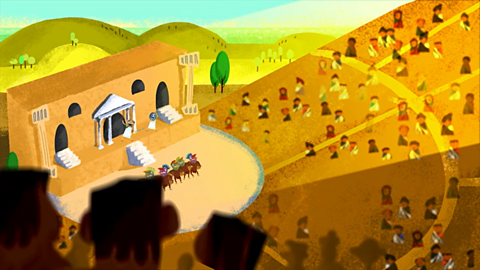
The Greeks pretty much invented the theatre.
Thousands of people packed the hillside arena of ancient Athens to watch plays by famous writers like Sophocles, Euripides and Aeschylus.
The Greeks also celebrated the arts with big festivals. There was always music, dancing and feasting in honour of their gods.
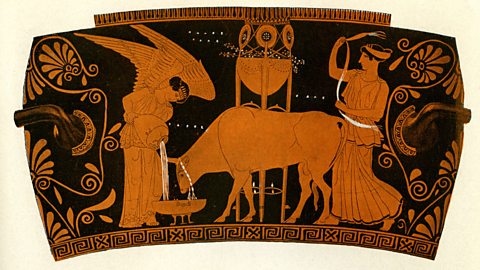
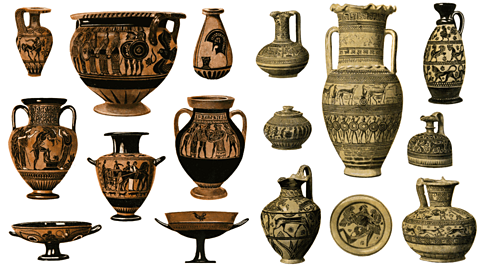
The Greeks' red and black pottery was very fashionable, and it was bought and sold all over the Mediterranean and even parts of Asia.
They were great builders too. The Greeks built grand temples to their gods and superb sculptures of brave heroes.
What was daily life like in ancient Greece?
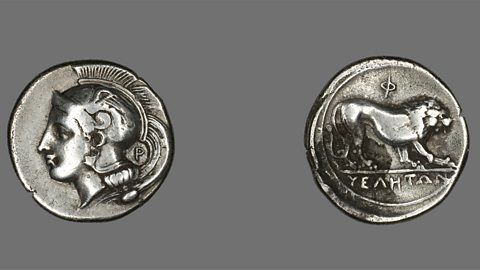
Most ancient Greeks lived in small houses with open courtyards and simple furniture. Families cooked on small fires and ate bread, olives, cheese, fish and fruit.
Men often worked outside the home as farmers, craftsmen or traders. Women managed the household. Wealthier Greek men often spent their free time discussing politics, philosophy and government, sharing ideas about how their city-state should be run.
Children helped their parents and learned stories, songs and games that taught them about Greek myths and heroes.
Architecture and sculpture

The Greeks believed that the secret to making a great building was maths. They carefully designed and measured their buildings, making sure they got all their angles, shapes and sizes right.
Their temples were held up with stone columns and sometimes decorated with stone carvings of famous battles from Greek myths.
The Greeks were really good at making statues too. Sculptors carved lifelike marble statues and decorated them with brightly-coloured paints. To make them even more spectacular, they added some gold, bronze and ivory jewellery - this would glint and sparkle in the sunlight.
What did ancient Greek pottery look like?
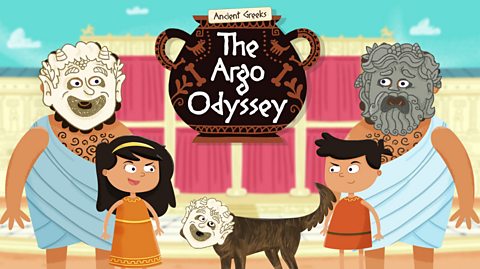
Watch: Ancient Greek theatre
Find out about the topsy-turvy world of the ancient Greek theatre.
The Greeks loved theatre. They brought incredible stories to life with drama, music and dance. So, in ancient Greece, theatres were everywhere.
Every town had a big bowl-shaped arena, usually on a hillside, where thousands would flock to sit on hard stone seats and watch the latest play.
The most successful Athenian playwright was Sophocles, who won so many Greek theatre competitions that he became a big celebrity.
There were three types of plays – comedies, tragedies (which were sad, serious plays), and satyrs (a rude kind of play involving naughty half-men, half-goat characters).
Audiences could make a play a success by cheering and stamping their feet or a miserable failure by throwing food at the performers.
But if the audience were getting too rowdy, the theatre staff had big sticks to keep them quiet.
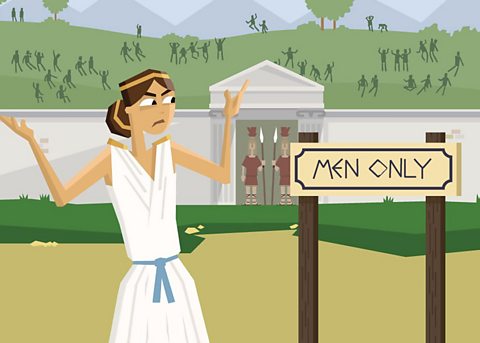
Actors in ancient Greece were all men… apart from that one… oh no, that’s a man too.
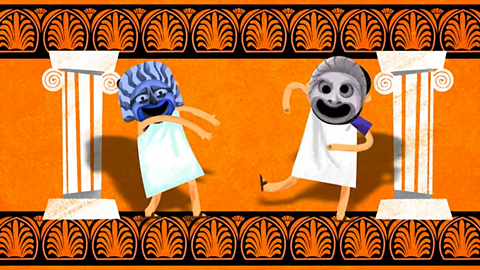
Actors changed the way they looked by wearing masks, wigs and padded costumes.
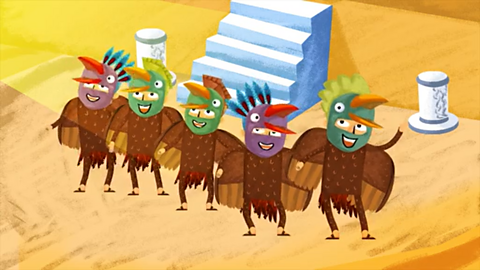
The chorus, standing below the stage, told the audience what was going on in the story. Lots of the time they delivered their lines in beautiful song and dance.
Their costumes could be even stranger than the actors with animal skins and bird heads!
So next time you see a play, a film or are even just sitting at home watching TV, remember that it all started with the Greeks and their masks.
Just don’t try and throw your dinner at the telly!
What happened at Greek festivals?
The Greeks were always putting on big parties for their gods.
Athens was the place to go in ancient Greece for culture. Every four years, Athens held the Panathenaic Games.
- Thousands of people paraded through the city to worship the god Athena.
- There were competitions for athletics, poetry reading and music.
- The Games ended with an enormous all-night banquet.
Athens was the place to go for plays too.
- The city put on a drama festival called the Dionysia.
- The festival was held in honour of the god Dionysus - the god of the theatre and wine.
- Judges gave prizes for their favourite tragedy and comedy performances.
How did the ancient Greeks enjoy music and dance?
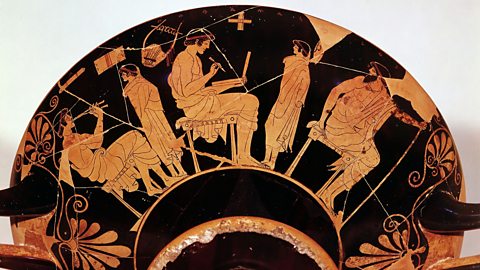
Music and dance were important parts of Greek festivals, theatre and daily life.
People played instruments such as the lyre, flute and drums during celebrations and religious ceremonies.
Greek dancers often performed in groups, using graceful movements to honour the gods or tell stories.
Boys learned about music and rhythm as part of their education, showing how much the Greeks valued the arts.
Think like a historian

Have a look at the thinking points below and think about your answer to each question. You could even write them down on a piece of paper or discuss them with somebody else if you want to.
How does daily life in ancient Greece compare with the way we live today?
What does Greek music and dance tell us about what the Greeks enjoyed and valued?
Why do you think music and dance were included in festivals as well as daily life?
Did you remember that most families in ancient Greece cooked on small fires, fetched their own water and worked close to home? Today we use technology, electricity and transport that makes everyday tasks quicker. But some things are similar, like families eating meals together and children learning through school and play.
Maybe you thought that their use of music and dance shows that the Greeks enjoyed celebrating together. They valued creativity, rhythm and community. As music and dance were used in festivals, ceremonies and theatre, they also show that the Greeks believed the arts were an important way to honour the gods.
Music and dance might have helped the people feel connected to each other and joyful. In festivals, they brought the whole community together and in religious events they showed respect to the gods. In everyday life, they made work and celebrations more enjoyable. This could show that the Greeks saw music and movement as part of a good and balanced life.
Quiz
Grown-ups corner
Are you a parent, carer or teacher?
Take a look at some of the links below on KS2 History which are packed full of knowledge, videos, quizzes and activities.
An introduction to the ancient Maya
KS2 History
What remains of Ancient Egypt?
KS2 History
Ancient Greece: Theories, thoughts, language and law
Bitesize for Teachers
More on Ancient Greece
Find out more by working through a topic
- count7 of 15
- count8 of 15
- count9 of 15
- count10 of 15