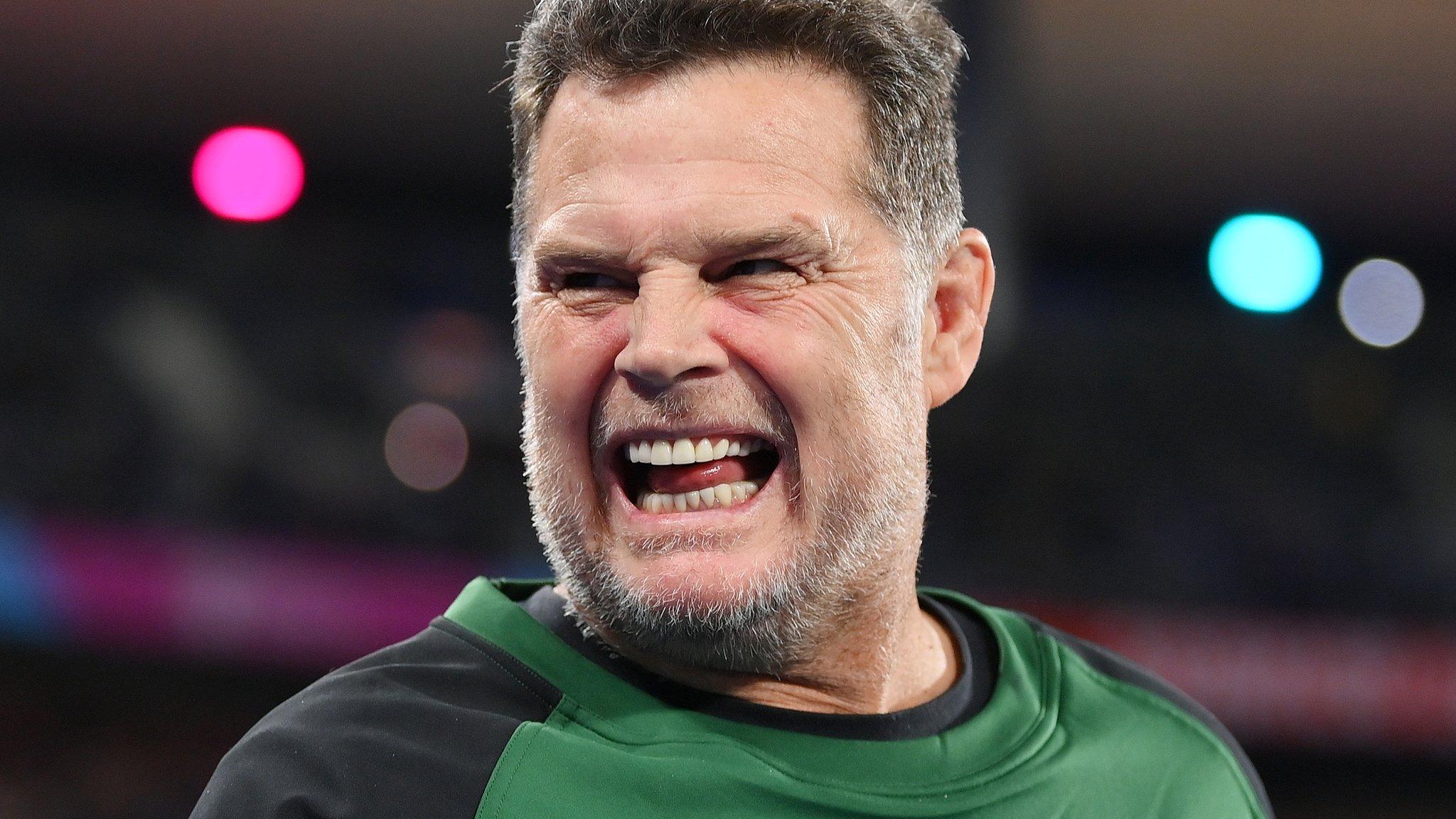
Divide and conquer - now maverick Erasmus plans online watchalong

Rassie Erasmus took the South Africa job after the departure of Allister Coetzee
- Published
Having been banned from the touchline for six matches, you will not find Rassie Erasmus at the Aviva Stadium when his South Africa side face Ireland.
Instead he will be hosting an online watchalong of Saturday's match, courtesy of a swiftly purchased domain name.
The South Africa head coach plans to stream his reactions live while watching on television from his team's Dublin hotel.
It is typical Erasmus. An unapologetic, unabashed show of defiance in the face of the authorities.
And he will not be short of virtual company.
Because, while Erasmus has run low of advocates elsewhere, his compatriots have rushed to his defence.
"Rassie was just asking questions," said former South Africa hooker Hanyani Shimange in the wake of Erasmus' ban for a scattergun series of complaints about the injustices suffered by his side.
"But you have to look at the facts. Where was the accountability for that refereeing performance [in the loss to France]?"
Naas Botha, legendary South Africa fly-half turned pundit, described Erasmus' punishment as a "debacle". "You can't tell me [officials] are untouchable," he said.
Supersport, which broadcasts South Africa's games domestically, published an article accusing Erasmus' critics of "pearl clutching", external and "shooting the messenger" with regards to the game's faults.
Despite slurring officials with a suggestion of match-fixing, Erasmus has the support of South Africa.
It is not surprising.
His feats with the team are astonishing.
South Africa were ranked sixth in the world when he took over in March 2018.
He arrived after a November tour in which they lost to Wales and were thrashed 38-3 by Ireland. New Zealand had racked up a record 57-0 win a few months earlier.
Erasmus turned the team around at speed, marrying their trademark up-front power with pace out wide.
They won the 2019 World Cup. The defended their title in 2023. They will go into the tournament in 2027 aiming for an unprecedented hat-trick. And few would bet against them achieving it.
Erasmus is relentlessly innovative.
Long before the sport's data revolution, he was coding game footage, picking up the technique from a friend who worked in the military. He has since developed Outfox, his own software which allows his teams to run through moves virtually on a screen away from the pitch.
Tactically, he has also been ahead of the curve. He pioneered the use of forward-heavy replacement benches, giving his team an edge in the final quarter of the match.
He saw the game-breaking potential of diminutive Sevens specialist Kurt-Lee Arendse and moulded Andre Esterhuizen into a genuine hybrid player, capable of playing in the back row and the backline.
Trick plays - forcing a scrum with a deliberate infringement off kick-off, or setting up a line-out in the middle of the pitch - have been part of Erasmus' arsenal.
Legally, he is across every possible loophole.
There was controversy before the match against France last weekend when he made use of the Nations Championships' looser regulations to swap his starting front row just over an hour before kick-off.
Previously, he demoted himself to water boy so he could run the touchline during the 2021 series win over the British and Irish Lions.
Former Springbok wing Bryan Habana worked under Erasmus at the Stormers in Cape Town.
"He is one of the master tacticians the game has ever seen," Habana told BBC Sport's Ireland Rugby Social.
"I don't always agree with how Rassie comes across, but I understand he wears his heart on his sleeve. He has got incredibly high standards.
"He's willing to be in the firing line to defend what he believes is right."

France's win over South Africa was only the Springboks' third defeat in 11 matches this year
But there is no doubt, by the letter of the law, that Erasmus is wrong - certainly in terms of the platform and terms he chose for his complaints.
In July World Rugby introduced new rules around criticism of officials. It specifically targeted "comments which, viewed objectively, a reasonable person would conclude were an attack on the credibility or competence of the match officials".
Mentioning "match-fixing" undermines the officials in exactly that way.
Considering Erasmus' previous, including an hour-long monologue bemoaning officiating of a first-Test defeat by the Lions in 2021 and a series of tweets after a loss to France a year later, he may be fortunate to only be banned for six matches.
World Rugby, perhaps pre-empting the reaction in South Africa, was clear that it was not punishing Erasmus for asking questions.
"Robust, respectful debate is natural, but teams have access to well-established and supported channels and protocols for raising officiating matters before and after matches," it said in its judgement.
"Challenging a decision is not the same as questioning an official's integrity or making comments that expose them to personal abuse."
For many South Africans, though, Erasmus is still an outlaw hero.
World Rugby, based in Dublin, is seen by them as tilted towards the north.
Australian Brett Robinson, the current chairman, is the first figure from outside the Six Nations countries to hold the organisation's top job since it became an elected position.
The World Cup has been lifted by South Africa on four occasions, but held there only once.
Japan coach Eddie Jones, Erasmus' fellow maverick, recently suggested Ireland's political clout, external was behind his team's home game being staged in Australia rather than Tokyo.
South Africa were a powerful voice against the possible moves to "depower" the scrum - a key part of the Springbok game - at a February conference to discuss future law tweaks.
Erasmus' public pronouncements have fuelled conspiracy theories weaved from those threads. They have also made an all-time great team harder for outsiders to love.
Whether it is a deliberate ploy is hard to tell.
Certainly Erasmus is a repeat offender, but his offences have also come in his second language. He is an Afrikaans speaker.
Some also see instinctive honesty rather than a premeditated ploy in his public speaking.
"He also has almost no filters, so he will speak his mind without fully appreciating the consequences of what he has done," his biographer David O'Sullivan told BBC Sport in 2023.
Whatever the motivation, the consequences keep coming - for Erasmus, but also the rest of world rugby.
Referees Nic Berry and Wayne Barnes, previous targets of Erasmus' criticism, have detailed the effects it had on them.
Berry described "a character assassination" that caused "immeasurable damage". He has not refereed a South Africa game in the five years since.
Barnes' wife and children were threatened over social media.
South Africa's latest appeal to their supporters not to abuse officials, external may be too late for referee Andrea Piardi and his television match official Matteo Liperini, who oversaw France's win on Friday.
There is a wider question too.
For a complex sport, the image of a world champion coach publicly criticising officials does not little to dispel a wavering viewer's assumption that it is too intricate and confusing to justify their attention.
South Africa will always line up alongside their rebel chief.
But the patience of the rest of the rugby world with Erasmus' antics is wearing ever thinner.
Ireland v South Africa
Nations Championship
Saturday 21 November
Aviva Stadium, Dublin
Live on 5 Sports Extra, BBC Sounds, BBC Sport website and app, with accompanying live text commentary
Related topics
- Published1 day ago

- Published25 October 2023