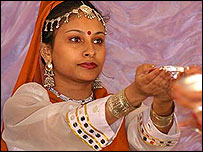
| What is Diwali? | Diwali, the Hindu festival of lights, is the most popular of all the festivals from South Asia, and is also the occasion for celebrations by Jains and Sikhs as well as Hindus. It celebrates the New Year sometime between late October and mid-November. The festival of Diwali extends over five days. Because of the lights, fireworks, and sweets involved, it's a great favourite with children. The festival celebrates the victory of good over evil, light over darkness, and knowledge over ignorance, although the actual legends that go with the festival are different in different parts of India. In Britain, as in India, the festival is a time for thoroughly spring-cleaning the home and for wearing new clothes and most importantly, decorating buildings with fancy lights.
|
Diwali is the Hindu celebration of lights and is the biggest festival on the Hindu calendar. It is celebrated all over the world on the Hindu New Year, which according to the lunar calendar, falls on the full moon between October and November. This year it falls on 1 November. The festival celebrates the victory of good over evil, light over darkness and knowledge over ignorance. However, the actual legends that go with the festival are different in different parts of India. 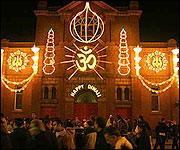 | | Diwali celebrations in Leicester |
The most legendary is that Diwali marks the day when Lord Ram was crowned as the King of Ayodhya on his return to the kingdom with wife Sita and brother Laxman after 14 years of exile and slaying of the demon King Ravan. To celebrate their return, the people of Ayodhya lit divas, little oil lamps, and placed them along the streets. The time is also significant to Sikhs. During the festival time in 1620, the sixth Guru, Hargobind Singh, gained the release of 52 Hindu princes who had been falsely imprisoned in Gwallior Fort by the rulers of the area, the Mughals. The Golden Temple was lit with many lights to welcome the release of Guru Hargobind and Sikhs have continued the celebration. All over the world Diwali is celebrated with a great deal of joy and optimism, as it is a period that marks new beginnings. Houses are thoroughly cleaned or redecorated. In India, courtyards are swept and decorated with 'rangoli' – patterns created with powdered or wet paint. Doorways of homes are festooned with 'torans' – decorative garlands made with golden marigolds and fresh mango leaves. Private and communal worship is a major feature of the festival, and devout Hindus wake up early and bathe at the crack of dawn to go to temple. | "Leicester boasts the biggest celebrations outside India. The Golden Mile, Melton Road, is lit up with thousands of coloured lights and decorations" | | Jeevan Panesar |
Every year Leicester boasts the biggest celebrations of Diwali outside of India. The city's Golden Mile, Melton Road, is lit up with thousands of colourful lights and decorations to mark the arrival of the festival. The switching on of the Diwali lights has in the past attracted up to 60,000 people from all over the region, who come to join in with the unique celebrations. Fireworks are released to symbolise the celebration of lights. Hindus and Sikhs visit temples across the city and as it is also the New Year for Hindus, it is a time to visit family, rejoice and reflect. |