(Image: Getty)


Introduction
Sometimes people leave you to do something on your own because they trust you. Sometimes people just don't want to help you. In both of these situations we can say that you are left to your own devices. Learn how to use this expression with Feifei and Phil.
Transcript
Feifei
Hello and welcome to The English We Speak, where we explain phrases and expressions used by fluent English speakers so that you can use them too. I'm Feifei.
Phil
And I'm Phil.
Feifei
Your lunch looks interesting today.
Phil
Yeah, my kids made it for me. It's leftovers from yesterday's dinner.
Feifei
They cooked it on their own?
Phil
Yes, they really wanted to make something. We just left them to their own devices, and they looked up a recipe, bought the ingredients and made it – all on their own.
Feifei
You used the expression 'leave to their own devices'. I think we should have a look at that. it's a really interesting one. But it's got nothing to do with devices, has it?
Phil
Well, certainly not in the way that we that word today. If you are left to your own devices, it means that you're left on your own. Sometimes, we use it to say that we trust people enough to do things on their own. We also sometimes use it to talk about being left without any help.
Feifei
So, you were able to leave your kids to their own devices because you trusted them. Another example is, if your boss gives you a massive piece of work and doesn't explain anything about it, you might be unhappy that you've been left to your own devices.Feifei
Phil
Let's hear some more people using the expression 'leave to one's own devices'.

Examples
The flight from Seoul was delayed for about two hours. We didn't have any information. They just left us to our own devices.
I've got a few things to do before everyone else arrives. So can I just leave you to your own devices for a bit?
Oh, I really love being left to my own devices which is why I enjoy working from home so much.
Feifei
We've been learning the expression 'leave to one's own devices' to talk about being left to do something on your own.
Phil
We said that one meaning was 'to be left on your own without any help', and another expression that has meaning is 'to be left to fend for one's self'.
Feifei
Well, this is the end of the programme, but we're not just going to leave you to your own devices. We'll back next time to help you learn more English phrases and expressions.
Phil
See you then.
Feifei
Bye!
Next
Discover our latest programmes.
Find out how some people are fightling loneliness with soup: 6 Minute English
Find programmes to improve your skills.
最新 The English We Speak




One size fits all
Episode 260727 / 27 Jul 2026
When we say one size fits all, sometimes we mean it fits no-one. Learn how to use this expression here.

Side quest
Episode 260720 / 20 Jul 2026
Sometimes you want to do something different. Learn an expression to talk about that here.

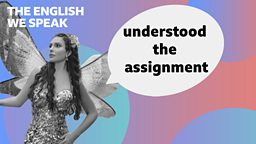
Understood the assignment
Episode 260706 / 06 Jul 2026
My friend dressed up as a fairy for the costume party – she understood the assignment




Like a moth to a flame
Episode 260601 / 01 Jun 2026
I try to be healthy but when it comes to chocolate, I’m like a moth to a flame!



Can't see the wood for the trees
Episode 260420 / 20 Apr 2026
Learn an idiom for when you’re focusing too much on the details



A bit of a stretch
Episode 260323 / 23 Mar 2026
Have you ever said something that was a bit of stretch

Cut corners
Episode 260309 / 09 Mar 2026
Cutting corners is about taking the easiest, quickest or cheapest route