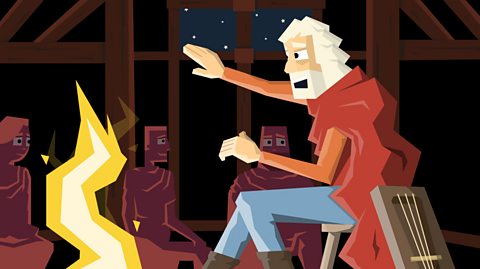
Who were the Anglo-Saxons and where did they come from?

The Anglo-Saxons were different tribes of people from Germany, the Netherlands and Denmark.
They settled in England - land of the Angles - from around AD450.
The Anglo-Saxons built village settlements and were farmers and skilled craftspeople. They ruled England until 1066.
Timeline: The Anglo-Saxons

Image caption, Click the arrows to learn more about the Anglo-Saxons!


1 of 8
Important words for the Anglo-Saxons
| Keyword | Definition |
|---|---|
| Germanic languages | Languages from northern Europe. |
| Runes | The Anglo-Saxon writing system. Anglo-Saxons carved runes into stone, metal and wood. |
| The Battle of Hastings | A battle in 1066 between the Anglo-Saxons and the Normans. The Anglo-Saxons lost and their rule in England ended. |
| Archaeology | Digging up and uncovering artefacts to help understand the past. |
Where did the Anglo-Saxons come from?
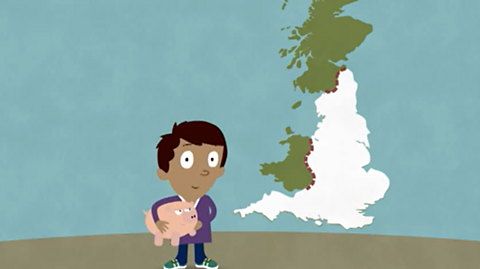
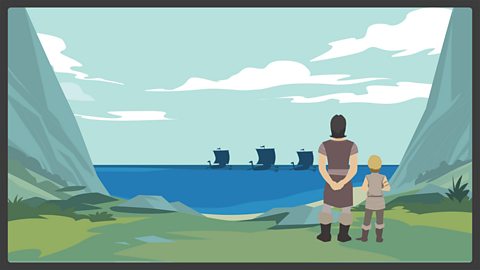
The last Roman soldiers left Britain by AD410. New people came to Britain in ships across the North Sea – the Anglo-Saxons. The Anglo-Saxon age in Britain was from around AD410 to 1066.
- The Anglo-Saxons were a mix of tribes from Germany, Denmark and the Netherlands.
- The three biggest were the Angles, the Saxons and the Jutes.
- The land they settled in became known as 'Angle-land', or England.
- They brought Germanic languages and new customs and dress.
If we use the modern names for the countries they came from, the Saxons were German-Dutch, the Angles were Southern Danish, and the Jutes were Northern Danish. They arrived over a number of decades.
Watch: Introduction to the Anglo-Saxons
Find out where the Anglo-Saxons came from, what they were like and what they left behind
Excuse me. Yes, you! Would you like to learn more about the Anglo-Saxons? Great!
Well let’s start at the beginning. The Anglo-Saxon age in Britain was about 410 to 1066 and they originally come from Germany and Scandinavia.
Some historians say they were driven from their homes by rising floodwaters.
They were not one united people, but lots of warring tribes that settled in different parts of Britain.
The biggest tribes were the Angles, Saxons and the Jutes.
But they weren’t always at war. They were mostly farmers who lived in wooden huts. Children here would generally not go to school.Girls would help around the home and boys learned the skills of their fathers.
I would take a step back if I were you.
The Anglo-Saxons loved making things from wood. And they made intricate jewellery and metalwork.
We still see their influence today, with words like, cow, cheese, werewolf and ghost.
Plus several place names and even areas that still exist. They even laid the foundation for the creation of England.
There we go, the history of the Anglo-Saxons in a matter of minutes, from invaders to settlers, to makers. How enjoyable was that? Plus you have made a new friend.
Oh… hold on, I think his mother wants a word with you.
Fantastic! Another successful day, look what happens when history happens to you!
Farming and craftwork
Life on an Anglo-Saxon farm was hard work. All the family had to help out - men, women and children. Men cut down trees to clear land to sow crops. Farmers used oxen to pull ploughs up and down long fields.
The Anglo-Saxons were great craftspeople too. Metalworkers made iron tools, knives and swords. The Anglo-Saxons were skilled jewellers, who made beautiful brooches, beads and ornaments from gold, gemstones and glass.
The Anglo-Saxons had armies, but their soldiers didn't fight all the time. After a battle, they went home as soon as they could and looked after their animals and crops.
Growing up in an Anglo-Saxon village
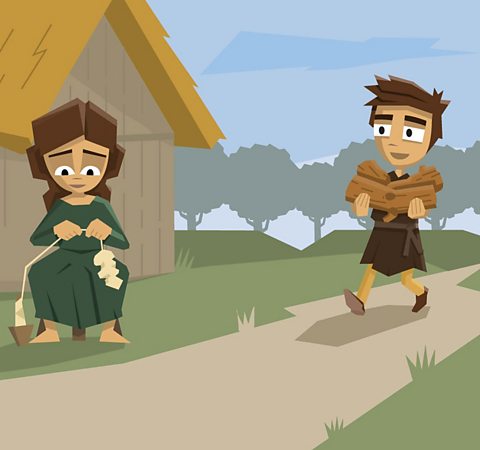
Anglo-Saxon children had to grow up very quickly. By the time they were ten, they were seen as an adult. They had to work as hard as any adult and would be punished as adults if they stole or broke the law.
Boys learned the skills of their fathers. They learned to chop down trees with an axe, plough a field, and use a spear in battle. They also fished and went hunting.
Girls worked in the home. They were in charge of housekeeping, weaving cloth, cooking meals, making cheese and brewing ale.
Only a few children learned to read and write. The sons of kings or wealthy families might be taught at home by a private teacher. The only schools were run by the Christian church, in monasteries. Some children lived there to train as monks and nuns.
How do we know all this?
When the Romans left, very few people wrote about Britain. A British monk called Gildas wrote in Latin in around AD530. However, he doesn't write much about the Anglo-Saxon settlements, since he is too busy writing about the British tribes fighting each other.
Later in AD730 an Anglo-Saxon monk called Bede wrote about the history of English people.
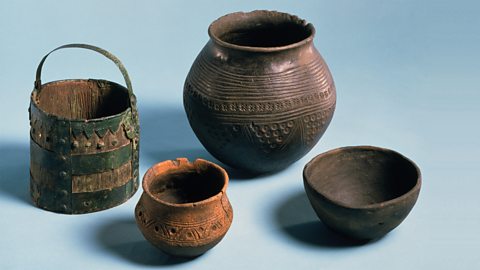
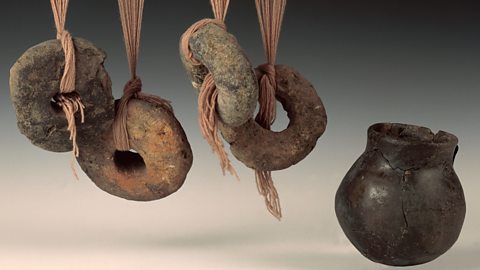
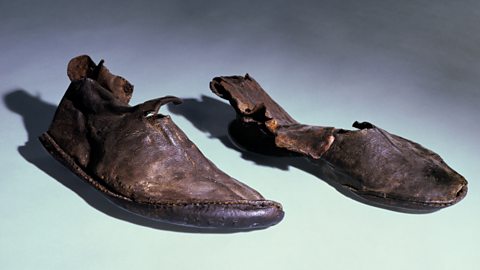
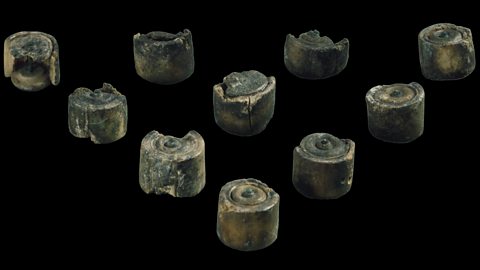
Anglo-Saxons also used runes (marked stones) but little has survived. Much of our evidence comes from archaeology: burials, grave goods, treasure hoards and building remains.
Look at the artefacts below to get an idea of what everyday life was like for Anglo-Saxons.
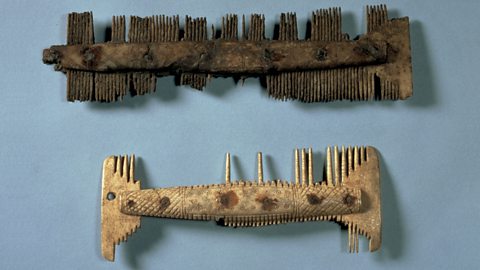
Image caption, These combs are made from bone. We don't know exactly what Anglo-Saxon hairstyles looked like, but we have found many combs so they must have had long hair and taken care of it.
1 of 3
Think like a historian

Have a look at the thinking points below and think about your answer to each question. You could even write them down on a piece of paper or discuss them with somebody else if you want to.
Why do you think we don’t know the date when the first Anglo-Saxons came to Britain?
What can artefacts tell us about life in Anglo-Saxon England?
Did you think about the lack of written evidence? This is why historians don’t know for sure when the first Anglo-Saxons arrived in Britain.
Artefacts can tell us a lot of different things about the past. Perhaps you thought about some of these ideas: artefacts can tell us about different materials used by the Anglo-Saxons, they can tell us about the different skills the Anglo-Saxons had or they can tell us about the different jobs the Anglo-Saxons did.
Activities
Activity 1: Anglo-Saxon village
Explore the village below and listen to Hild as she tells you about her life, friends, and family.
Did you find everything in Hild's village? Click on the question mark button to reveal all the things you can click on.
Activity 2: Quiz - Who were the Anglo-Saxons?
Grown-ups corner
Are you a parent, carer or teacher?
Take a look at some of the links below with your children on KS2 History which are packed full of knowledge, videos, quizzes and activities.
Drama: The Anglo-Saxons arrive
Bitesize for Teachers
Song: We are Anglo-Saxons!
Bitesize for Teachers
Anglo-Saxon Britain (animation)
Bitesize for Teachers
Teaching resources
Are you a teacher looking for more resources? These animated dramas explore Anglo-Saxon times, including Alfred the Great, Athelstan, the story of Beowulf and the end of the Anglo-Saxon dynasty at the Battle of Hastings.
BBC Bitesize for Teachers has thousands of free, curriculum-linked resources to help deliver lessons - all arranged by subject and age group.
Horrible Histories: Raid and Trade game! game
Play Horrible Histories: Raid and Trade KS2 History
More on Anglo-Saxons
Find out more by working through a topic
- count2 of 8
- count3 of 8
- count4 of 8
- count5 of 8