How was Anglo-Saxon England ruled?

The Anglo-Saxons had seven different kingdoms called The Heptarchy. Different kingdoms had different rulers.
They fought each other and Viking invaders for control of the country. Over time, the kingdoms were united to become England.
Different groups of people had different social status in Anglo-Saxon England. This meant that they had different roles in society and were treated differently in law.
Important words for the Anglo-Saxons
| Keyword | Definition |
|---|---|
| Cyning | Anglo-Saxon word for king. |
| Cwen | Anglo-Saxon word for queen. |
| Bretwalda | Anglo-Saxon word for ruler of all. |
| Heptarchy | The seven Anglo-Saxon kingdoms. |
| Weregild | Money paid to a family if someone was hurt or killed. |
| Thane | A land holder who served the king. |
| Ceorl | A free peasant. |
| Danelaw | The area of northern and eastern England that belonged to the Vikings. |
What were the Anglo-Saxon Kingdoms?
Anglo-Saxon Britain wasn't ruled by one person and the Anglo-Saxons were not united. They arrived as many different tribes and each took over different parts of Britain. Sometimes they got along, sometimes they went to war. These were the seven most important kingdoms:
| Anglo-Saxon kingdom | Area in Britain | Settlers were called |
|---|---|---|
| Kent | Kent | Jutes |
| Wessex | South West England | West Saxons |
| East Anglia | Norfolk and Suffolk | East Angles |
| Mercia | Midlands | Mercians |
| Northumbria | North of the River Humber | Northumbrians |
| Sussex | Sussex | South Saxons |
| Essex | Essex | East Saxons |
How were these kingdoms ruled?
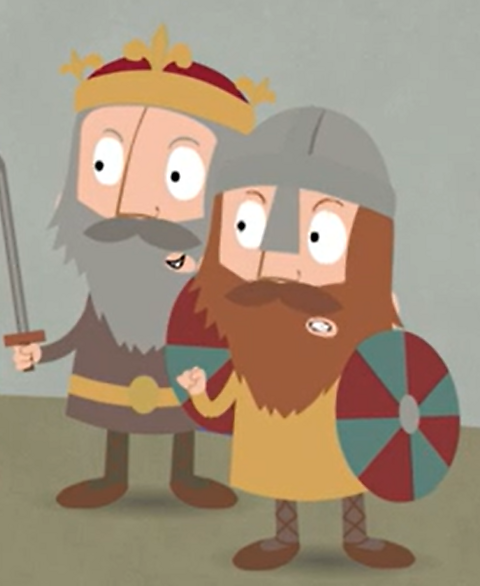
Each group of Anglo-Saxon settlers had a leader or war-chief.
A strong and successful leader became 'cyning', the Anglo-Saxon word for 'king'.
Each king ruled a kingdom and led a small army.
The Anglo-Saxon kings were from ruling families who passed their power on to their children.
From time to time, the strongest king would claim to be 'bretwalda', which meant 'ruler of all'.
Did they have laws?
The Anglo-Saxons didn't have prisons. People found guilty of crimes were either executed or punished with fines.
If they ran away, they became 'outlaws' (outside the law), and anyone could hunt them down - unless they hid in a church. The fine for breaking into someone's home was five shillings, paid to the home-owner. For minor crimes like stealing, a nose or a hand might be cut off.
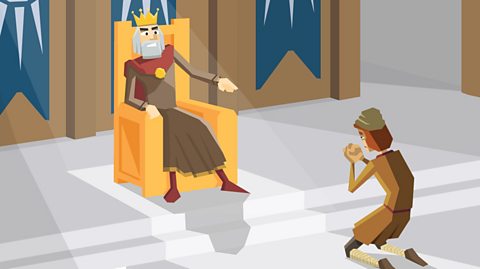
The Saxons had a system called 'weregild', which meant that if you injured someone, you had to pay for the damage!
If a person killed someone, they paid money to the dead person's relatives. The idea was to stop long fights or 'blood feuds' between families by making them pay money instead.
How did the Anglo-Saxons and Vikings split Britain?
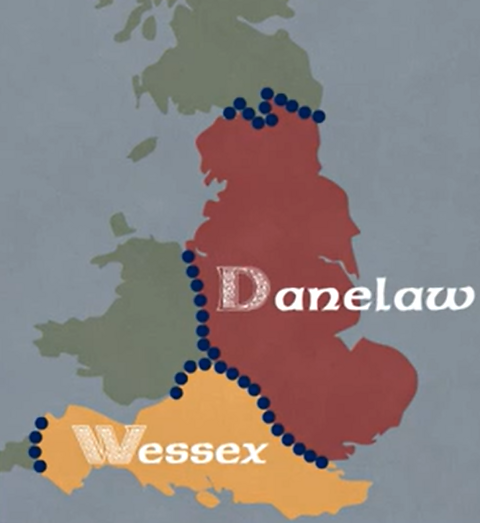
Anglo-Saxon history tells of many Viking raids. The first Viking raid recorded in the Anglo-Saxon Chronicle was around AD787. It was the start of a fierce struggle between the Anglo-Saxons and the Vikings.
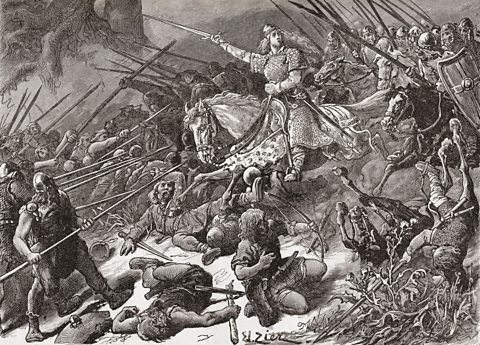
Over time the Vikings took control of several Anglo-Saxon kingdoms. Eventually the Anglo-Saxons and Vikings made a peace agreement led by King Alfred the Great who had defeated Viking leader Guthrum in AD878.
The Vikings and Anglo-Saxons divided up Britain with the Anglo-Saxons living mainly in the west and the Vikings in an area to the east, known as the Danelaw.
Who was Aethelflaed?
The Anglo-Saxon word for queen was cwen. Archaeologists have found the graves of many high-status women from early Anglo-Saxon England.
Aethelflaed was a powerful Anglo-Saxon leader. She was the daughter of Alfred the Great. He left her money and land. She also married the most powerful noble of Mercia, Ethelred.
When Ethelred died in 911, Aethelflaed ruled Mercia by herself, rebuilding towns and forts. She was never ‘queen’ but had a lot of power. Aethelflaed also brought up a boy called Athelstan who eventually became the first King of all England.
Think like a historian

Have a look at the thinking points below and think about your answer to each question. You could even write them down on a piece of paper or discuss them with somebody else if you want to.
How was life in Anglo-Saxon England different for different groups of people?
How was life in Anglo-Saxon England different for women and for men?
Perhaps you thought about the different roles of: kings or chiefs, thanes, ceorls, and slaves?
Did you think about how men and women had different roles in the household? However, not all women were treated the same. Perhaps you remembered Aethelflaed who became a powerful leader in Mercia. This shows that women could be of high status too.
Activities
Activity 1: Anglo-Saxon society
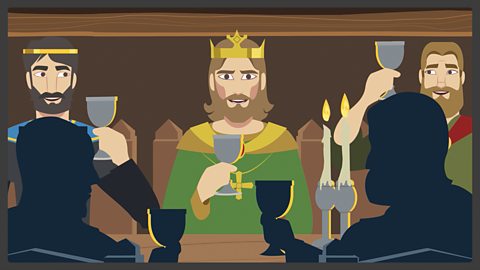
Anglo-Saxons were not all equal. Click on the people at this feast below to find out about the different roles in Anglo-Saxon society.
Activity 2: Offa, King of Mercia
Click on the pictures below to find out how one of the most famous Anglo-Saxon kings was Offa, who was the king of Mercia from AD757 to 796.
Activity 3: Quiz – Life under Anglo-Saxon rule
Grown-ups corner
Are you a parent, carer or teacher?
Take a look at some of the links below on KS2 History which are packed full of knowledge, videos, quizzes and activities.
Athelstan - first king of England?
Bitesize for Teachers
Alfred the Great
Bitesize for Teachers
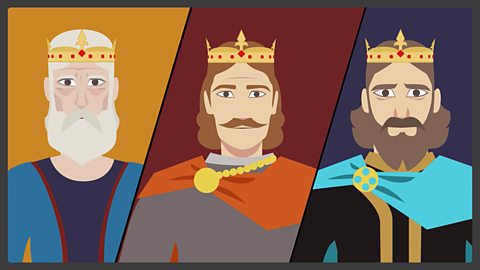
1066 - The year of three kings
Bitesize for Teachers
Horrible Histories: Raid and Trade game! game
Play Horrible Histories: Raid and Trade KS2 History
More on Anglo-Saxons
Find out more by working through a topic
- count4 of 8
- count5 of 8
- count6 of 8