Why was the Roman army significant?
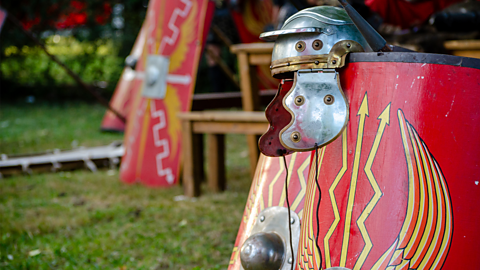
The Roman army was one of the most successful armies of the ancient world, helping to push the boundaries of the Roman Empire.
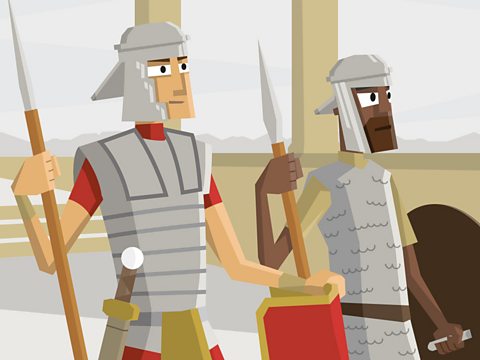
They were well-trained, had standard weapons and armour and used the skills and tactics they learned from across the empire to make them even stronger.
It was one of the largest fighting forces in the ancient world and conquered a huge empire that stretched from Britain all the way to the Middle East.
When the Romans invaded Britain, their army was so good that it took on armies 10 times its size and won!
Important words
Important words on life in the Roman army.
| Keyword | Definition |
|---|---|
| Auxiliaries | Soldiers in the Roman army who were not citizens and were usually recruited from across different parts of the empire for their skills. |
| Citizen | Someone belonging to a certain place. A Roman citizen was protected by laws and enjoyed more freedoms than non-citizens. |
| Centurion | The leader of a group of 80 soldiers and 20 non-soldiers, making 100 in total. |
| Colonia | A settlement for Roman citizens, usually retired soldiers. |
| Legion | The largest unit in the Roman army, usually of around 4,000 to 6,000 men. |
| Legionaries | The most elite Roman soldiers who were citizens of Rome, meaning that they were protected by Roman laws. |
How was the army organised?
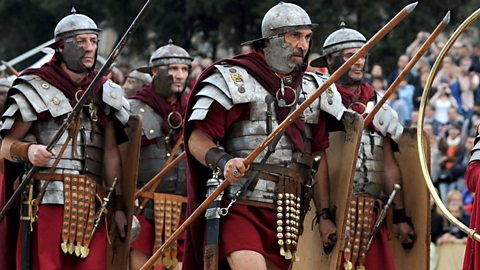
Only men could be in the Roman Army, no women were allowed.
There were two main types of Roman soldiers:
- legionaries (the most elite soldiers who were citizens of Rome)
- auxiliaries (soldiers who were not citizens).
The legionaries were the elite (very best) soldiers. A legionary had to be over 17 years old and a Roman citizen (someone belonging to a certain place, protected by laws and enjoyed more freedoms than non-citizens).
Every new recruit had to be fighting fit - anyone who was weak or too short was rejected.
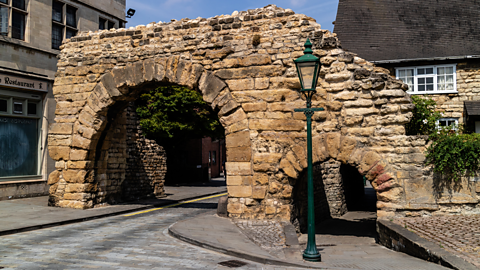
Legionaries signed up for at least 25 years service. But if they survived their time, they were rewarded with a gift of land they could farm.
Old soldiers often retired together in military towns, called ‘colonia’ (a settlement for Roman citizens, usually retired soldiers).
An auxiliary was a soldier who was not a Roman citizen, he was only paid a third of a legionary’s wage.
Auxiliaries guarded forts and frontiers but also fought in battles, often in the front lines where it was the most dangerous.
How did the Roman army fight?
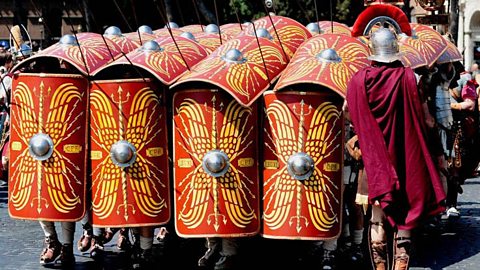
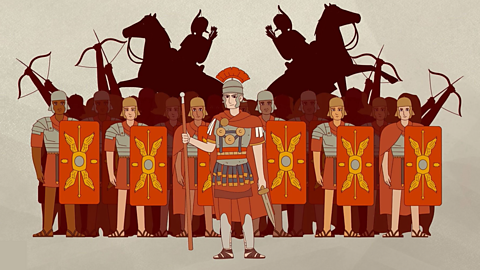
The Roman army was huge, it was divided up into groups called legions (the largest units in the Roman army).
Each legion had between 4,000 and 6,000 soldiers.
A legion was further divided into groups of 80 men called centuries’.
The man in charge of a century was known as a ‘centurion’. He carried a short rod, to show his importance.
Some soldiers shot bows and arrows, flung stones from slingshots, or could swim rivers to surprise an enemy.
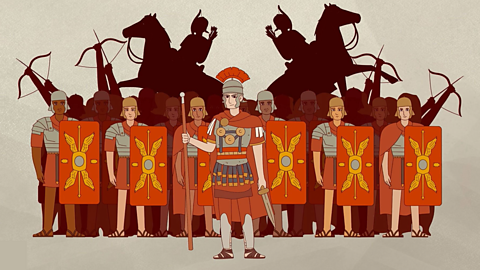
Roman soldiers lined up for battle in a tight formation called the testudo (tortoise). They covered themselves with shields, looking like a tortoise's shell.
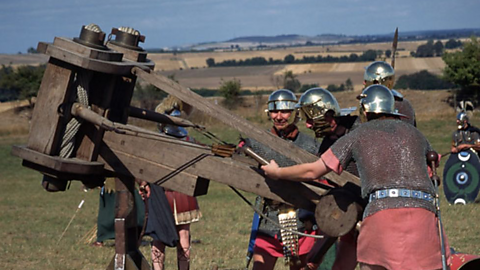
After a burst of arrows, the Roman soldiers marched towards the enemy together.
At the last minute, they hurled their spears and drew their swords, before charging into the enemy.
Then the cavalry (soldiers riding horses) chased anyone who tried to run away.
The Romans were one of the first fighting forces in the ancient world to use artillery.
This included:
- Ballistas - Huge crossbows that could fire big arrows.
- Onagers - Giant catapults that fired rocks or balls of burning tar.
Watch the video below and take a trip around the famous Roman fort at Vindolanda on Hadrian's Wall.
Find out about Vindolanda.
Presenter: The fort here at Vindolanda was the home to 800 soldiers and their job was to guard the wall against people they described as barbarians.
Now, for the Romans, barbarians were local tribes who lived on the other side of the wall in what’s now, northern England and Scotland.
But it wasn’t the legionaries that guarded the wall. This was the job of auxiliary soldiers who came from right across the Roman empire… places like Belgium, Spain, Greece, and even as far away as Africa.
After 25 years working as an auxiliary, you could become a Roman citizen. And when the soldiers weren’t on duty guarding the wall, they lived here with their families. These are their barracks. And we can still see their remains today.
Barracks are soldiers’ homes. These ones at Vindalanda used to have two floors and an attic on top.
This was the main road in the middle and it would have been humming with activity with the soldiers coming out and washing themselves in the morning and at the end of the day.
That big building that you can see at the end there, that was basically the posh bit, that was where the centurions slept so they were the bosses keeping their eyes on all the soldiers down here.
This is one of the three public loos that’s been left here at Vindalanda. You’d have had twelve wooden seats along here. You’d sit down, do your business straight into the drain below and probably have a chat with some of your friends as you did so.
And I know it looks a bit odd but that’s because in Roman times people always used to go to the loo at the same time, together so it wasn’t very private.
For the last forty years, archaeologists who are really like detectives, have been digging carefully through layers of soil, finding extraordinary evidence of the lives of the soldiers who once lived here.
Justin Blake, Archaeologist: What we’re looking for is the little things that they’ve dropped and left behind: shoes, writing tablets, little bits of weapons and armour and like a detective, those are the clues that we use to find out what the Roman people were doing here all that time ago.
Presenter: And what’s particularly special about what’s been found here?
Justin Blake: The undoubted highlight from Vindolanda are the amazing writing tablets that we find and these are tiny little postcard sized scraps of birch and alderwood that the Roman soldier have written to each other and further afield with an old fashioned iron pen that they dip into the ink and write straight on top of the bits of wood.
And from those letters we just have an enormous amount of information about the Roman soldiers but others as well and exactly what they thought about living right at the edge of the empire on Hadrian’s Wall.
Presenter: The letters reveal the most fantastic details about the soldiers’ lives, how they miss their friends and their families and the good wine back at home. But the main thing that they seem to moan about is the freezing cold up here in the north of England.Luckily some of their mates could send them supplies.
“I have sent you some pairs of socks from Satura, two pairs of sandals and two pairs of underpants. I pray that you live in the greatest of good fortune.”
Well it’s good to know that even the Romans had to wear pants.
How well trained were Roman soldiers?
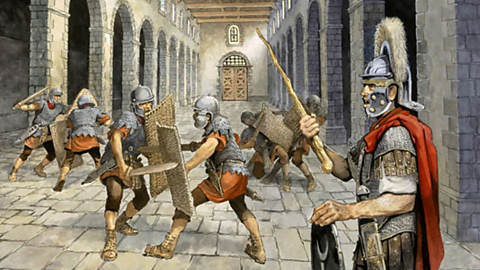
A Roman soldier was a well-trained fighting machine. He could march 20 miles a day, wearing all his armour and equipment. He could swim or cross rivers in boats, build bridges and smash his way into forts.
After a long day’s march, Roman soldiers had to build a camp, complete with a ditch and a wall of wooden stakes. The next day, they had to do it all again!
Roman soldiers weren't always at war - they spent most of their time training for battle. They practised fighting in formation and man-to-man.
Legionaries also patrolled their conquered territories and built roads, forts and aqueducts (a bridge which carried water).
Think like a historian

Have a look at the thinking points below and think about your answer to each question. You could even write them down on a piece of paper or discuss them with somebody else if you want to.
Why might the Roman army have been one of the most successful in the ancient world?
Why would Roman soldiers have been used to build roads and forts instead of engineers?
Why might it be important for us to find evidence of the Roman army in Britain?
The Romans were a significant fighting force because they used professional soldiers rather than ordinary people who might have been farmers as well. They also trained together, creating formations and using standard weapons and armour that every soldier had access to.
Roman soldiers were usually the ones on the edges of the empire, so the effect of this was that they would be the first into new places that might not have roads or forts.
Finding different weapons and armour helps us identify which types of soldiers came to Britain from across the empire. It also helps us know more about the materials and tactics that they might have used.
Activities
Activity 1: Roman legionary's equipment
Click on this Roman legionary below to find out about his equipment.
Activity 2: Quiz – Roman army
Grown-ups corner
Are you a parent, carer or teacher?
Take a look at some of the links below on KS2 History which are packed full of knowledge, videos, quizzes and activities.
KS2 History: The Romans
BBC Bitesize for Teachers
KS2 History: The Romans. 3: The Roman army
BBC Bitesize for Teachers
KS2 History: The Romans. 1: Society and culture
BBC Bitesize for Teachers
Horrible Histories: Raid and Trade game! game
Play Horrible Histories: Raid and Trade KS2 History
More on Roman Empire
Find out more by working through a topic
- count3 of 4
- count4 of 4
- count1 of 4