Applicable context
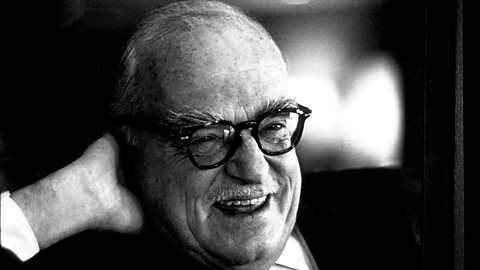
Thornton Wilder was a Pulitzer Prize-winning novelist and playwright, born in America in 1897. He is the only writer so far who has won Pulitzers for both fiction and drama. At the age of 23, while studying Latin and archaeology, Wilder attended a ‘dig’ in Rome, unearthing artefacts from a first-century Roman family. Seeing items that had been dear to the family and images of them from hundreds of years ago while hearing the passing traffic of the modern world left an impression on Wilder; he realised that in this juxtaposition between ancient and modern worlds there were threads of universal similarity in what people thought, felt and did, no matter what time period they lived in. This foundational idea for the play can be seen in the Act One reference the Stage Manager makes to ancient Babylon and how little is known of the everyday lives of its people.
Our Town was partly inspired by Dante’s Purgatorio, a section of his 14th-century epic poem The Divine Comedy. In it, Dante is a character himself and climbs out of Hell and towards Heaven via a steep mountain representing Purgatory, the place where sinners wait to be purified before being allowed into Heaven. He meets various characters from different eras of history along the way and hears their stories of the sins they committed and the lives they led.
Another text that inspired Wilder was a novel by his friend, Gertrude Stein, The Making of Americans, which traced the history of two fictional American families. Stein was a modernist, interested in playing with traditional methods of storytelling and in drawing more attention to how words create meaning than to how plots and characters unfold. She interspersed the families’ stories with digressions about human psychology, the evolution of the human race and her own experiences of writing the book itself. A critic compared the novel’s story to a “great spiral” and wrote: “The people in this world appear to be motionless at every stage of their progress. Each one is simultaneously being born, arriving at all ages and dying.” The multi-layered nature of the book, as well as its metatheatrical When a play reminds you it is a play. It tells the audience they are watching a performance, rather than trying to create a completely believable “real world”. references to the fact that it is constructed as a book and does not simply appear as a fully formed story of the families, are details that influenced Wilder’s presentation of Our Town. The character of the Stage Manager, the multiple references to Our Town being a play that are made by characters performing in it, and other such devices owe a debt to Stein’s modernist novel. Its focus is on interior feelings, rather than outward events.
Our Town won the 1938 Pulitzer Prize for Drama by unanimous recommendation of the judges. When it was first licensed for amateur production in 1939, over 650 theatre companies and community player societies staged productions in the first two years alone. It remains a widely and frequently performed play: theatre companies appreciate the lack of costly scenery and staging, while audiences continue to value its universal themes of love, loss and everyday life.
Key quotes from Our Town
| Theme | Quotes | Significance |
|---|---|---|
| Love and marriage | “People are meant to go through life two by two. ’Tain’t natural to be lonesome.” – Mrs Gibbs “I think that once you’ve found a person that you’re very fond of . . . I mean a person who’s fond of you, too, and likes you enough to be interested in your character. . . . Well, I think that’s just as important as college is, and even more so.” – George Gibbs “I’m celebrating because I’ve got a friend who tells me all the things that ought to be told me.” – George Gibbs “Almost everybody in the world gets married, — you know what I mean? In our town there aren’t hardly any exceptions. Most everybody in the world climbs into their graves married.” – Stage Manager “I was the scaredest young fella in the State of New Hampshire. I thought I’d make a mistake for sure. And when I saw you comin’ down that aisle I thought you were the prettiest girl I’d ever seen, but the only trouble was that I’d never seen you before. There I was in the Congregation Church marryin’ a total stranger.” – Dr Gibbs | In Our Town, marriage is shown to be something that is assumed to be normal and natural. It provides companionship and conversation, a foundation for raising children and the basis for the family home, the units out of which the whole community of Grover’s Corners is built. Weddings themselves are shown to be intimidating, and the expectations placed on young couples by society and even their own families may be difficult, but the play shows a number of ‘good’ marriages with care and friendship at their centre. It seems as though George and Emily’s relationship, which we see develop over years, will be one of these. |
| Life and time | “Does anyone ever realize life while they live it…every, every minute?” “No. Saints and poets maybe…they do some.” – Emily Webb and the Stage Manager “Oh, earth, you're too wonderful for anybody to realize you.” – Emily Webb “Let's really look at one another!.. It goes so fast. We don't have time to look at one another. I didn't realize. So all that was going on and we never noticed… Wait! One more look.” – Emily Webb “Choose the least important day in your life. It will be important enough.” – Mrs Gibbs “There are the stars - doing their old, old crisscross journeys in the sky. Scholars haven't settled the matter yet, but they seem to think there are no living beings out there. Just chalk… or fire. Only this one is straining away, straining away all the time to make something of itself. Strain's so bad that every sixteen hours everybody lies down and gets a rest.” – Stage Manager “It’s like what one of those Middle West poets said: You’ve got to love life to have life, and you’ve got to have life to love life…It’s what they call a vicious circle.” – Stage Manager “Y'know — Babylon once had two million people in it, and all we know about 'em is the names of the kings and some copies of wheat contracts . . . and contracts for the sale of slaves. Yet every night all those families sat down to supper, and the father came home from his work, and the smoke went up the chimney, — same as here… So I'm going to have a copy of this play put in the cornerstone and the people a thousand years from now'll know a few simple facts about us… This is the way we were: in our growing up and in our marrying and in our living and in our dying.” – Stage Manager “Ma, I don’t want to grow old. Why’s everybody pushing me so?” – George Gibbs “But, Mother Gibbs, how can I ever forget that life? It’s all I know. It’s all I had.” – Emily Webb | The Stage Manager provides a kind of wider commentary throughout the play, which invites the audience to consider the place of Grover’s Corners in the wider world, and the place of small everyday occurrences in the overall miracle of life. The play explicitly discusses the history and society of the town (through characters like Professor Willard as well as the Stage Manager himself), links the townspeople’s everyday lives to those of ancient societies in Babylon, Rome, and Greece, and even considers the place of Grover’s Corners in the larger cosmos. Rebecca’s anecdote about the address on the letter and the Stage Manager’s musings about stars and eternity. Within this immense framing of space and time, Emily finds herself musing on small things – coffee, baths, sleeping – and wishing her family had actively engaged with each more on their ordinary mornings and had realised just how special life was. Wilder stated: “I have set the village against the largest dimensions of time and place” and noted that to focus on small things in Emily’s life like her homework or birthday presents is both frivolous (because so many other girls have existed or will exist with the same concerns) and important, because those things were important to her and can be universally important to anyone or everyone. Wilder meant to show that the individual aspects of life are deeply personal but also universal at the same time, because people’s cares, hopes and lives are often so much more similar than they are different. |
| Town and family | “Only it seems to me that once in your life before you die you ought to see a country where they don't talk in English and don't even want to.” – Mrs Gibbs “Good-by, Good-by, world. Good-by, Grover's Corners… Mama and Papa. Good-by to clocks ticking… and Mama's sunflowers. And food and coffee. And new-ironed dresses and hot baths…and sleeping and waking up. Oh, earth, you're too wonderful for anybody to realize you.” – Emily Webb “And let that be a lesson to you, George, never to ask advice on personal matters.” – Mr Webb “They’ll have a lot of troubles, I suppose, but that’s none of our business. Everybody has a right to their own troubles.” – Dr Gibbs “Oh, Mama, look at me one minute as though you really saw me. Mama, fourteen years have gone by. I'm dead. You're a grandmother, Mama! Wally's dead, too. His appendix burst on a camping trip to North Conway. We felt just terrible about it - don't you remember? But, just for a moment now we're all together. Mama, just for a moment we're happy. Let's really look at one another!.. I can't. I can't go on. It goes so fast. We don't have time to look at one another. I didn't realize.” – Emily Webb “I guess new people aren’t any better than old ones. I’ll bet they almost never are, Emily… I feel that you’re as good a friend as I’ve got. I don’t need to go and meet the people in other towns.” – George Gibbs | Grover’s Corners has characteristics shared by many small towns. The people who live there all know each other and are aware of each other’s business, good or bad. Many of the families are interlinked by marriage and those who leave often return; those who remain like Dr Gibbs do not often care to go elsewhere. The town atmosphere may stifle ambition somewhat – George gives up his chance at college to stay with Emily, while Emily never mentions college despite being remarked upon by several characters as being very bright and capable. However, when Joe Crowell leaves we hear he gets an excellent education only to be killed in war. The play doesn’t say whether it’s better to stay in place or go further afield, but accepts that the lives people live in a small town with little excitement are still significant to the people that live them. There is emphasis on the fact that people need each other, and that the love of a family is important in keeping people happy both individually and as a wider community. |
| Human nature | “Yes, now you know. Now you know! That's what it was to be alive. To move about in a cloud of ignorance; to go up and down trampling on the feelings of those…of those about you. To spend and waste time as though you had a million years. To be always at the mercy of one self-centred passion, or another. Now you know — that's the happy existence you wanted to go back to. Ignorance and blindness.” – Simon Stimson “Men aren’t naturally good; but girls are.” – George Gibbs “Wherever you come near the human race there’s layers and layers of nonsense.” – Stage Manager “Now there are some things we all know, but we don't take'm out and look at'm very often. We all know that something is eternal… There's something way down deep that's eternal about every human being.” – Stage Manager “No…I should have listened to you. That’s all human beings are! Just blind people.” – Emily Webb “Every child born into the world is nature’s attempt to make a perfect human being.” – Stage Manager | The play gives perspectives on several aspects of humanity, suggesting how rich and varied every life can be. Simon Stimson’s nihilism The belief that life has no real meaning, purpose, or value. and pessimism The tendency to expect the worst to happen, or to believe that situations and people are more likely to end badly than well.can be seen to persist after death, and may have contributed to the ‘troubles’ he suffered in life; meanwhile, the Stage Manager can acknowledge some follies and hypocrisies of humanity while still maintaining a warm and generally positive stance to life, without sentimentality or mawkishWriting, speech or behaviour that is overly sentimental or emotional in a way that feels exaggerated, insincere or uncomfortable. . Emily is new to being dead – she is still jarred by the change, aware of the living world and afraid to let go of it. Her sense of appreciation for even the little things in life is heightened by her loss, allowing the audience to re-evaluate what truly matters and suggesting that they too should appreciate more of life while they still have it. |
Test your knowledge of quotations from Our Town
More on Our Town
Find out more by working through a topic
- count1 of 4
- count2 of 4