What is the Solar System?
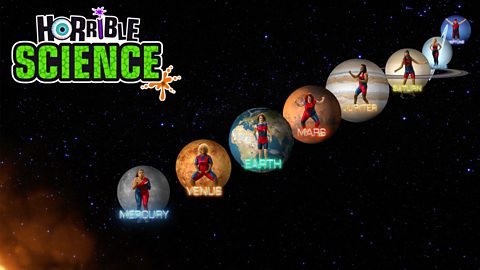
The Solar System is our big space neighbourhood and Earth is one of the homes in it! At the centre of the Solar System is the Sun. It is a giant ball of hot gas that gives us light and heat.
All the planets move around the Sun in paths called orbits. Starting from the planet closest to the Sun, the planets are:
Mercury, Venus, Earth, Mars, Jupiter, Saturn, Uranus, and Neptune.
The planets don’t all look the same. Some are rocky like Earth and Mars. Others are made of gas like Jupiter and Saturn.
Watch: Galactic Gladiators
Planets, ready! Gladiators, ready! Time to take on all the planets in the Solar System.
VOICEOVER: These guys know what it's like to hang tough. They've been doing it in the night sky for billions of years. Say hello to the universe's biggest stars or planets, because that's what they are. It's the Galactic Gladiators.
Closest to the Sun is Mercury. She may be small, but she has magnetic tornadoes 500 miles wide. And you thought Cyclone was wild?
Next up is Venus. Good luck landing a blow on her in Duel. She has clouds of toxic acid rain that would dissolve your pugil sticks. And also you. And also that umbrella.
The third rock from the Sun is Earth.
EARTH: Hello!
VOICEOVER: He may be small, but his liquid water means he's full of life. Deadly life like Vipers. There's one now. Oh, that's right to look terrified. Viper could snap him like a twig. A twig with a terrible moustache.
EARTH: I would fight you, but I don't feel like it.
VOICEOVER: Next up is Mars. Her violent dust storms can last weeks.
Uh, oh!
Another one bites the dust storm. Planet five is Jupiter. Oh, this Powerball is so big, you can fit 1000 Earths inside him. He's a true gas giant.
Uh oh.
I think he just unleashed.
Twinkle, twinkle little Saturn. A clobbering is about to happen. He'll run rings around you with his seven rings. He's also yellow from the ammonia in his atmosphere. You know. The stuff you get in pee.
SATURN: Can we focus on the twinkle? Less on the tinkle. Thank you.
VOICEOVER: Number seven is Uranus. She's ice cold at -224 degrees. She can freeze and snap off anything.
ADJUDICATOR: Foam fingers. Contestants' fingers. Baguettes.
VOICEOVER: Wait. Where did she get baguettes from?
And finally, it's Neptune.
He may seem distant because he is. He's the furthest planet from the Sun.
He's in an atmosphere all on his own.
The Galactic Gladiators.
The solar system's real stars.
Do the planets move?
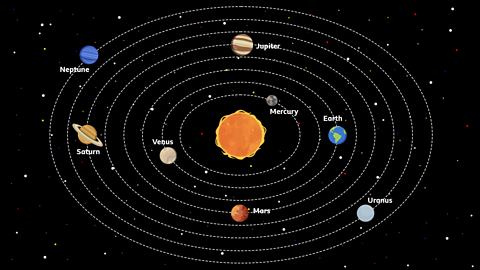
Yes! Planets move all the time. The planets in our Solar System are constantly moving around the Sun, which sits right in the centre. The path each planet follows is called an orbit. It’s like an invisible track in space!
The Sun’s powerful gravity pulls each planet towards it, keeping the planets on their paths and stopping them from flying away.
Each planet has its own orbit and takes a different amount of time to go all the way around the Sun. This is what we call a year. For example, Earth takes around 365 days to orbit the Sun, while Neptune takes about 165 years to do just one orbit because it’s much further away. The planets are like runners on different tracks all moving around our shining Sun.
Horrible Science fact
The planet Uranus actually smells terrible! Scientists discovered that its atmosphere has a lot of hydrogen sulphide which is the same gas that makes rotten eggs and farts smell bad! Luckily, Uranus is about 1.8 billion miles away from Earth, so we don’t have to worry about smelling it here on Earth.
Find out more about the Solar System.
Play the Stinky Space game to find out more about the planets of our Solar System.
Quiz
How to use Horrible Science in the classroom
If you're looking to bring energy, humour and curriculum-aligned content into your science lessons, Horrible Science might just be your new secret weapon.
More on Horrible Science
Find out more by working through a topic
- count4 of 50
- count5 of 50
- count6 of 50