How is sound made?
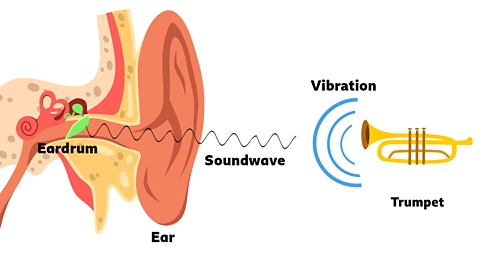
Sound happens when something vibrates. A vibration is a quick back-and-forth movement that creates waves in the air, which our ears can detect as sound.
In musical instruments such as trumpets, the player’s lips vibrate to create sound. The faster the vibrations, the higher the pitch.
Louder sounds happen when the vibrations are stronger.
Watch: First honk of the proms
It’s nearly time for the proms, but will Grace be able to get her vibrations right and give a star performance?
NARRATOR: The Royal Albert Hall is hosting a groundbreaking concert.
GRACE: Morning.
NARRATOR: Featuring a once in a lifetime performance.
From a soloist with a very special instrument…
…her bum.
SOUND: FARTING AND INSTRUMENT NOISES
NARRATOR: This is the First Honk of the Proms.
SOUND: MORE FARTING NOISES
GRACE: Let's have an A.
SOUND: FARTS IN TUNE WITH NOTE
GRACE: And a B.
SOUND: FARTS IN TUNE WITH NOTE
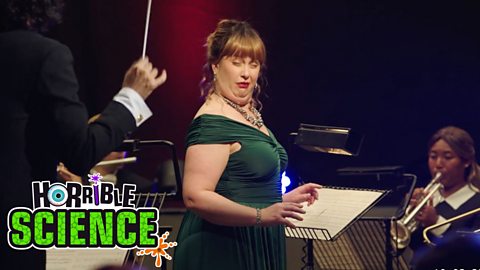
GRACE: Farting is just like playing a brass instrument. With a trumpet sound is made by vibrating your lips as you blow air into the mouthpiece.
KLAUS VON PARPER: Okay. From the bottom, ja?
GRACE: I'm doing the same thing. Except the mouthpiece is my bum and the air is a trump.
SOUND: MUSIC PLAYS WITH FARTS ACCOMPANYING
GRACE: Mine's the one instrument where a bum note is a good thing.
NARRATOR: With one week to go until the big night.
SOUND: MANY FARTS
NARRATOR: The wind is blowing in the wrong direction.
SOUND: FREQUENT FARTS
KLAUS VON PARPER: No, no, no, no, no. That was wrong!
GRACE: Um, actually, that last one wasn't me.
KLAUS VON PARPER: Philip, out! We don't need two trouser trumpets in the orchestra.
SOUND: PHILIP CRIES
KLAUS VON PARPER: Grace, I want passion. I want you to open up.
GRACE: That sounds risky.
KLAUS VON PARPER: Take risks.
KLAUS VON PARPER: The bottom is like a brass instrument.
For a louder sound, you blow out more gas more quickly.
I want the audience to hear your talent.
If they're near the front, I want them to smell it. Maybe even… …taste it.
NARRATOR: But with showtime approaching. There are more problems.
GRACE: I'm too nervous to guff!
KLAUS VON PARPER: Oh, come on. I believe in you.
GRACE: Okay.
SOUND: MASSIVE FART
KLAUS VON PARPER: Oh, the curtains will open tonight.
And all the doors and windows. Euuurgh.
Shepherd's pie?
GRACE: Yes. Oh, well done.
NARRATOR: And with the beefy smell of anticipation in the air. It's time for the final performance.
SOUND: ORCHESTRA PLAYS WITH FART SOLOS
NARRATOR: Grace has done it. It's a performance they'll never forget.
KLAUS VON PARPER: Fabulous. Fabulous.
GRACE: I don't know if my instrument's going to change the world, but I'm certainly going to change my underwear.
KLAUS VON PARPER: Philip! I know at least one of those was yours.
What makes one instrument sound different from another?
Every musical instrument has unique properties that affect the sounds it produces. These properties control how the vibrations behave, which changes what we hear.
Some properties describe the instrument that makes it and others describe the sound produced.
The material an instrument is made from is one of the properties that can affect its sound. Instruments made from metal, wood or plastic can sound different, even if they are the same shape, because different materials vibrate in different ways.
Some examples of the properties of sound are pitch and volume.
- Pitch is used to describe how high or low a sound is. Faster vibrations create higher-pitched sounds, while slower vibrations make lower-pitched sounds.
- Volume describes how loud or quiet a sound is. Stronger vibrations produce louder sounds.
In brass instruments, the player’s lips act like a reed (a thin piece of material that vibrates to produce sound in a woodwind instrument) vibrating air through the instrument. In these instruments valves or slides can change the pitch by making the air travel longer or shorter distances.
The length of the vibrating column of air inside the instrument affects the pitch of the sound it makes:
a longer column makes a lower sound
a shorter column makes a higher sound
Horrible Science fact
Humans can hear pitches from as low as 20 vibrations per second up to as high as 20,000 vibrations per second … including farts!
Dogs can hear much higher pitches than humans – up to 45,000 vibrations per second! This is why they can hear high-pitched whistles, but we can’t.
Quiz
How to use Horrible Science in the classroom
If you're looking to bring energy, humour and curriculum-aligned content into your science lessons, Horrible Science might just be your new secret weapon.

More on Horrible Science
Find out more by working through a topic
- count24 of 50

- count25 of 50
- count26 of 50

- count27 of 50