What is a decibel?
A decibel (dB) is a unit used to measure how loud a sound is. The louder the sound, the higher the decibel number.
Sounds are made when something vibrates, creating sound waves that travel through the air to our ears.
- Quiet sounds, like breathing, have low decibel levels.
- Loud sounds, like drills or thunder, have much higher decibel levels.
Decibels work on a special scale, where a small increase in number can mean a big increase in loudness.
Watch: Decibel Countdown
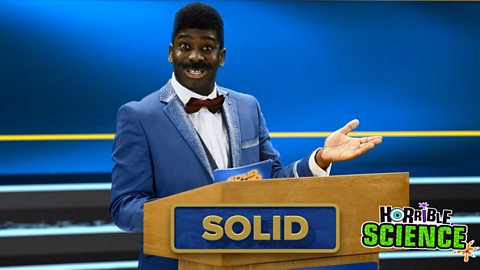
Michaela and Barry loudly explore how sounds are measured in decibels.
BARRY LOUD: I'm Barry Loud.
MICHAELA EXPLOSION: And I'm Michaela Explosion. Welcome to the Loud Explosion Decibel Ranking Countdown Show. This is the show where we rank every sound in the world by how loud it is.
BARRY LOUD: We measure everything in decibels, which is the standard unit for measuring sound intensity.
MICHAELA EXPLOSION: Oh, it's basically how loud something is.
BARRY LOUD: So let's start our countdown in at 10 decibels. It's the sound of your own breathing.
BOTH: Ooh.
MICHAELA EXPLOSION: Love that. Next, jumping up one place to 20 decibels. It's a whisper.
WOMAN: Please don't film me.
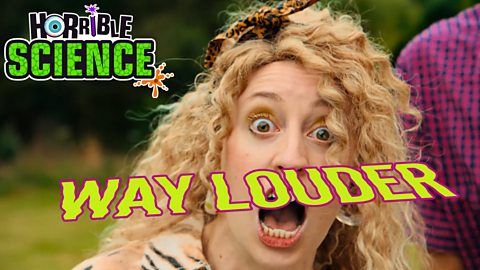
MICHAELA EXPLOSION: Oh. Weirdly, even though 20 decibels looks like. It's just 10 decibels more than 10 decibels, it's actually ten times as intense. Which is way louder.
BARRY LOUD: And in at 60 decibels, it's the volume of a normal conversation. Oh she's gone?
MICHAELA EXPLOSION: There!
WOMAN: Why are you following me?
BARRY LOUD: We're having a normal conversation.
WOMAN: This is not normal.
[SILLY NONSENSE NOISES]
BARRY LOUD: Next in our countdown, up at 70 decibels. That's 10 decibels more than a normal conversation. It's the sound of an alarm clock.
WOMAN: That's way louder than a normal conversation.
WOMAN: How is that only 10 decibels more?
BARRY LOUD: Well, it's like we said, the decibel scale is weird. A 10 decibel increase is 10 times more intense.
WOMAN: Will you please stop following me?
BARRY LOUD: Oh, and in at 80 decibels, it's the sound of a fart.
WOMAN: Hey. I wouldn't say that was at 80.
MICHAELA EXPLOSION: The average fart is 100 times more intense than normal conversation.
BARRY LOUD: Oh, that just reached me.
MICHAELA EXPLOSION: And in at 100 decibels is a pneumatic drill.
WOMAN: It's so loud.
MICHAELA EXPLOSION: Thanks.
BARRY LOUD: Next in the countdown.
MICHAELA EXPLOSION: A non mover at 120 decibels. It's a thunderclap.
WOMAN: What even is this show?
BARRY LOUD: But a new entry in at 129 decibels is the Guinness World Record holder for an individual scream - teaching assistant Jill Drake.
JILL DRAKE: Hello?
[JILL SCREAMS]
BARRY LOUD: Well, that's all we got time for this week. Tune in next week when hopefully your ears will have recovered.
[SCREAMS]
How does loudness change?
Loudness depends on how strong the vibrations are. Bigger, stronger vibrations make louder sounds. Smaller vibrations make quieter sounds.
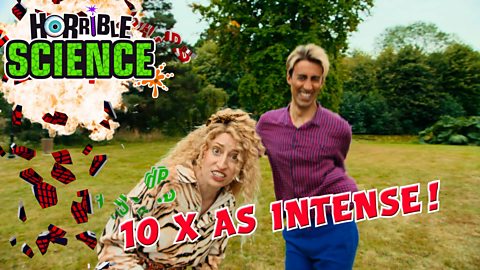
Decibels increase in steps, but they do not increase evenly. An increase of 10 decibels means the sound is ten times stronger, not just a little bit louder.
For example:
breathing is about 10dB
normal conversation is around 60dB
a drill can reach 95dB
thunder can be over 120dB
A pneumatic drill is very loud, producing sounds of about 100 to 110 decibels (dB). This is loud enough to damage your hearing if you hear it for too long, which is why people using them should wear ear protection.
Horrible Science fact
The loudest sounds ever recorded include volcanic eruptions and massive explosions, which can reach over 200 decibels, which is loud enough to cause instant damage to your hearing.
That’s louder than a jet engine taking off and definitely louder than your alarm clock on a Monday morning!
Quiz
How to use Horrible Science in the classroom
If you're looking to bring energy, humour and curriculum-aligned content into your science lessons, Horrible Science might just be your new secret weapon.

More on Horrible Science
Find out more by working through a topic
- count27 of 50

- count28 of 50
- count29 of 50
- count30 of 50