How did Tutankhamun become Pharaoh?
Pharaohs were the kings of Ancient Egypt.
They ruled over the land, collected taxes from the people, enforced the law and led the Egyptian army against invaders.
Tutankhamun, also known as King Tut or The Boy King, became pharaoh when he was around 9 years old and was the last of his dynasty of pharaohs.
He ruled for a short time, after the death of his father Akhenaten.
King Akhenaten was not very popular because he outlawed all gods apart from Aten.
After King Akhenaten’s death, the people destroyed many of his statues and monuments because they were unhappy with how he had ruled.
Important words
Important words on Tutankhamun.
| Keyword | Definition |
|---|---|
| Dynasty | A family line of rulers. |
| Funerary bed or couch | Is a bed that would carry the deceased into the afterlife. |
| Outlawed | Made illegal or banned. |
| Pharaoh | A king or queen who ruled over the land, collected taxes, enforced the law and led the army. |
| Significance | A past event or person who is important. |
Timeline: Ancient Egypt
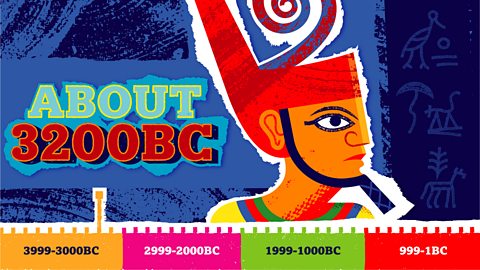
Image caption, Click the arrows learn more about the timeline of Ancient Egypt!
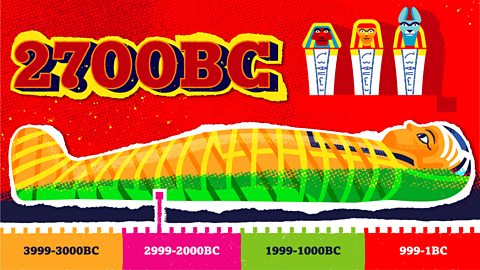
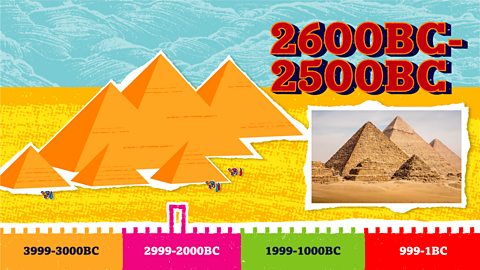
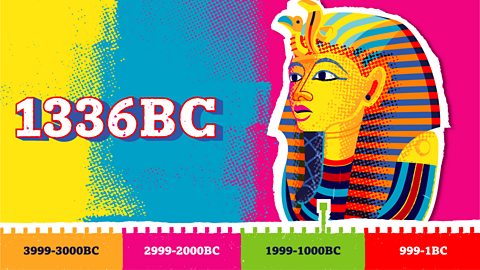
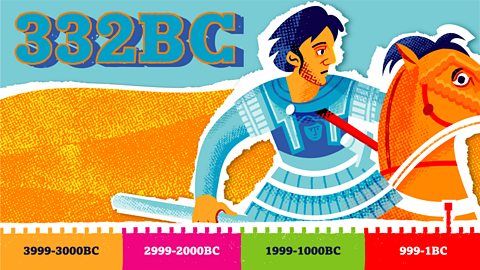
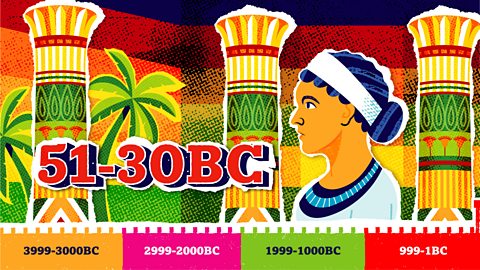
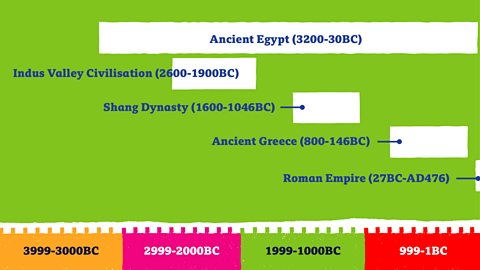
1 of 8
Watch: Who was Tutankhamun?
Watch the video to learn about King Tutankhamun.
Learn about the famous Egyptian Pharaoh Tutankhamun.
Child: Tutankhamun, ruler of Egypt, from around 1332 to 1323BC.
Tutankhamun: Yes, that’s me.
Child: You’re Tutankhamun?
Tutankhamun: The very same.
Child: I was expecting someone…
Tutankhamun: Older? I’ve been king since I was nine you know.
Child: Wow! I wasn’t even allowed to walk to school on my own and you’re in charge of a whole country?
Tutankhamun: I do have advisers. General Horemheb and an official called Ay, who help me make decisions.
Child: You haven’t ruled for long though.
You must have made a big impression!
Tutankhamun: Ah, that’s mainly because I fixed some mistakes my dad made.
You see, he forced everyone to worship a god called Aten which was pretty unpopular…
So I’ve let people worship their old gods and built lots of statues to them.
Child: So what’s all this stuff?
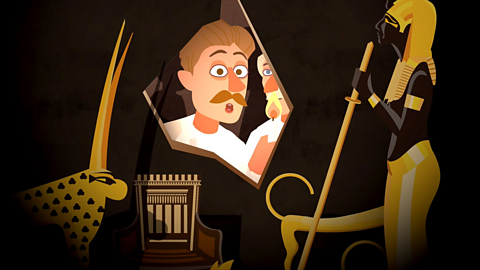
Tutankhamun: Just a few bits and pieces I’ll bring on my journey into the afterlife.
Child: Woah! You’ve got jewellery, chariots, furniture, wine, weapons… and board games?
Tutankhamun: Well, the afterlife goes on for a while so I’ll need something to do.
Child: I hope you’ll keep this lot safely tucked away in a tomb.
Tutankhamun: Yeah, sure, it’ll be in a tomb in the Valley of the Kings, so it’s like… well safe!
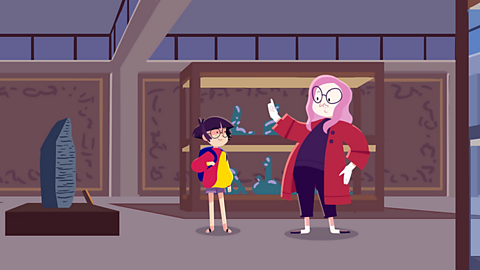
Child: I wouldn’t be so sure. My local museum has lots of things archaeologists have brought back from expeditions to Egypt.
I’m sure some of these items look familiar.
Explorer: Can you see anything?
Howard Carter: Yes! Wonderful things. Wonderful things!
What do we know about Tutankhamun?
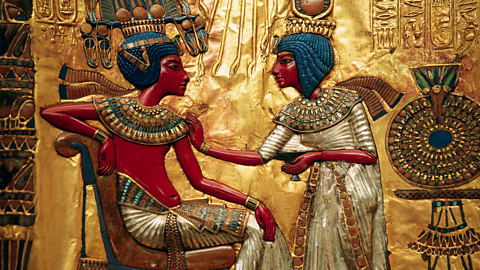
Tutankhamun inherited the throne around age 9 and became Pharaoh in around 1332 BC.
Because he was so young, he had powerful advisers around him to help him rule Egypt.
They included General Horemheb and Grand Vizier Ay.
Tutankhamun reversed many decisions made by his father, King Akhenaten.
King Akhenaten had outlawed (made illegal or banned) the traditional gods of Ancient Egypt.
Tutankhamun let people worship the old gods again and made sure the damaged temples were repaired.
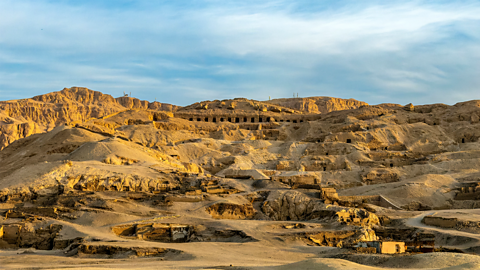
He moved the Egyptian capital back to Thebes.
Tutankhamun reigned for roughly 10 years.
He died around the age of 18, possibly from malaria or a broken leg from a chariot accident.
He was buried in a tomb in the Valley of the Kings, the burial ground for the Pharaohs and most important nobles.
Tutankhamun married his half-sister but their children did not survive.
He was succeeded by his vizier (the highest official after the Pharaoh), Ay.
Watch: Tutankhamun's tomb
Watch the video to learn more about Tutankhamun's tomb.
Dan Cruikshank tells the story of Howard Carter's discovery of Tutankhamun's tomb.
This is it. This where it happened. The magical moment. Where Carter found the entrance to the tomb.
It’s been tidied up a bit since his time but nevertheless it’s all very exciting.
Down these few steps is the entrance to the tomb itself.
This is the first door where Carter found the seals intact. He then removed the rubble and go down a descending passage as I am now.
Carter reached the second door here it is. Also filled with rubble, plastered over, seals intact. Goodness me, this is exciting.
Well, he then met a hole here, I suppose hoping against hope that they wouldn’t see a sea of devastation. Look through this little huddle and saw something that made him turn back to Carnarvon up there and say ‘I can see wonderful things’.
He realised the tomb had not been pillaged by robbers in antiquity much survived.
He saw in front of him a series of ritual couches, gilded with animal heads, chests down there, a great treasury of artefacts, bits of chariots all around.
And over here, where we came in, there is a wall since removed, a rubble wall, dividing this the antechamber from the burial chamber.
Here we see the sarcophagus of Tutankhamun with all the coffins inside it. Of course inside that coffin is the young pharaoh’s body.
Why is Tutankhamun’s tomb so famous?
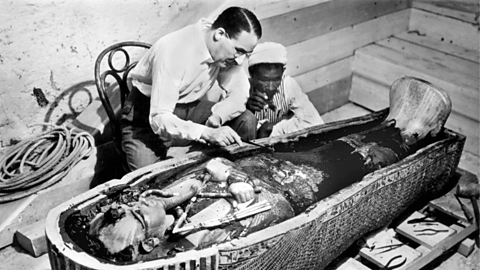
Tutankhamun's tomb was hidden for many centuries.
It was covered in debris from other tombs and then hidden by workers' houses.
In 1907 it was declared that there was nothing left to find at the Valley of the Kings but in 1922 the Egyptologist (someone who studies Egypt) Howard Carter discovered the tomb.
On the 17th February, 1923, the seal to the tomb was broken and a living human stepped inside for the first time in 3,200 years.
What was inside Tutankhamun's tomb?
The tomb contained 5,398 items, including:
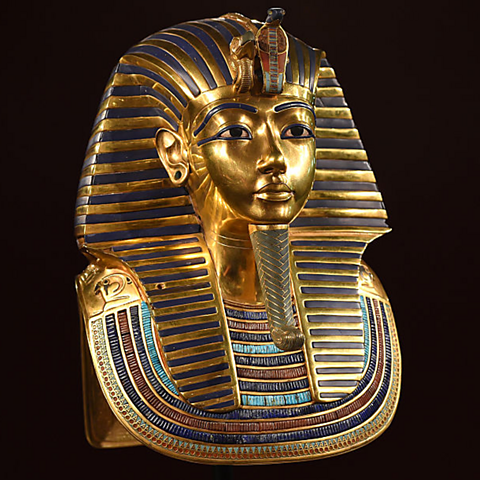
- Tutankhamun’s famous golden death mask
- a solid gold coffin
- thrones
- trumpets
- fresh linen
- a chariot
- a dagger made from meteorite iron.
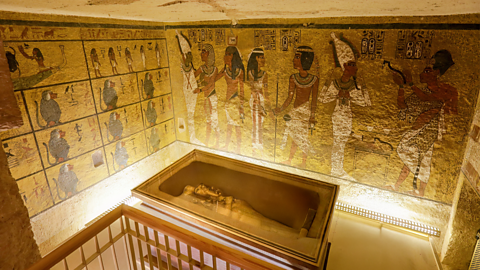
It took Howard Carter 10 years to catalogue the finds from the tomb.
Parts of Tutankhamun’s chest with a beaded collar were stolen after the discovery, along with his skull cap!
What did Tutankhamun look like?
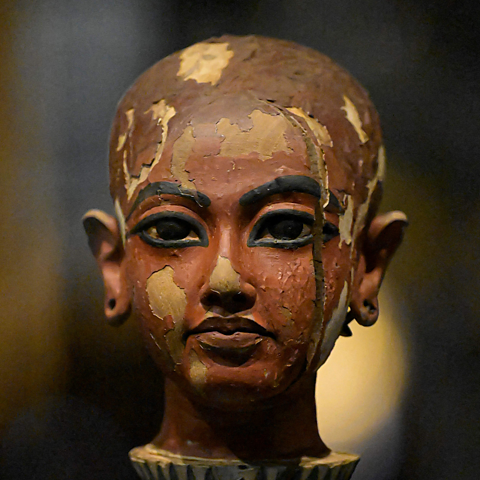
We know what Tutankhamun looked like because scientists have done experiments on his skull, bones and DNA.
We know that Tutankhamun was slim, 5’6” tall with rounded hips, a narrow waist and large front teeth.
Tutankhamun's tomb also had statues and artwork that showed what he may have looked like.
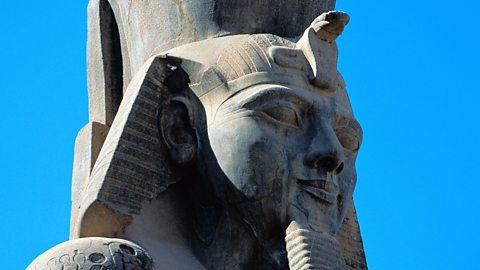
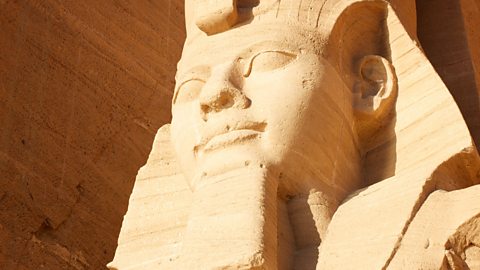
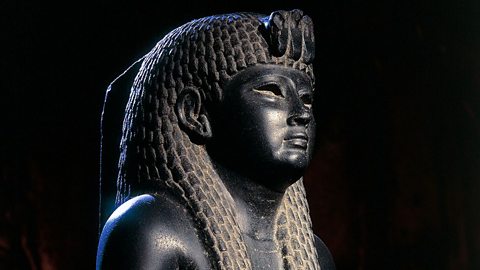
Slideshow: Famous Pharoahs
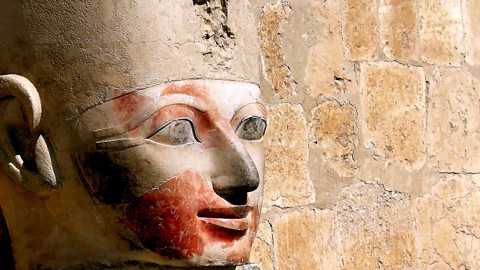
Image caption, Hatshepsut (1478 - 1458BC)
Hatshepsut was the longest reigning female pharaoh of Ancient Egypt. She ruled for about 21 years. She is considered one of the most successful pharaohs. She became pharaoh after her husband died, because her stepson was too young to rule. She commissioned hundreds of grand buildings and established important trade routes.
1 of 4
Think like a historian
Have a look at the thinking point below and think about your answer to the question. You could even write it down on a piece of paper or discuss it with somebody else if you want to.
- Why do you think the discovery of Tutankhamun’s tomb is significant?
You many have thought that the discovery was significant because in 1907 the Valley of the Kings had been declared empty!
Perhaps you thought the discovery allowed archaeologists and historians a greater insight into the Ancient Egyptians, their beliefs and customs.
Maybe you thought it was significant because he was a child king and what was inside the tomb was perhaps different to what was in adult pharaohs tombs?
Or, you might have wondered that it was a significant discovery because no-one else had managed to find it and it hadn't been raided like lots of other tombs in the Valley of the Kings.
Activities
Activity 1: Solve the puzzle
Activity 2: Quiz – King Tutankhamun
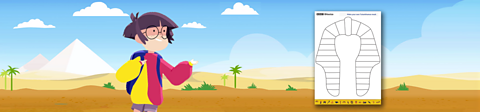
Activity 3: Make your own Tutankhamun mask
Make your own Tutankhamun mask. document
Download the ancient Egyptian headdress, colour it in and after placing it on your head, declare yourself Pharoah!
Activity 4: History Explorer game
Play this game to test your knowledge and learn even more facts about Ancient Egypt.
History Explorer: Secrets through time
History Explorer: Secrets through time: KS2 History
Grown-ups corner
Are you a parent, carer or teacher?
Take a look at some of the links below on KS2 History which are packed full of knowledge, videos, quizzes and activities.
KS2 History: Ancient Egypt
BBC Bitesize for Teachers
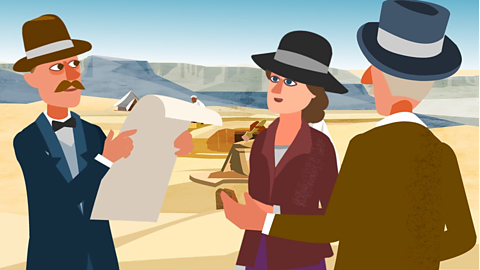
KS2 History: Ancient Egypt. King Tutankhamun
BBC Bitesize for Teachers
KS2 Music: Ancient Egypt. Song: 'Out of the gloom, Tutankhamun'
BBC Bitesize School Radio
Horrible Histories: Raid and Trade game! game
Play Horrible Histories: Raid and Trade KS2 History
More on Ancient Egypt
Find out more by working through a topic
- count8 of 18
- count9 of 18
- count10 of 18
- count11 of 18