What can hieroglyphs tell us about Ancient Egypt?
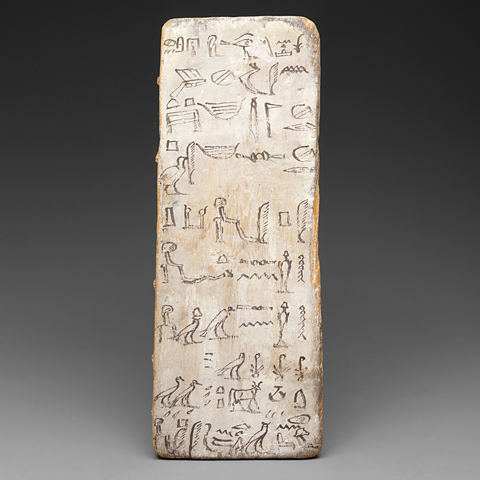
Hieroglyphs are picture symbols used by the Ancient Egyptians to show words and sounds.
They were invented around 3000BC.
There were about 700 signs.
They show us important events and stories about Pharaohs, what people did in their daily life and how they worshipped gods and goddesses.
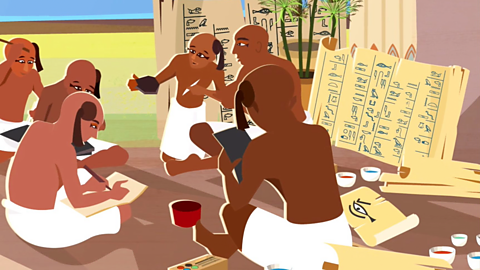
Only scribes (a person who wrote hieroglyphs or documents) and priests (someone who worked in temples and worshipped gods) could read and write them.
Not many people in Ancient Egypt could read and write so being a scribe was a respected role.
The Rosetta Stone, found in 1799, helped people understand hieroglyphs.
It was like cracking a code, finally allowing historians to understand the language of the Ancient Egyptians.
Important words
Important words on Ancient Egyptian hieroglyphs.
| Keyword | Definition |
|---|---|
| Hieroglyphs | Pictures and symbols used by Ancient Egyptians for writing. |
| Priest | Someone who worked in temples and worshipped gods. |
| Rosetta Stone | A carved stone from found near Rosetta in 1799. Its text is written in 3 languages: Greek, hieroglyphs and demotic. |
| Scribe | A person who wrote hieroglyphs or documents. |
| Tombs | Special places where people were buried after they died. |
| Translate | To change writing from one language into another. |
What are hieroglyphs?
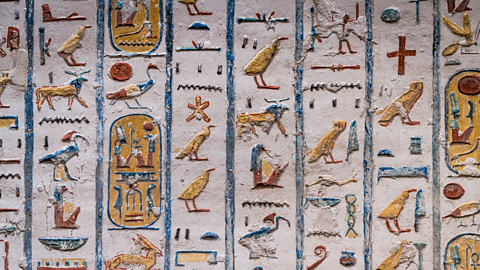
Hieroglyphs are picture symbols used to show words and sounds.
The Ancient Egyptians invented their own writing system, using hieroglyphs, in about 3000BC.
Hieroglyphs were known as ‘the words of God’ by the Ancient Egyptians.
They had about 700 different signs for objects and animals.
Who wrote hieroglyphs?
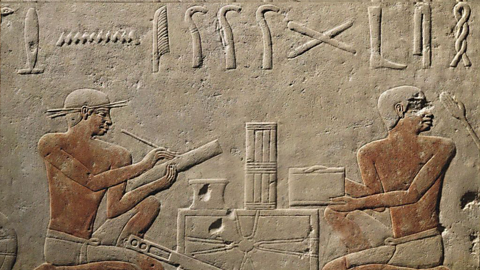
The people who wrote hieroglyphs were called scribes.
Scribes and priests were the only ones in Ancient Egypt who could read and write hieroglyphs.
Many people in Ancient Egypt could not read or write.
Many children had jobs or learned a trade.
Boys from wealthy families were trained to be scribes in schools.
They went to a special school to learn all the symbols.
The hieroglyph alphabet
The hieroglyph alphabet is a set of picture symbols that the ancient Egyptians used to represent sounds.
This is the closest version to our modern English alphabet.
There were no symbols for vowels (‘a’, ‘e’, ‘i’, ‘o’ or ‘u’), but there are some that sound similar.
What is the Rosetta stone?
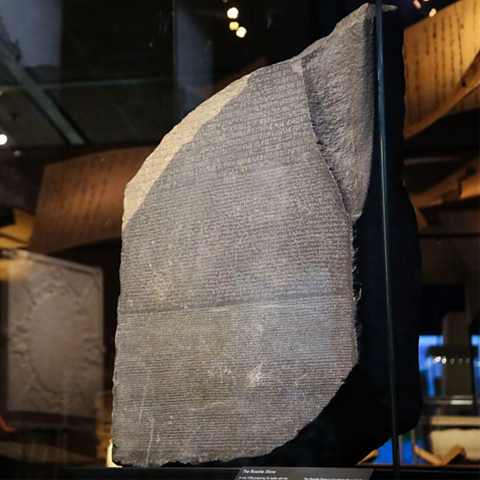
The Rosetta Stone was discovered in 1799 by a French soldier in Egypt.
It is over one metre tall and more than 2,000 years old.
The Rosetta Stone contained the same text written in three different languages;
- hieroglyphs
- demotic (the everyday Egyptian language)
- Ancient Greek
People already knew how to read Ancient Greek, so they used it to translate (to change writing from one language into another) the hieroglyphs.
Egyptologists translated the Greek into modern European languages.
Then they used those words to understand the ancient Egyptian hieroglyphs.
The writing on the Rosetta Stone is an official message about the king, Ptolemy V.
The message says that the temple priests in a city called Memphis supported the king.
Where have we found hieroglyphs?
Hieroglyphs are often found inside tombs (special places where people were buried after they died) and pyramids.
They tell us about the Pharaohs and their journeys to the afterlife.
Temples have walls covered in hieroglyphs.
They show religious ceremonies and offerings to the gods.
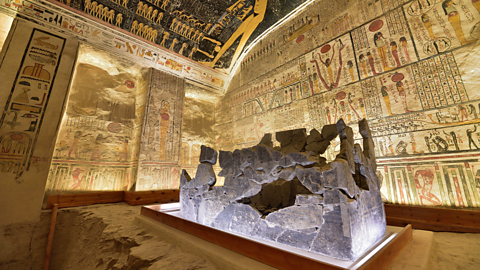
Hieroglyphs tell us about beliefs, gods, clothing and everyday life.
The Ancient Egyptians also used papyrus and writing boards to keep records of things like laws.
This is different from societies living at the same time who used no writing, such as the people who built Stonehenge.
Slideshow: Examples of hieroglyphs
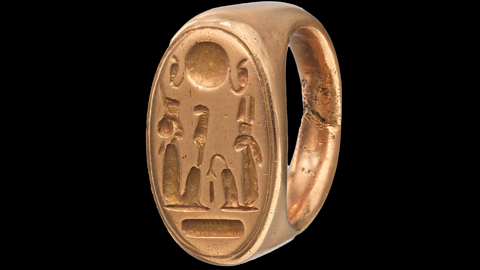
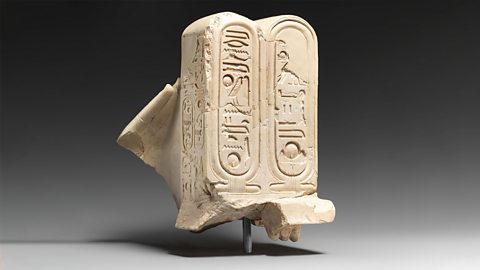
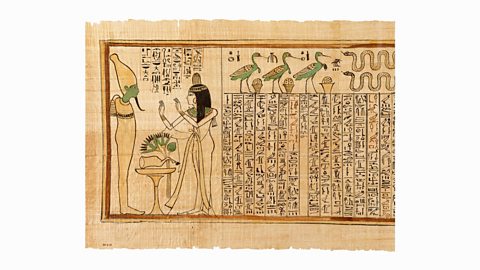
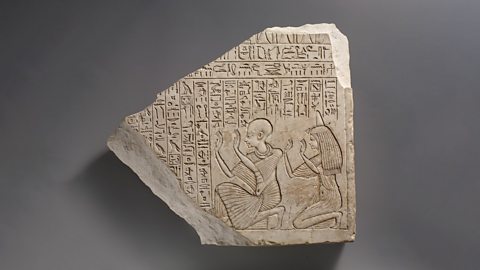
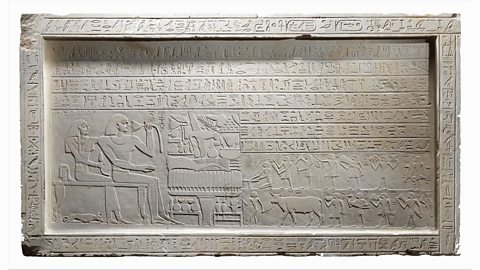
Click through the slideshow to see some examples of hieroglyphs on Ancient Egyptian artefacts.
- Image source, The Metropolitan Museum Of Art, New York
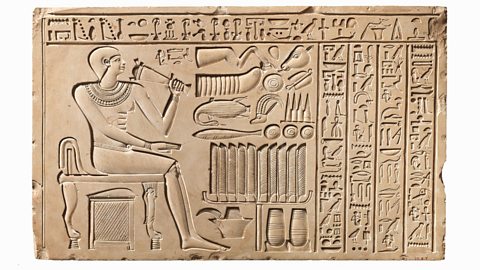
Image caption, Stone carving of Gatekeeper Maati, ca. 2051–2030BC
In this image, an official of Pharaoh Mentuhotep II, called Maati, sits in front of an offering table. It looks like a carving related to a funeral because the table is a stand with tall leaves. Food offerings float above the table and below it is a bowl for Maati to wash himself. The hieroglyphs on the right are traditional passages carved to remember the dead.
1 of 5
Think like a historian
Have a look at the thinking points below and think about your answer to the questions. You could even write it down on a piece of paper or discuss it with somebody else if you want to.
Who was able to read and write in Ancient Egypt and who couldn’t?
What can we learn from the Rosetta Stone?
Did you think about how not everyone in Ancient Egypt could read or write? In Ancient Egypt, only scribes and priests could read and write. Scribes went to special schools to learn all the hieroglyph symbols. Boys from rich families could become scribes, but many other children learned a job or helped their families instead of going to school.
Perhaps you thought about how the Rosetta Stone helped us understand hieroglyphs. We can read Ancient Egyptian hieroglyphs because the Rosetta Stone has the same message written in three languages: hieroglyphs, ancient Egyptian language and Greek. This helped historians and Egyptologists understand the stories, laws and messages that ancient Egyptians wrote thousands of years ago. It also shows us what life was like in Ancient Egypt and how important writing was to them.
Activities
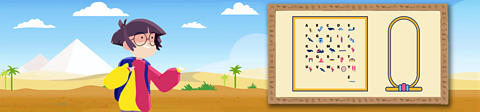
Use the hieroglyph alphabet below to help you complete the activities.

Activity 1: Spell with hieroglyphs
Use the hieroglyph alphabet above to help you spell the word.
Activity 2: Crack the hieroglyph code
Activity 3: Write your name in hieroglyphs
Practise your ancient Egyptian hieroglyphs. document
Download the ancient Egyptian alphabet and try to copy them. Can you write your name in hieroglyphs?
Activity 4: Hieroglyph quiz
Activity 5: History Explorer game
Play this game to test your knowledge and learn even more facts about Ancient Egypt.
History Explorer: Secrets through time
History Explorer: Secrets through time: KS2 History
Grown-ups corner
Are you a parent, carer or teacher?
Take a look at some of the links below on KS2 History which are packed full of knowledge, videos, quizzes and activities.
KS2 History: Ancient Egypt
BBC Bitesize for Teachers
KS2 Music: Ancient Egypt. Song: 'Amulets and hieroglyphs'
BBC Bitesize School Radio
KS2 Music: Ancient Egypt. Song: 'So many gods and goddesses'
BBC Bitesize Schools Radio
Horrible Histories: Raid and Trade game! game
Play Horrible Histories: Raid and Trade KS2 History
More on Ancient Egypt
Find out more by working through a topic
- count18 of 18
- count1 of 18
- count2 of 18
- count3 of 18