What are the key points about electromagnetic waves and radar?
Recall the 7 different regions of the The different types of electromagnetic radiation, arranged in order of frequency or wavelength..
Recall the names of the different regions in order.
Stateapplications and dangers of each region of the EM spectrum.
Explain how SONAR and RADAR work and perform echo calculations.
What are the common properties of electromagnetic waves?
A transverse wave caused by oscillations in an electromagnetic field. are members of a family of waves with common properties called the The different types of electromagnetic radiation, arranged in order of frequency or wavelength..
All electromagnetic waves:
are A wave that moves in a direction at right angles to the way in which the particles are vibrating.;
can travel through a A volume/ region of space that contains no matter.;
travel at exactly the same speed in a vacuum, the speed of light, 300,000,000 m/s.
Like all waves, electromagnetic waves:
transfer energy from one place to another;
can be reflected.
Differences
Each type of wave in the electromagnetic spectrum has different:
The length of a single wave, measured from one wave peak to the next.;
The number of waves produced each second. The unit of frequency is hertz (Hz)..
What is the electromagnetic spectrum?
The electromagnetic spectrum is a continuous range of The length of a single wave, measured from one wave peak to the next..
The types of radiation that occur in different parts of the spectrum have different uses and dangers - depending on their wavelength and The number of waves produced each second. The unit of frequency is hertz (Hz)..
There are seven members of electromagnetic family.
Radio waves have the lowest frequencies and longest wavelengths, while gamma waves have the highest frequencies and shortest wavelengths.
All of these waves travel at the same speed in a vacuum, which is the speed of light or about 300,000,000 m/s (metres per second).
Key fact
It is important to remember the order of the seven regions of the electromagnetic spectrum.
The following sentence might help: Rats and Mice In Venice Use eXtra Gondolas.
What are the hazards of electromagnetic radiation?
Over-exposure to certain types of electromagnetic radiation can be harmful.
The higher the The number of waves produced each second. The unit of frequency is hertz (Hz). of the radiation, the more energy it carries and the more damage it is likely to cause to the body.
Radio waves can cause a very small rise in the temperature of the human body - of up to 0.2oC. Some people claim the very low frequency radio waves from overhead power cables and mobile phone base stations near their homes has affected their health, although this has not been reliably proven.
Microwaves can cause internal heating of body tissues. The microwaves are absorbed by water molecules and vibrate vigorously, causing a rise in temperature.
Infrared radiation is felt as heat and causes skin to burn.
Visible light from a laser which is very intense can damage the retina at the back of the eye.
Ultraviolet can damage skin cells and lead to skin cancer and damage the eyes, it can cause skin to age prematurely.
X-rays damage cells inside the body. They cause dangerous Process by which electrons can be added or removed from an atom to create an ion. and when this happens with A collection of two or more atoms held together by chemical bonds. in living cells, the genetic material of a cell, the The part of the cells of living things that carries information about how they look and function. Everyone’s DNA is different, except identical twins who share the same DNA. is damaged. This can lead to cancer. This is why doctors and dentists stand behind protective screens when taking lots of X-rays.
Gamma rays also damage cells inside the body causing dangerous ionisation in living cells which damages DNA. This can lead to cell death and cancer.
What is ionising radiation?
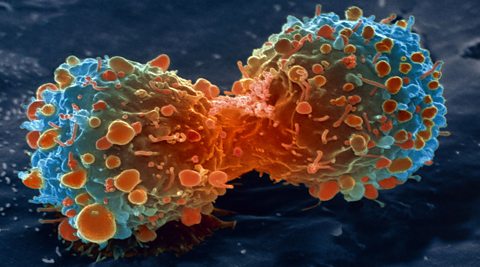
Ultraviolet waves, X-rays and gamma rays are types of ionising radiation.
This means that they have enough energy to knock electrons from the shells of atoms, turning them into Electrically charged particle, formed when an atom gains or loses electrons..
This process of ionisation can damage DNA in cells, leading to mutations in cells, which, in turn, can lead to cancer.
Ultraviolet radiation and suntan
Ultraviolet radiation, UV, is found naturally in sunlight.
We cannot see or feel ultraviolet radiation, but our skin responds to UV exposure by turning darker over time.
This is called a sun tan.
This is important, because prolonged exposure to ultraviolet radiation can cause skin cancer and damage to eyes.
It is sensible to wear high protection, UV blocking sunscreen on sunny days to avoid skin cancer.
Overexposure of our eyes to ultraviolet radiation can cause blindness, so we should also wear hats and sunglasses on sunny days.
It is worth remembering:
Reflections from snow, sand and concrete increases the intensity of UV radiation.
A light cloud cover does not block UV from the sun, and can still reach your skin.
Water reflects only a small amount of UV. The rest can penetrate below the water's surface, and so you are not safe from UV in the sea.
The following practices are recommended to minimise UV exposure when outdoors:
Avoid midday sun (10:00 a.m. - 3:00 p.m.).
Wear clothing that is tightly woven to block sunlight.
Wear a broad-brimmed hat that will shade your face, neck, and ears.
Apply waterproof sunscreen - Factor 30 or higher, to all sun exposed skin – don’t forget your ears and nose.
Wear UV protection sunglasses.

WATCH: What is the electromagnetic spectrum?
Here is everything you need to know about the electromagnetic spectrum in 90 seconds.
The EM spectrum is a group of waves which share three common properties.
One, they all travel through a vacuum. If you need a reminder, a vacuum is empty space.
Two, they all travel at the same speed in a vacuum: three times ten to the eight metres per second.
That’s the equivalent of a wave travelling around the circumference of the Earth 7.5 times in one second.
And three, they are all transverse waves.
Like the seven colours of the rainbow, there are seven types of wave on the electromagnetic spectrum.
The spectrum goes in order of increasing wavelength but decreasing frequency.
One, gamma rays. Gamma rays have the highest frequency, so they are the most dangerous waves. They are used to sterilise medical equipment, but they can also damage cells, which could lead to cancer.
Two, X-rays. We all know that X-rays are used in medical imaging to detect broken bones, but too much exposure to X-rays can also damage cells and lead to cancer, which is why radiographers stand behind a lead screen.
Three, ultraviolet rays. UV light is used to detect fake bank notes and to cure manicures, but too much exposure to UV rays can lead to skin cancer. UV rays in the sun are damaging and that’s why we need to use protection in the sun.
Four, visible light. This is what allows us to see, but even this can be damaging. Looking at a bright light source, like the sun, for too long can damage our eyes, leading to impaired vision.
Five, infrared waves. Infrared waves are used in remote controls, but they are felt as heat and, when too intense, can cause skin burns.
Six, microwaves. Microwaves are used to cook food quickly, but as useful as they are, microwaves can also be dangerous as they can cause internal heating of body tissues.
Seven, radio waves. Radio waves are used for communication and, with the lowest frequency, they are the least harmful waves on the electromagnetic spectrum, but even so, extremely large doses are believed to lead to cancer.
Okay, recap: there are seven waves in the electromagnetic spectrum, going from the smallest wavelength and highest frequency to the largest wavelength and smallest frequency. These are gamma rays, X-rays, ultraviolet rays, visible light, infrared, microwaves, and radio waves.
How do microwaves heat food? (Higher tier only)
Microwaves are used for cooking food in microwave ovens.
Microwaves are easily absorbed by water molecules in food, causing them to vibrate more vigorously.
The microwave energy is changed to heat energy as it is absorbed, which cooks the food.
That's why foods that are high in water content, like fresh vegetables, can be cooked more quickly in microwave ovens.

Example question
Radio 1 broadcasts on a frequency of 99.7 MHz.
Calculate the wavelength of Radio 1 waves.
Answer
Radio waves are electromagnetic waves and so their speed in a vacuum = 300,000,000 m/s.
v = f \(\lambda\)
v = 300,000,000 m/s
v = 300,000,000 m/s
f = 99.7 MHz = 99.7 x 10⁶ Hz
300,000,000 m/s = 99.7 x 10⁶ Hz x\(\lambda\)
\(\lambda\) = \(\frac{\text{300,000,000}}{\text{99.7 x 10}^{6}}\)
\(\lambda\) = 3.0 m
The wavelength of Radio 1 waves is 3.0 m.
Question
State three differences between sound waves and electromagnetic waves.
Answer
- Sound waves are A wave that moves in the same direction (parallel) as the direction in which the particles are vibrating. , electromagnetic waves are A wave that moves in a direction at right angles to the way in which the particles are vibrating..
- Sound waves cannot travel through a vacuum, electromagnetic waves can travel through a A volume/ region of space that contains no matter..
- Sound waves travel at 330 m/s through air, electromagnetic waves travel much faster, at 300,000.000 m/s through air.
What is radar?
Ultrasound travels at the speed of sound which is 330 m/s in air.
This is not fast enough to track fast, high-flying aircraft.
For example, an ultrasound pulse would take over 6 seconds to return after reflecting from an aircraft 1 km away.
By that time the aircraft would have moved position significantly.
So, instead of using ultrasound, radio waves are used as they travel at 300,000,000 m/s.
A radio wave echo from the same aircraft would return after 3 millionths of a second. (3µs).
This is why radar is used instead of sonar for aircraft.
Radar stands for Radio Detection And Ranging.
It works in the same way as sonar but with radio waves in place of ultrasound.
A short pulse of radio waves is transmitted and the time it takes for the reflection (the echo) to return is measured.
The distance is calculated using distance = speed x time.
As with sonar, it is important to remember to only use half of the time there and back when calculating the distance.
Example
People who study weather. use radar to track a storm.
A pulse of radar is reflected by the storm and returns to the receiver after 3 ms.
- How far away is the storm?
- Why do the meteorologists use radar to track the storm rather than sonar?
Answer
1. How far away is the storm?
Radar uses radio waves which are electromagnetic waves and travel at a speed of 300,000,000 m/s.
Distance = speed x time
Speed = 300,000,000 m/s
Time for the radio waves to travel to the storm and back = 3 ms.
This must be converted to seconds to use in the wave speed equation.
3 ms = \(\frac{\text{3}}{\text{1000}}\) = 0.003 s
Time for the radio waves to travel to the storm and back again = 0.003 s.
Time for the radio waves to travel to the storm = \(\frac{\text{0.003 s}}{\text{2}}\) = 0.0015 s
Distance = 300,000,000 m/s x 0.0015 s = 450,000 m = 450 km.
The storm is 450 km away.
2. Why do the meteorologists use radar to track the storm rather than sonar?
The meteorologists uses radar because the distance involved is so large and ultrasound travels relatively slowly at 330 m/s.
It would take sonar too long to travel to the storm and back, during which time the storm would have moved.
This would make it impossible to determine its position accurately.
WATCH: How do sonar and radar work?
Give me 90 seconds to explain how sonar and radar work.
Both sonar and radar use echoes to detect, locate and measure the distance to objects, a bit like how bats fly through a cave.
They emit a sound and the sound waves reflect off the walls of the cave.
The quicker the sound comes back the closer they are to a wall, allowing them to know when they need to turn.
Sonar, which stands for Sound Navigation and Ranging, uses sound waves to detect, locate and measure the distance to objects underwater.
Sound waves are used underwater because they travel much further than radio waves in water.
Submarines moving in the pitch‑black deep ocean use Sonar to guide them safely through the water.
They measure the time taken for a pulse to be sent out and returned to the submarine to find out how close they are to colliding with an object.
This is calculated using the formula distance equals speed times time over two.
We divide by two because the time measured is to the nearest object and back again, but the distance required is just the distance to the object.
Radar, which stands for Radio Detection and Ranging, uses radio waves to detect the presence, direction, distance and speed of objects.
Radio waves are used because they travel much faster than sound in air.
Radar is used in aviation so pilots can detect weather conditions ahead of them, allowing them to attempt to avoid thunderstorms and turbulence.
It also allows pilots to guide the aircraft onto the runway in difficult conditions where visibility may be reduced.
So to recap, sonar and radar work by sending out waves that reflect off objects and return to the source.
Sonar sends out sound waves underwater, while radar sends out radio waves in air.
The equation used for measuring distance using sonar is distance equals speed times time over two.
How do mobile phones work?
Mobile phones work by sending and receiving low powered radio waves.
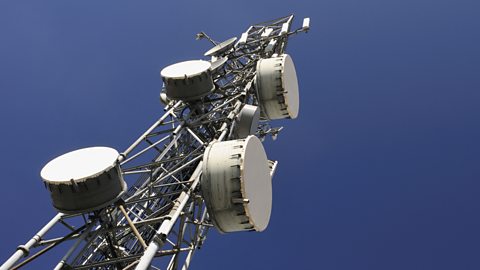
The radio waves are sent to, and received from, a mast or aerial, called a mobile phone base station.
The base station passes the signal/call into the landline network or on to the mast nearest the mobile phone the call is being made to.
Each mobile phone base station covers an area known as a cell.
Cells are aligned next to each other in a similar pattern to a honeycomb, and it is for this reason that mobile phone networks are sometimes referred to as cellular networks.
The phone masts can act as repeater stations, passing the call from mobile phone A to mobile phone B.
Base station transmitters/receivers are often positioned high up, often on tall radio masts.
They cannot be spaced so far apart that hills, tall buildings or the curvature of the Earth stop the beam.
What are the possible health risks of mobile phone use?
Mobile phones have only been in widespread use for a comparatively short time, so there is not much data about the possible long-term dangers of using them.
The phone is held close to the user’s head so the radio waves may have a small heating effect on the brain.
One of the few known effects of radio waves on the human body is a very small rise in temperature of up to 0.2oC.
Do mobile phones cause cancer?
As of 2026, according to Cancer Research UK, the best scientific evidence shows that using mobile phones does not increase the risk of cancer.
The radio waves that mobile phones or phone masts transmit and receive is non-ionising and is very weak.
This non-ionising radiation does not have enough energy to damage DNA and cannot directly cause cancer.
But research is still continuing, to make sure there aren’t any potential long-term effects.
Concerns have been raised that exposure to radio waves from mobile phones might cause various health problems, ranging from brain tumours, cancer and infertility to headaches, sickness and memory loss.
So far, studies have not found that users have suffered any serious ill effects.
How are microwaves used in satellite technology?
Microwaves are used to send signals to and from satellites.
The satellites can relay signals around the Earth.
Microwaves are used because they can pass through the Earth’s atmosphere and can travel through the vacuum of space.
The signals may be for television programmes, long distance telephone conversations, weather forecasting or spying.
Radio waves are not used to send signals to satellites as they are reflected by the Earth’s atmosphere and do not penetrate out into space and so would not reach the satellite.
How much do you know about electromagnetic waves and radar?
More on Waves
Find out more by working through a topic
- count1 of 4
- count2 of 4

- count3 of 4