What are the key learning points about echoes and sonar?
The display of different sound waves as traces on a cathode ray A device used to record signals that change regularly, such as sound or other vibrations. (CRO)
Amplitude (loudness) of a sound.
Frequency (pitch) of a sound.
The range and limit of human hearing.
The uses of Sound with a frequency greater than 20,000 Hz (20 kHz)..
Echo calculation in industry and medicine.
What type of waves are sound waves?
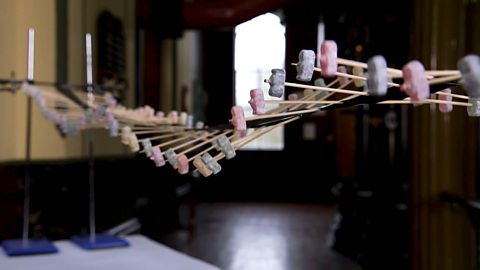
Sound waves are A wave that moves in the same direction (parallel) as the direction in which the particles are vibrating. .
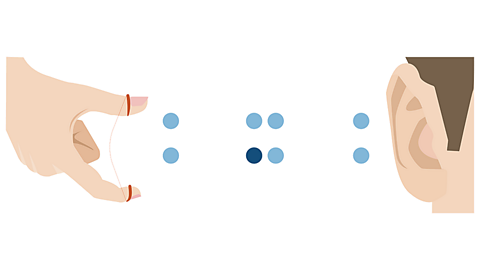
They cause particles to vibrate parallel to the direction of wave travel.
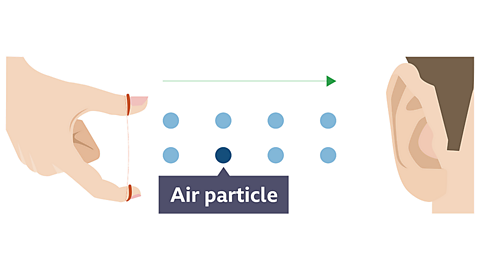
Image caption, How does sound travel?
When there is no sound, the air particles are still.
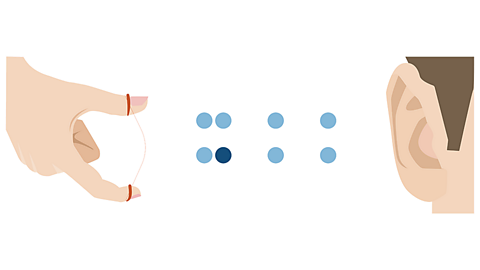
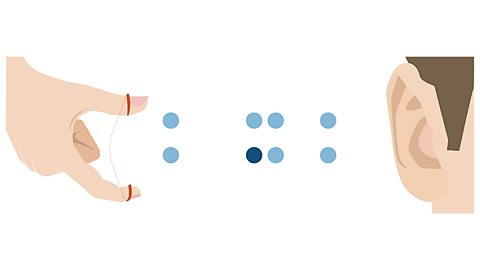
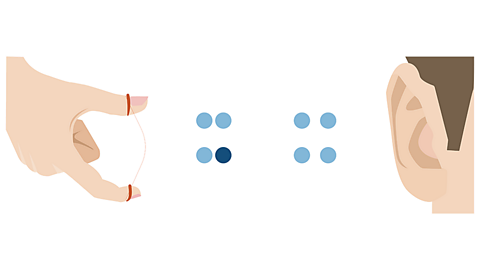
1 of 5
The vibrations can travel through solids, liquids or gases.
The speed of sound depends on the A material through which a wave can be transmitted (propagate). through which it is travelling.
When travelling through air, the speed of sound is about 340 m/s.
Sound cannot travel through a A volume of space that contains no matter. because there are no particles to carry the vibrations.
What are the properties of sound waves?
A device used to record signals that change regularly, such as sound or other vibrations. traces are a visual way to display sound waves.
The The amplitude of a wave is its maximum displacement from its undisturbed position. of a sound wave is related to the volume of the sound:
Small amplitude sound waves are quiet.
Large amplitude sound waves are loud.
The The number of waves produced each second. The unit of frequency is hertz (Hz). of a sound wave is related to the The frequency of a sound. Sounds with a high pitch have a high frequency. that is heard:
High frequency sound waves are high pitched.
Low frequency sound waves are low pitched.
Test
What is the range of human hearing?
Humans can only hear certain frequencies.
The range of normal human hearing is 20 Hz to 20,000 Hz (or 20 Hz to 20 kHz).
How do sound waves reflect?
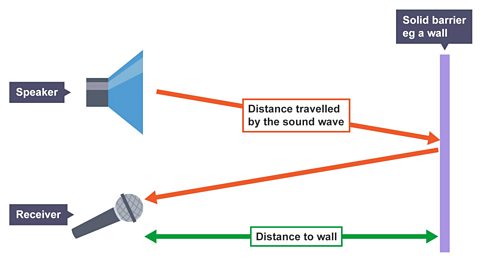
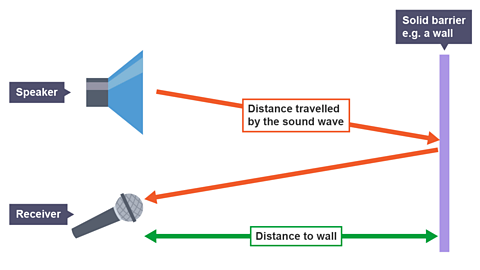
Sound waves can reflect off surfaces.
We hear reflected sound waves as echoes.
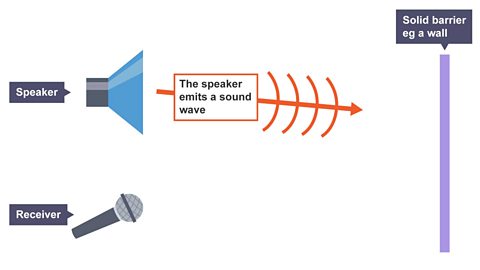
Image caption, 1. The speaker emits a sound wave.
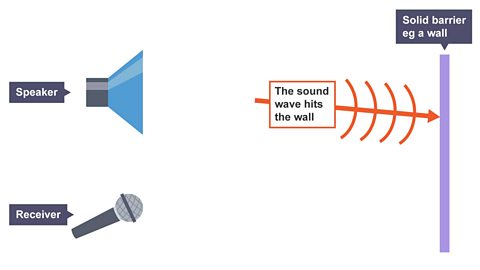
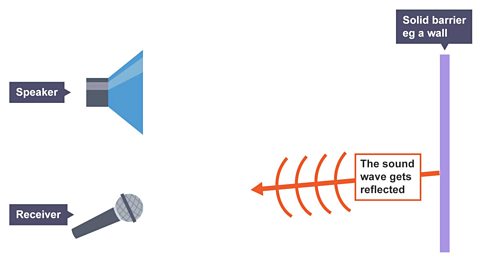
1 of 5
Hard, smooth surfaces are particularly good at reflecting sound.
This is why empty rooms produce lots of echoes.
Soft, rough surfaces are good at absorbing sound.
This is why rooms with carpets and curtains do not usually produce lots of echoes.
If we know the speed of sound and the time it takes for the echo to be detected, we can use the equation:
Speed = \(\frac{\text{distance}}{\text{time}}\) to work out distances.
Or
Distance = speed x time.
Key fact
Remember in echo, the sound has travelled to the object and back again. To calculate the distance to the object use half of the time (or calculate half the total distance there and back).
Example
A fishing boat sounds its foghorn.
The echo from a nearby cliff is heard after 5 s.
If the speed of sound is 340 m/s calculate the distance between the fishing boat and the cliff.
Answer
Distance = speed x time
Speed = 340 m/s
Time for sound to travel to the cliff and back again = 5 s
Time for sound to travel to the cliff = \(5\div 2 = 2.5 s\)
Distance to the cliff = 340 m/s x 2.5 s
Distance to the cliff = 850 m
The distance between the fishing boat and the cliff is 850 m.
What are ultrasound waves?
Ultrasound waves are sound waves which have a The number of waves produced each second. The unit of frequency is hertz (Hz).higher than the upper limit for human hearing - above 20,000 Hz.
Ultrasound waves are A wave that moves in the same direction (parallel) as the direction in which the particles are vibrating. because they are simply high frequency sound waves ie above 20 kHz.
Different species of animal have different hearing ranges.
This explains why a dog can hear the ultrasound produced by a dog whistle, but humans cannot.
Question
A builder uses an ultrasonic device to measure the length of a room.
The device shows that the distance from one wall to the opposite wall is 8.25 m.
If the speed of ultrasound in air is 330 m/s, how long does it take for the ultrasound to travel to the far wall and back again?
Answer
Speed = \(\frac{\text{distance}}{\text{time}}\)
Time = \(\frac{\text{distance}}{\text{speed}}\)
Distance to opposite wall = 8.25 m
Speed of sound = 330 m/s
Time taken from device to opposite wall = \(\frac{\text{8.25 m}}{\text{330 m/s}}\)
Time taken from device to opposite wall = 0.025 s
Time taken from device to opposite wall and back again
= 0.025 s x 2 = 0.050 s
The time taken for the ultrasound to travel to the far wall and back again is 0.050 s.
How does ultrasound imaging work?
Ultrasound imaging creates a picture of something that cannot be seen directly, such as an unborn baby in the womb (a foetus), or faults and defects inside metals.
These uses rely on what happens when ultrasound waves meet the boundary between two different materials.
What are the medical uses of ultrasound?
The best known example of the use of ultrasound is medical imaging.
An ultrasound scanner is simply run over the skin to obtain an image of what's inside.
The scanner probe has a built-in transducer that directs ultrasound pulses down into the body.
As the waves travel through the different bones and tissues, some are reflected off a boundary but some travel further to be reflected back up again off another boundary, as some parts have different densities.
Some of the ultrasound waves are reflected at a boundary.
The time taken for the waves to leave a source and return to the detector is measured.
The depth of the boundary can be determined using distance = speed of sound in the material x the time taken.
The probe receives the reflected waves and a computer connected to the scanner uses them to draw an image on a screen.
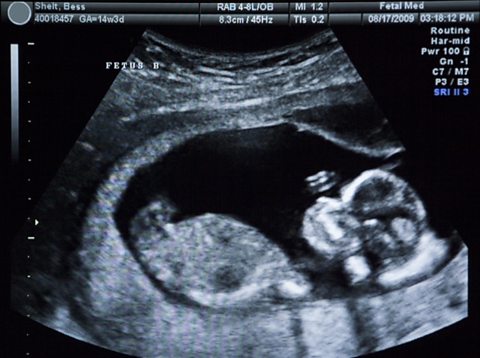
Scans of foetuses (unborn babies developing in the womb) are made this way and are used, for example, to measure the diameter of the head of a foetus so that growth can be monitored.
What is the advantage of using ultrasound in medicine?
- Ultrasound waves are non-ionising, they pass through tissue without causing harm, unlike x-rays which can damage DNA inside cells.
What are the industrial uses of ultrasound?
Detecting defects in metals
Ultrasound can be used in industry to detect defects in metals.
Materials can be tested for internal faults and cracks that could lead to the failure of a structure under certain conditions.
Ultrasound imaging provides a quick method of detection and perhaps prevents serious accidents.
How are sound waves used in detection?
High The number of waves produced each second. The unit of frequency is hertz (Hz). sound waves can be used to detect objects in deep water and to measure water depth.
The time between a pulse of sound being transmitted and detected and the speed of sound in water can be used to calculate the distance of the reflecting surface or object.
The process is very similar to ultrasound imaging.
For deep water, 50 kHz is the preferred frequency of the ultrasound.
This is because water absorbs sound waves at a slower rate than for lower frequencies and so the signal can travel farther before becoming too weak to use.
This technique is applied in sonar systems used to measure the depth of the seabed and to find shipwrecks, submarines and shoals of fish.
SONAR stands for SOund Navigation And Ranging.
Bats and dolphins use a similar method, called echolocation, to detect their surroundings and to find food.
Example
A sonar system on a boat sends an ultrasound pulse towards the seabed.
The pulse is reflected, and it is detected 0.1 s later by the system.
Calculate the depth of water if the speed of sound in water is 1,480 m/s.
Answer
Distance = speed × time
Speed = 1,480 m/s
Time for ultrasound to travel to seabed and back again = 0.1 s
Time for ultrasound to travel to seabed = 0.1 s ÷ 2 = 0.05 s
Distance to seabed = 1,480 × 0.05 = 74 m
The depth of water is 74 m.
WATCH: How do sonar and radar work?
Give me 90 seconds to explain how sonar and radar work.
Both sonar and radar use echoes to detect, locate and measure the distance to objects, a bit like how bats fly through a cave.
They emit a sound and the sound waves reflect off the walls of the cave.
The quicker the sound comes back the closer they are to a wall, allowing them to know when they need to turn.
Sonar, which stands for Sound Navigation and Ranging, uses sound waves to detect, locate and measure the distance to objects underwater.
Sound waves are used underwater because they travel much further than radio waves in water.
Submarines moving in the pitch‑black deep ocean use Sonar to guide them safely through the water.
They measure the time taken for a pulse to be sent out and returned to the submarine to find out how close they are to colliding with an object.
This is calculated using the formula distance equals speed times time over two.
We divide by two because the time measured is to the nearest object and back again, but the distance required is just the distance to the object.
Radar, which stands for Radio Detection and Ranging, uses radio waves to detect the presence, direction, distance and speed of objects.
Radio waves are used because they travel much faster than sound in air.
Radar is used in aviation so pilots can detect weather conditions ahead of them, allowing them to attempt to avoid thunderstorms and turbulence.
It also allows pilots to guide the aircraft onto the runway in difficult conditions where visibility may be reduced.
So to recap, sonar and radar work by sending out waves that reflect off objects and return to the source.
Sonar sends out sound waves underwater, while radar sends out radio waves in air.
The equation used for measuring distance using sonar is distance equals speed times time over two.
How much do you know about echoes and sonar?
More on Waves
Find out more by working through a topic
- count4 of 4
- count1 of 4
- count2 of 4