Key learning points
In a reversible reaction the A chemical which is made in a chemical reaction. Products are written on the right of a chemical equation, after the arrow (→). can react to turn back into the The chemical present at the start of a reaction. Reactants appear on the left of a chemical equation, before the arrow →.
The direction of a reversible reaction can be changed by altering the reaction conditions.
A dynamic equilibrium is formed in a reversible reaction when the rates of the forward and reverse reaction are equal and the amounts of the reactants and the products remains constant.
What are reversible reactions?
In many chemical reactions the reactants are converted into products and then the reaction stops.
For example:
2Mg + O2 → 2MgO
In this reaction, once the magnesium oxide has formed, it cannot go back to reform magnesium and oxygen.
This is a non-reversible reaction.
Other chemical reactions are reversible reactions.
In these reactions, the products, once formed, can change back into the original reactants.
For example:
N2 + 3H2 ⇌ 2NH3
In this reaction, once the ammonia (NH3) has formed, it can ‘go back’ to reform nitrogen and hydrogen.
Reversible reactions are shown with reversible arrows (⇌).
The reversible arrow has two ‘half-arrows,’ one pointing in each direction.
Changing the conditions of a reversible reaction, such as temperature, pressure or amount of a reactant or product, can change the direction of the reaction.
What is an example of a reversible reaction?
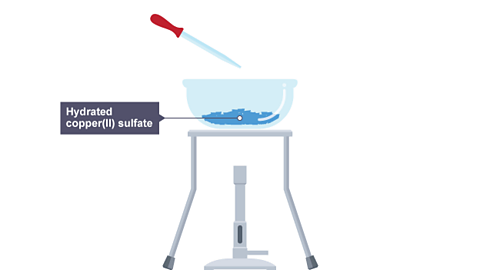
Hydrated copper(II) sulfate is blue in appearance.
When it is heated, the Water that is chemically bonded into a crystal structure. is removed, leaving anhydrous copper(II) sulfate which is white in appearance.
Equation: hydrated copper(II) sulfate ⇌ anhydrous copper(II) sulfate + water
CuSO4.5H2O(s) ⇌ CuSO4(s) + 5H2O(l)
This reaction is reversible, as the hydrated copper(II) sulfate is reformed if water is added to anhydrous copper(II) sulfate.
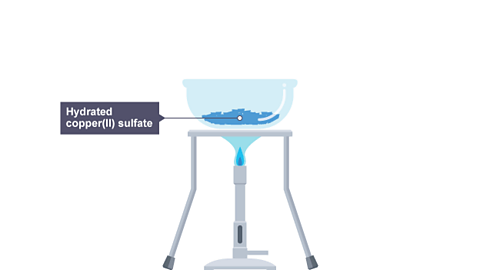
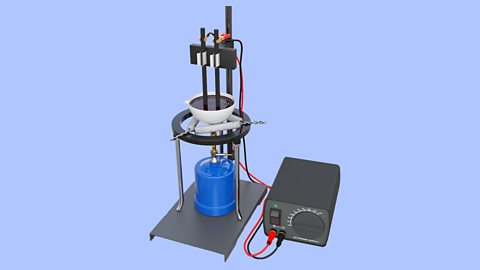
Image caption, 1. A Bunsen burner is used to heat an evaporating basin containing hydrated copper(II) sulfate.
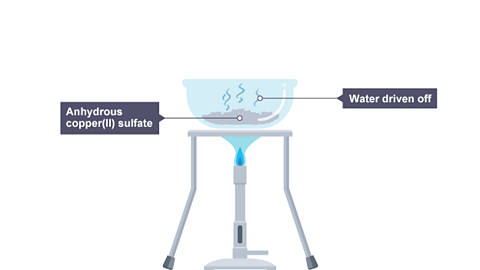
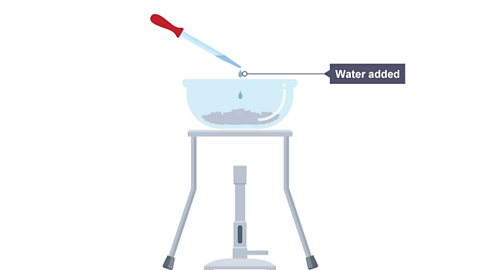
1 of 4
What is dynamic equilibrium?
When a reversible reaction happens in a closed system (closed container) , a A dynamic equilibrium is one in which the rate of the forward reaction equals the rate of the reverse reaction and the amounts of reactants and products remain constant. can be achieved.
In a dynamic equilibrium:
the rates of the forward and reverse reactions are equal.
the amounts of The chemical present at the start of a reaction. Reactants appear on the left of a chemical equation, before the arrow →. and A chemical which is made in a chemical reaction. Products are written on the right of a chemical equation, after the arrow (→). remains constant.
For example, consider a reversible reaction where gas A reacts to form a different gas B:
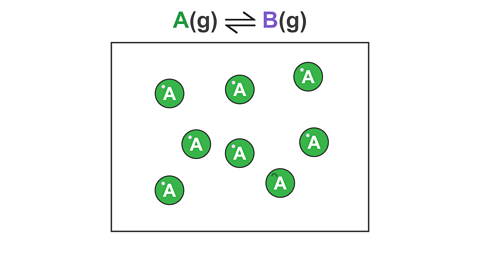
Image caption, 1. At the start of the reaction, the container contains only A.
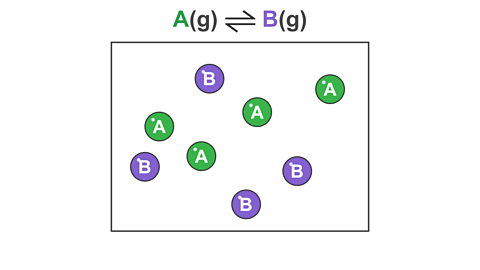
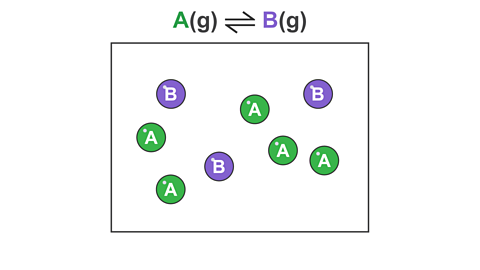
1 of 3
An everyday illustration of dynamic equilibrium is a person trying to walk up an escalator that is moving downwards.
The person appears to be stationary (not moving), but this is just because the rate of their walking up is equal to the rate the escalator is moving downwards.
Test your knowledge
More on Further chemical reactions, rates and equilibrium, calculations and organic chemistry
Find out more by working through a topic
- count5 of 9
- count6 of 9

- count7 of 9
- count8 of 9