What are the key learning points?
An empirical formula is the simplest A ratio is a way to show the relationship between amounts of one substance compared to another. It is usually written in the form a:b. of the A pure substance which is made from only one type of atom. Elements are listed on the periodic table. An element cannot be broken down into anything simpler by chemical means. in a compound, and can be worked out by calculation.
Water of crystallisation is water chemically bonded in a crystal structure. The degree of hydration of a A substance formed when two or more elements are chemically combined. can be worked out by calculation.
The concentration of a solution can be calculated from the number of A mole of a substance is its relative atomic mass in grams. of a substance and the volume of A mixture made when a solute (usually a solid) dissolves into a solvent (a liquid). Sea water is a solution of salt dissolved into water. it has been dissolved in.
For a chemical process, atom economy is a measure of the amount of atoms in the The chemical present at the start of a reaction. Reactants appear on the left of a chemical equation, before the arrow →. that end up as useful A chemical which is made in a chemical reaction. Products are written on the right of a chemical equation, after the arrow (→). . Chemists aim for high atom economies in their reactions.
What is empirical formula and molecular formula?
The molecular formula shows the actual number of atoms of each A pure substance which is made from only one type of atom. Elements are listed on the periodic table. An element cannot be broken down into anything simpler by chemical means. present in a compound.
The empirical formula of a A substance formed when two or more elements are chemically combined. is the simplest, whole number ratio of atoms of each element in a compound.
A molecular formula can be converted into an empirical formula by simplifying the ratio of the elements in the formula
Example
| Molecular formula | Empirical formula |
|---|---|
| C6H12 | CH2 |
| C6H6 | CH |
| CH4 | CH4 |
How to convert empirical formulae to molecular formulae
You can work out the The actual number of atoms of each element present in a compound. from the Empirical formula of a compound is the simplest, whole number ratio of atoms of each element in a compound., if you know the The sum of the relative atomic masses of the atoms in a formula. Relative formula mass has the symbol, Mr or RFM. (Mr) of the compound.
Add up the atomic masses of the atoms in the empirical formula.
Example:
The empirical formula of a hydrocarbon is CH2 and its Mr is 42.
- the mass of the atoms in the empirical formula is 14
- 42 ÷ 14 = 3
- multiply the numbers in the empirical formula by 3
The molecular formula of the hydrocarbon is C3H6.
How to calculate the empirical formula of a compound (Higher tier only)
The empirical formula of a compound can be calculated from mass changes that take place during a chemical reaction.
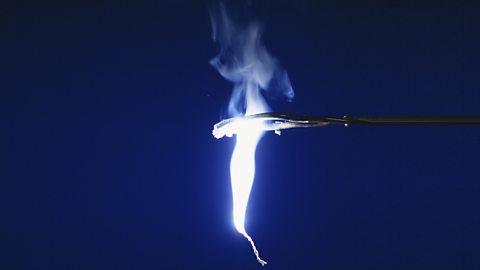
For example, a metal will increase in mass when it reacts with oxygen to produce a metal oxide.
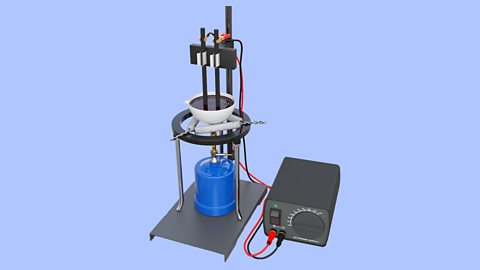
This can be carried out in the apparatus below:
In this experiment the metal would be heated and then weighed a number of times until two consecutive mass readings are the same.
This is known as heating to constant mass.
Example
A sample of titanium was heated in a A small porcelain dish that can be heated very strongly over a Bunsen burner when it is supported in a pipeclay triangle. to produce titanium oxide.
The following mass data was obtained.
Calculate the empirical formula of titanium oxide.
| Mass of titanium before heating | Mass of titanium oxide after heating to constant mass |
|---|---|
| 9.6 g | 16.0 g |
This calculation is best laid out in a table.
The mass of oxygen is obtained by subtracting the initial mass from the final mass.
This is because it is the addition of oxygen that causes the titanium to increase in mass.
| Ti | O | |
|---|---|---|
| Mass | 9.6 g | (16.0 - 9.6) 6.4 g |
| Ar | 48 | 16 |
| Moles | (9.6 ÷ 48) = 0.2 mol | (6.4 ÷ 16) = 0.4 mol |
| Ratio | (0.2 ÷ 0.2) = 1 | (0.4 ÷ 0.2) = 2 |
| Formula | TiO2 | |
The method involves working out the number of A mole of a substance is its relative atomic mass in grams. of both elements.
To convert the number of moles into a whole-number ratio for the Empirical formula of a compound is the simplest, whole number ratio of atoms of each element in a compound., both values should be divided by the smaller value.
Question
29.5 g of nickel (Ni) was heated in a crucible to obtain nickel oxide.
The mass of nickel oxide obtained after heating to constant mass was 37.5 g.
Calculate the empirical formula of nickel oxide.
Ar of Ni = 59, Ar of O = 16.
Answer
Mass of nickel = 29.5 g
Mass of oxygen = 37.5 - 29.5 = 8 g
| Ni | O | |
|---|---|---|
| Mass | 29.5 g | 8 g |
| Ar | 59 | 16 |
| Moles | (29.5 ÷ 59) = 0.5 mol | (8 ÷ 16) = 0.5 mol |
| Ratio | (0.5 ÷ 0.5) = 1 | (0.5 ÷ 0.5) = 1 |
| Formula | NiO | |
The empirical formula of nickel oxide is NiO.
What is water of crystallisation?
Water of crystallisation is water that is chemically bonded into a crystal structure.
This is found in many An ionic compound occurs when a negative ion (an atom that has gained an electron) joins with a positive ion (an atom that has lost an electron)..
Here is the formula for hydrated copper(II) sulfate.
Notice that water of crystallisation is separated from the main formula by a dot.
CuSO4.5H2O ← water of crystallisation
- hydrated means that the solid crystals contain water of crystallisation.
- an anhydrous substance contains no water of crystallisation.
- dehydration is the removal of water of crystallisation.
- the degree of hydration is the number of moles of water of crystallisation chemically bonded in 1 mole of the compound. The degree of hydration in the example above is 5.
How to determine the degree of hydration experimentally
A This means that solid crystals contain water of crystallisation. compound loses Water that is chemically bonded into a crystal structure. when it is heated.
As it loses water of crystallisation, it loses mass.
When it has lost all of its water of crystallisation it is A substance containing no water of crystallisation..
We can use difference in the mass between the hydrated and anhydrous compound to calculate the mass of water of crystallisation removed by heating.
The compound should be heated to constant mass to ensure all of the water of crystallisation is removed.
The following apparatus is used:
A common calculation is to work out the value for the degree of hydration in a compound (often shown as ‘x’, or ‘n’).
Example
The following measurements were taken when a sample of hydrated aluminium nitrate Al(NO3)3.xH2O was heated to a constant mass in an oven.
Mass of evaporating basin = 52.67 g.
Mass of evaporating basin + hydrated salt = 56.42 g.
Mass of evaporating basin and contents after heating to constant mass = 54.80 g.
Use the figures above to calculate the degree of hydration in Al(NO3)3·xH2O.
Mass of anhydrous salt = 54.80 – 52.67 = 2.13 g
Mass of water lost = 56.42 – 54.80 = 1.62 g
| Al(NO3)3 | H2O | |
|---|---|---|
| Mass | 2.13 g | 1.62 g |
| Mr | 213 | 18 |
| Moles | (2.13 ÷ 213) = 0.01 mol | (1.62 ÷ 18) = 0.09 mol |
| Ratio | 0.01 ÷ 0.01 = 1 | 0.09 ÷ 0.01 = 9 |
| Formula | Al(NO3)3.9H2O | |
The value of ‘x’ = 9.
Question
A sample of hydrated calcium sulfate (CaSO4.xH2O) was heated to constant mass.
The mass of the solid before heating was 68.8 g and the mass after heating was 54.4 g.
Calculate the degree of hydration of the compound.
(Ar of Ca = 40, Ar of S = 32, Ar of O = 16, Ar of H = 1)
Answer
Mass of CaSO4 = 54.4 g
Mass of H2O = 68.8 – 54.4 = 14.4 g
| CaSO4 | H2O | |
|---|---|---|
| Mass | 54.4 g | 14.4 g |
| Mr | 136 | 18 |
| Moles | (54.4 ÷ 136) = 0.4 mol | (14.4 ÷ 18) = 0.8 mol |
| Ratio | 0.4 ÷ 0.4 = 1 | 0.8 ÷ 0.4 = 2 |
| Formula | CaSO4.2H2O | |
Degree of hydration ‘x’ = 2.
Practical C5: Determine the mass of water in hydrated crystals
Please use the link below to access the article on: Practical C5: Determine the mass of water in hydrated crystals
How to calculate the percentage of water of crystallisation
Once we have the The sum of the relative atomic masses of the atoms in a formula. Relative formula mass has the symbol, Mr or RFM. of a hydrated compound, we can determine how much of this mass is water of crystallisation.
The mass of the water of crystallisation can be worked out by multiplying the Mr of water by the degree of hydration.
Multiply the degree of hydration by the Mr of water, and divide this by the Mr of the whole compound.
Example
Calculate the percentage of water of crystallisation in hydrated copper (II) sulfate, CuSO4.5H2O% of water crystallisation
\({\%~water~of~crystallisation}\)
\( = \frac {degree~of~hydration \times M_r~of~water}{M_r~of~compound} \times 100 = \frac {5 \times 18}{250} \times 100 = 36\%\)
Note: the mass of the water of crystallisation should be included when calculating the Mr of the compound.
WATCH: How to calculate amounts in moles
How to calculate amounts in moles.
We're going to talk about the chemist's old friend, the mole.
Not the furry kind.
In chemistry, a mole is the unit of measurement for expressing the number of particles.
So that's atoms, molecules or ions in a certain substance.
It's not exactly easy to measure numbers of atoms, because atoms are so tiny.
So tiny in fact, if you take just one grain of sand it's actually composed of more atoms than there are grains of sand on an entire beach.
With this in mind, particle numbers get ridiculously big.
So there needs to be a really simple way to count them, and that's moles.
The same way that a "pair of socks" means 2 socks or a "dozen eggs" means 12 eggs, "one mole" of a substance contains a fixed number of atoms, molecules or ions: 6.02 × 10²³ particles.
Yes, it's a scarily huge number — six, zero, two followed by twenty one zeros.
Do you see why we need to simplify things?
This number is called the Avogadro constant.
It doesn't have anything to do with avocados.
It's Avo-ga-dro.
It's based on the number of atoms found in 12 grams of carbon 12, but it's used for measurements of all substances.
A mole of particles is always the same number of actual particles no matter what kind of particle they are.
So how do we know how many moles in a substance?
First, you need to know its relative formula mass, which you can work out by adding up the relative atomic masses — the AR values — of all the atoms in your formula.
AR values are easy to find because they're right there on the periodic table.
Then you need to know the mass of a substance — simple — and then you divide the mass by the relative formula mass.
So let's work out how many moles there are in, say, 37 grams of calcium hydroxide.
We know the mass: 37.
Next, we need to work out the relative formula mass.
There are three types of atoms present here, so add up their relative atomic masses: calcium is 40, oxygen is 16 and hydrogen is 1.
But the formula shows there are two hydrogen atoms and two oxygen atoms present for every calcium atom, which means the values for the hydrogen and oxygen have to be doubled.
So that's a total of 74 for the relative formula mass.
Now divide the mass by the relative formula mass: 37 ÷ 74 = 0.5 moles.
So, there are 0.5 moles in 37 grams of calcium hydroxide.
That turns a mountain of a calculation into a molehill.
How to calculate the concentration of a solution (Higher tier only)
The The amount of a substance that has been dissolved in a certain amount of solution. Measured in mol/dm3 (moles per decimetre cubed). of a solution depends on the number of A mole of a substance is its relative atomic mass in grams. of the The solid (or occasionally a gas) which dissolves into a solvent (liquid) in order to make a solution. For example, the main solute in sea water is sodium chloride. and the volume of the solution.
You can therefore calculate the concentration of a A mixture made when a solute (usually a solid) dissolves into a solvent (a liquid). Sea water is a solution of salt dissolved into water. in mol/dm3 using the number of moles in the solution and the volume in dm3.
\(concentration~in~mol/dm^3 = \frac{number~of~moles}{volume~in~dm^3}\)
Divide volumes in cm3 by 1000 to convert them into dm3.
Question
0.5 mol of solute is dissolved in 250 cm3 of solution.
Calculate the concentration of the solution.
Answer
250 cm3 = 250 ÷ 1000 = 0.25 dm3
Concentration = 0.5 ÷ 0.25 = 2.0 mol/dm3
How to calculate the number of moles of a solute
The equation above can be rearranged to find the number of moles of solute in a solution.
Rearranging the equation: number of moles = concentration (mol/dm3) × volume (dm3)
Question
Calculate the amount of solute dissolved in 2 dm3 of a 0.1 mol/dm3 solution.
Answer
Amount = 0.1 × 2 = 0.2 mol
How to calculate the volume of a solution
This equation above can also be rearranged to find the volume of a solution.
Rearranging the equation:
volume (dm3) = moles ÷ concentration (dm3)
Question
Calculate the volume of a 2 mol/dm3 solution that contains 0.5 mol of solute.
Answer
Volume = 0.5 ÷ 2 = 0.25 dm3
Note that 0.25 dm3 is the same as 250 cm3 (0.25 × 1000).
How to change the units of concentration
Concentrations can also be expressed in grams per decimetre cubed (g/dm3).
Use the relative formula mass (Mr) to convert the two units of concentration.
Question
The concentration of a solution of sodium hydroxide, NaOH, is 0.5 mol/dm3.
What is this concentration in g/dm3?
Ar of Na = 23, O = 16, H = 1.
Answer
Concentration (g/dm3) = concentration (mol/dm3) × Mr
Mr of NaOH = 23 + 16 + 1 = 40.
Concentration (g/dm3) = 0.5 × 40 = 20 g/dm3.
What is atom economy?
Some products in chemical reactions are desired, and others are not desired (sometimes called A product from a side reaction which is formed during the creation of another product, usually an undesirable product.).
For example, in the manufacture of hydrogen from methane and steam:
methane + steam → hydrogen + carbon monoxide
The hydrogen is the desired product and the carbon monoxide is the by-product (not-desired).
In a chemical reaction atoms in the reactants rearrange themselves to form the products.
Atom economy is a measure of the amount of the reactant atoms that end up as useful products.
How to calculate percentage atom economy
The percentage atom economy of a reaction is calculated using this equation:
atom economy = \(\frac{mass~of~desired~product}{total~mass~of~products}\) x 100
Note: Mr values can be used for mass in atom economy calculations.
The highest possible value of atom economy is 100%, when all the reactant atoms end up in the desired product.
If the atom economy is 50%, for example, then half the reactant atoms end up in the desired product or products.
It is important to aim for a high atom economy in chemical processes for two reasons:
Sustainability: High atom economy reactions help to preserve natural resources of chemicals.
Economic: It is less expensive to have a process with a high atom economy as the majority of the atoms in the reactants end up in useful products.
Example
Hydrogen can be manufactured by reacting methane with steam:
CH4(g) + H2O(g) → 3H2(g) + CO(g)
Calculate the atom economy for the reaction. (Ar of H = 1, Ar of C = 12, Ar of O = 16)
Answer
H2 is the desired product, CO is the by-product.
Mr of H2 = 2 × 1 = 2
Mass of desired product = 3 × 2 = 6 (there are three H2 in the balanced equation)
Mr of CO = 12 + 16 = 28
Total Mr of all products = 3 × 2 + 28 = 34
Atom economy = \(\frac{mass~of~desired~product}{total~mass~of~products}\) = 100
Atom economy = \(\frac{6}{34}\) x 100
Atom economy = 17.6%
Question
Ethanol (C2H5OH) can be produced by the fermentation of glucose (C6H12O6), producing carbon dioxide as a by-product.
Calculate the percentage atom economy for this process.
C6H12O6 → 2C2H5OH + 2CO2
Ar of C = 12, H = 1, O = 16
Answer
C2H5OH is the desired product: Mr = (2 × 12) + (5 × 1) + 16 + 1 = 46
Mass of desired product = 2 × 46 = 92
CO2 is the undesired product: Mr = 12 + (2 ×16) = 44
Total mass of products = (2 × 46) + (2 × 44) = 180
Atom economy = \(\frac{mass~of~desired~product}{total~mass~of~products}\) = 100
Atom economy = \(\frac{92}{180}\) x 100
Atom economy = 51.1%
How much do you know about quantitative chemistry 2?
More on Further chemical reactions, rates and equilibrium, calculations and organic chemistry
Find out more by working through a topic
- count7 of 9
- count8 of 9
- count9 of 9

- count1 of 9