Watch: Who were the Vikings?

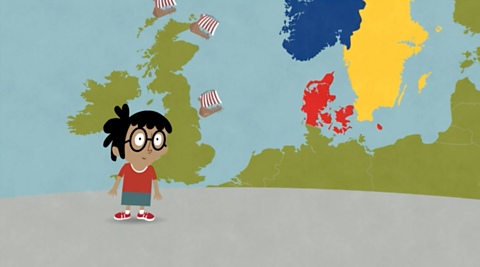
The Vikings came from Norway, Sweden and Denmark because there were too many people on their farmland. They searched for new lands to conquer and settle.
In AD787, the first Viking raids took place across Europe. They attacked Christian monasteries because they had valuable treasure and were undefended.
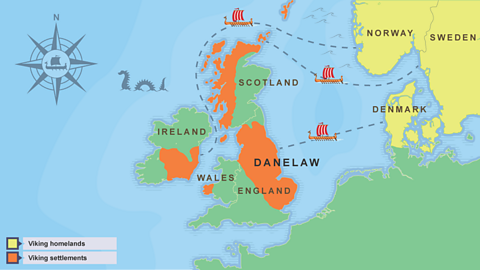
In AD865, a Viking army (The Great Heathen Army) sailed across the sea to conquer land. By AD878, they had conquered the Anglo-Saxon kingdoms of Northumbria, East Anglia and Mercia. Most Vikings settled in the Danelaw area, to the north and east of England.
Find out more about who the Vikings were and where they came from.
Excuse me. Yes, you… would you like to learn about the Vikings? Great! Well let’s start at the beginning…
The Vikings lived over 1000 years ago, but they don’t look that old to me, what’s your secret? The Vikings were Norse people who came from an area called Scandinavia. You might know it better as Norway, Sweden and Denmark.
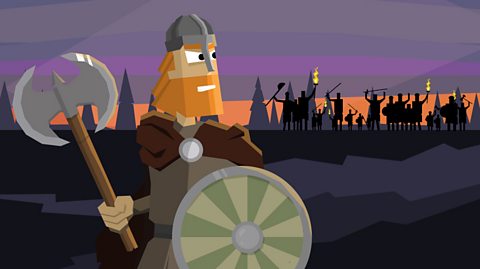
The word Viking means ‘a pirate raid’, which is a fitting name as they were fearsome warriors and often raided monasteries for treasure.
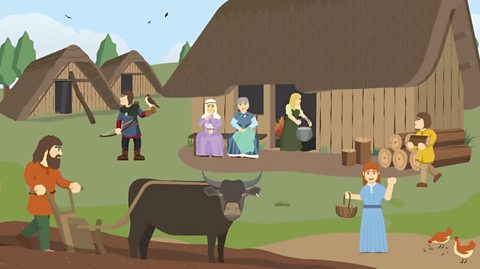
But they weren’t all bad, bloodthirsty and violent - they also settled with their families and farmed the land peacefully for many years.
I’m sorry about this… they never wore horned helmets. Let’s move on.
Did you know they were great explorers too and travelled all over the world? Vikings explored as far away as North America. Can you believe they even travelled through Russia to trade in the Middle East. Amazing!
Ah, ‘The Thing’, an early version of today’s parliament. The Norse people met to discuss new laws and solve arguments. They’re arguing over who owns your shoes.
Plus, we still use some of their Old Norse language today. Words like ‘egg’, ‘muck’ and ‘dirt’.
Even some modern town names are based on Viking words! York and places that end in ‘thorpe’, ‘by’ or ‘kirk’. So for example, the Viking word for deer is “djúr” and village is ‘bȳ’ - together making “Derby”.
There we go - the history of the Norse people in a matter of minutes. How enjoyable was that? Fantastic! Isn’t history great? Oh, you look like you need a bath.
Timeline - The Vikings

Image caption, Click the arrows to learn more about the Vikings!


1 of 10
Important words for the Vikings
| Keyword | Definition |
|---|---|
| Conquer | To take control by force. |
| Settle | To make an area your home. |
| Craft | A skilled job. |
| Raids | Quick, surprise attacks. |
| Monastery | Where monks live and pray. |
| Undefended | Open to attack. |
| Kingdom | A country ruled by a King or Queen. |
| Danelaw | The area of northern and eastern England that belonged to the Vikings. |
What were the Vikings like?
The name 'Viking' comes from a language called 'Old Norse' and means ‘a pirate raid’.
Some came to fight, but others came peacefully.
They were farmers, and kept animals and grew crops.
They were skilful at crafting, and made beautiful metalwork and wooden carvings.
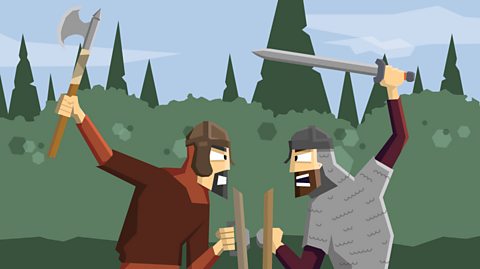
Viking warriors fought using long swords and axes.
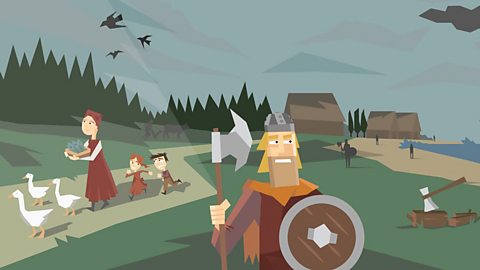
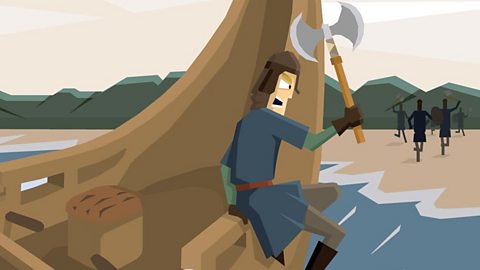
The first Viking raid recorded in the Anglo-Saxon Chronicle was around AD787.
It was the start of a fierce struggle between the Anglo-Saxons and the Vikings.
The Vikings were pagans, not Christians like most people living in Britain at the time.
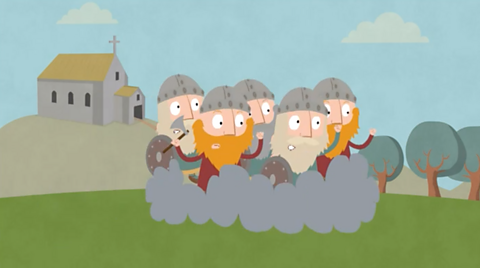
Christian monasteries in Britain were easy targets for the Vikings because they were undefended. The Vikings stole treasure and set fire to buildings. They also attacked villages and took people as slaves.
What was the Viking invasion?
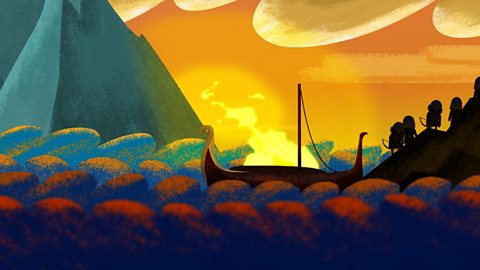
In AD865 a Viking army (The Great Heathen Army) sailed across the North Sea.
This time they wanted to conquer land rather than just raid it.
Over several years the army battled through Northern England.
By around AD878, almost all the kingdoms of Northumbria, East Anglia and Mercia had fallen to the Vikings. Wessex was still ruled by Alfred the Great because he stopped the Vikings from conquering the whole of England.
Where did the Vikings settle?
- Most Vikings settled in the Danelaw, to the north and east of England.
- Some sailed to Scotland, and on the Shetland and Orkney Islands.
- Vikings also settled on the Isle of Man and often raided Wales, but few made homes there. In Ireland, the Vikings founded the city of Dublin.
What was life like in the Danelaw territories?
The Danelaw covered three main areas:
- Northumbria (which included modern-day Yorkshire)
- East Anglia
- The Five Boroughs (also known as a town: they were Leicester, Nottingham, Derby, Stamford and Lincoln)
The most important city was York. The Vikings called it Jorvik (pronounced 'your-vick').
Think like a historian

Have a look at the thinking points below and think about your answer to each question. You could even write them down on a piece of paper or discuss them with somebody else if you want to.
What jobs did the Vikings have when they came to Britain?
In AD865, why did The Great Heathen Army sail across the North Sea?
Why is Alfred the Great a significant individual?
Some Vikings were warriors and some were farmers who kept animals and grew crops. Some Vikings were skilful at crafting (metalwork and woodwork).
In AD865, The Great Heathen Army sailed across the North Sea because they wanted to conquer land rather than just raid it.
Alfred the Great is a significant individual because he stopped the Vikings from conquering the whole of England. He ruled the kingdom of Wessex.
Activity: Quiz – Who were the Vikings?
Grown-ups Corner
Are you a parent, carer or teacher? Take a look at some of the links below on KS2 History which are packed full of knowledge, videos, quizzes and activities.
Who were the Anglo-Saxons?
KS2 History
Viking beliefs
Bitesize for Teachers
The importance of Lindisfarne for the Vikings
Bitesize for Teachers
Horrible Histories: Raid and Trade game! game
Play Horrible Histories: Raid and Trade KS2 History
More on Vikings
Find out more by working through a topic
- count4 of 6
- count5 of 6