How much do you know about the world's heaviest objects?
We all have our strengths, and for some, that includes the ability to lift extremely heavy objects that many others can only dream of lifting. From weights at the gym to taking part in popular competitions, it takes not only physical strength, but a lot of determination.
It is hard to define the heaviest object in the world, as there are a lot of different factors to take into account. But have you ever wondered which objects in the world are the heaviest and under what circumstances?
Here, BBC Bitesize takes a look at some of the record-holding heaviest objects and their astonishing weights. You can also find out more density, weight and mass below.

What is the heaviest object ever weighed in the world?
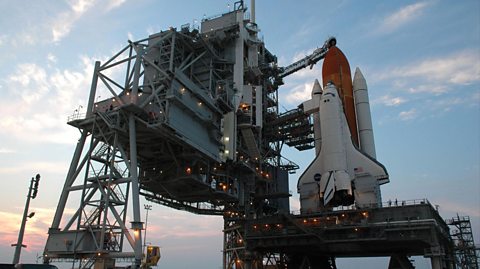
There are many extremely heavy objects to mention that can be classed as the heaviest in the world for different reasons. But we first want to focus on the heaviest object ever weighed in the world, according to the Guinness World Records.
The Revolving Service Structure (RSS) of launch pad 39B is the heaviest object ever directly weighed. At NASA's Kennedy Space Center in Florida, USA, the structure is said to have been lifted up on 21 jacking points.
A jacking point is a reinforced area designed to support an object’s weight safely when lifted by a jack, a mechanical lifting device. Between them, the 21 jacking points measured the mass of the RSS as 2,423 tonnes – which is a whopping 5,342,000 lbs!
The work was carried out over two decades ago on 23 January 2004 by Industrial Steel Inc and Buffalo Hydraulic.
What is the heaviest man-made object in the world?
In the world, there are many materials that can occur or be made naturally, like wood. But when we use the term man-made, we mean objects created by humans, such as plastic.
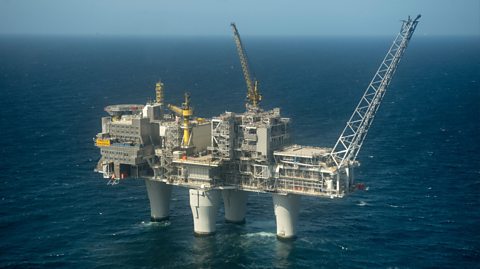
So now we turn our attention to the heaviest man-made object in the world. Again there are so many to name, but the Guinness World Record title for the heaviest man-made object ever moved is currently held by the Gullfaks C installation.
This is a huge Condeep (concrete deepwater structure) oil platform in the Norwegian North Sea. According to Guinness World Record, its displacement during its tow to the Gullfaks field was between “1.4 and 1.5 million tonnes (3.08 to 3.3 billion lb) at 210 m (688 ft 11.7 in) tow draft.”
Gullfaks C began production on 4 November 1989 and has a total height of 380m - 1,246 ft 8.6 in. Guinness World Record also recognises the heaviest man-made mobile object to be the Troll A offshore gas platform, located off Norway in the North Sea.
What is the heaviest object lifted on land, at sea and by air?
Titles are also held for the heaviest object lifted on land, at sea and by air. When it comes to land, the Guinness World Record title is held by a portion of the North Rankin B Platform.
One of the world’s largest offshore gas production platforms, it is located off the coast of Western Australia. But on 17 October 2011, a portion of the platform, weighing 23,178 tonnes (51.1 million lb) was lifted at the shipyard of Hyundai Heavy Industries in Ulsan, South Korea.
When it comes to lifts at sea, the offshore weightlifting record was broken in October 2004 by the crane vessel Saipem 7000 (Italy). The heaviest object lifted at sea was a 12,150-tonne (13,393-ton) single integrated deck (SID), which was transported from a heavy-transport carrier to the Sabratha platform in Libya’s Bahar Essalam field.
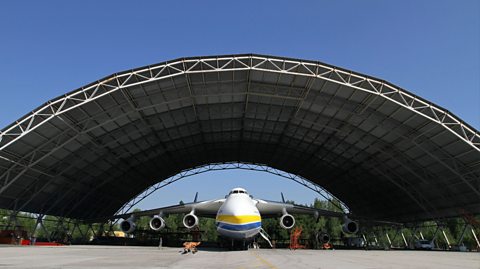
According to Guinness World Records, the heaviest item airlifted is a power plant generator, lifted by Antonov Airlines 225 "Mriya" aircraft. At the time in 2009, it was the biggest aircraft in the world and lifted the 187.6 tonnes (375,200 lb) power plant generator at Frankfurt Hahn Airport in Germany.
What is the heaviest object ever lifted by a human?

For generations, there has been a lot of fascination with humans lifting heavy objects. Many do it every week for strength training, whereas others take their talents to a new level and enter competitions.
Since 1977, international strongman competition, the World’s Strongest Man, has been held annually, seeing athletes from around the world test their strength. The annual strongwoman event, the World’s Strongest Woman, first started in 1997 and has since evolved and been known under various names.
But according to Guinness World Records, the greatest weight ever lifted by a human being was achieved by Canadian Gregg Ernst on 28 July 1996. Ernst backlifted two cars with drivers in them on a platform at 2,422.18 kg (5,340 lb).
What is the heaviest metal found on Earth?
There are so many different heavy materials and objects to mention – but have you ever wondered what the heaviest metal found on Earth is?
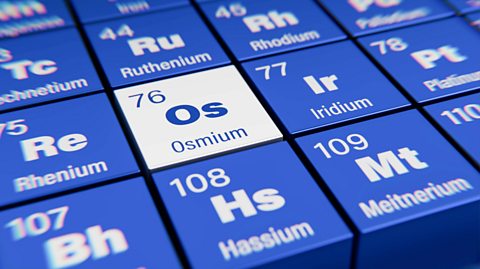
Well, the heaviest metal by density is believed to be Osmium. It is a naturally occurring rare element that is very hard and brittle and is said to have a density of around 22.59 g/cm³.
The density of an object or substance is its mass divided by its volume. The more dense a substance is, the heavier it feels for its size. You can find out more about density here.
Weight versus mass
We’ve discussed a lot about the weight of heavy objects here. But the terms weight and mass are sometimes used incorrectly – so here are the definitions.
Mass is defined as the amount of matter in an object and is measured in kilograms (kg). Everything that has mass is matter and in everyday life we usually come across matter in three states – solid, liquid and gas.
Weight is the force exerted on a mass due to gravity. It is measured in newtons (N).
Check out our physics pages below to find out more:
- Weight and mass - Forces and movement
- What is the difference between mass and weight
- Weight, mass and gravitational field strength - Newton's laws
This article was written in March 2026
