All you need to know about the Rubik’s cube
We all love a challenge - and sometimes nothing beats the feeling of when a puzzle finally clicks. They give your mind a proper workout and so many puzzles have been loved by generations, including the Rubik's cube.
Did you know there are over 43 quintillion possibilities when it comes to solving a Rubik’s cube? Sounds mind-blowing, but there are some hacks to help you succeed.
Here, BBC Bitesize shares lots of fun facts about the Rubik's cube - as well as top tips on how to solve it. Good luck!
Where does the Rubik’s cube come from?
The Rubik’s cube was invented by an architecture professor from Hungary in 1974.
Erno Rubik wanted to help his students learn about three-dimensional (3D) movement. He created a prototype for the cube and then got a patent for the structure – which is a way of getting exclusive permission to make, use or sell a product – the following year.
It didn’t take long for the ‘magic cube’, as it was called then, to take off – its popularity spreading from Hungary to the rest of the world at toy fairs. In 1980 the magic cube was renamed Rubik’s cube and became popular with generations of puzzle fans around the world.
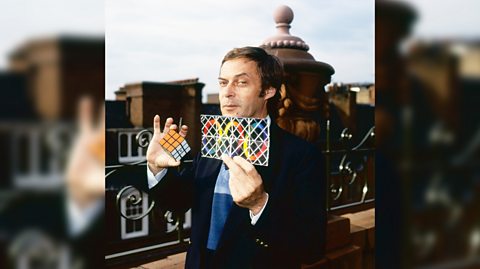
1981: Rubik's cube revolution
Originally broadcast on 13 December 1981, this BBC Archive video was filmed as part of BBC's The Money Programme and captures the popularity of the Rubik's cube at the time.
Ahead of Christmas 1981, The Money Programme reports on how the phenomenal success of the Rubik's cube got toy companies, inventors and enthusiasts clamouring to find the next big thing in the world of puzzles.
BBC Archive offers a unique collection of thousands of archive films, capturing life and events across the UK since the 1940s.
News presenter Brian Widlake begins segment
Brian Widlake said: "The Rubik Cube, brainchild of Hungarian professor Erno Rubik, is rapidly assuming the status of a world cult. It's one of those fiendishly brilliant and disarmingly simple ideas that can revolutionise the game's market overnight. There's even the first world Rubik Cube championship in the offing. The British heats were held yesterday, resulting in a new world record of 25.79 seconds. But with the great Christmas games rush now in full swing, Professor Rubik may have started more than he bargained for. John Watkinson now reports.
Cuts to montage narrated by reporter John Watkinson
John Watkinson said: "It's been called the insomniac's dream, the destroyer of marriages, the fastest route to insanity. But for a chosen few, the problem's no longer how to solve the cube, but the speed with which the solution can be reached. From 27,000 entries, 10 finalists have won their way through a series of regional heats to the British Rubik Cube final in the plush surroundings of London's Savoy Hotel. An occasion such as this would be incomplete without the high priest of this particular brand of cubism, Erno Rubik himself. He's not just a household name the world over. He's one of the very few communist millionaires. So how does he account for the cube's success?
Cuts to interview with Erno Rubik
Erno Rubik said: "It's a very basic form and a very basic problem. And there are no any special national style or something like that. There are international things, I think."
Cuts to new montage narrated by reporter John Watkinson
John Watkinson said: "It all started six years ago. Rubik invented the cube to help his students at Budapest University to think in three dimensions. In 1978, the American toy company Ideal bought the marketing rights to the puzzle. It really began to take off as the last children's craze, skateboarding, began to fade away. There are some who say that the cube will go the same way. But for the moment, it's a salesman's dream. It's easy to handle, pleasing to the eye and a brain teaser of infinite variety. Worldwide, Ideal reckon they've sold more than 25 million cubes worth about 100 million pounds."
Cuts to interview with Antony Lawrie, divisional managing director for Ideal Toys Company
Antony Lawrie said: "It's by far and away our best seller clearly this year and I should think it's the best seller by a long chalk in the toy industry - not only in this country but all over the world this year. These things don't come along very often, but when they do come along it's very pleasant. But the objective really is to sustain the market which we've discovered, and try and build on it in a worthwhile way in the future."
Cuts to new montage narrated by reporter John Watkinson
John Watkinson said: "We British don't exactly skimp our children when it comes to presents. We spend as much as 50 pounds per child a year. In all, the market's worth 700 million pounds, and now's the time when most of it's spent. For many toy firms, as much as three-quarters of their year's takings will come in these last few weeks of December. Most of them could do with a Rubik-style success to get them through what's been so far a disappointing year for business.
Watkinson continues: "In Hamleys of Regent Street, the toy market showcase, Puzzle Corner is buzzing with a whole new range of products. Proof that companies have been trying to cash in on the market that Rubik created. The Circus 7, the Varicone Pyramid, the Missing Cube puzzle, and the Maddening Liquid Geometry. But in the last few months, it's the Snake - yet another invention of Rubik that's moving up the toy top ten. Already, it's the number six bestseller, but it's one that slipped through the fingers of ideal."
Cuts back to Antony Lawrie, divisional managing director for Ideal Toys Company
Antony Lawrie said: "Well, I think when the Snake was first seen by our company, it was decided that perhaps it wasn't quite in the direct stable that the Rubik's cube has established. In retrospect, the Snake's been a very successful product, and I think we've been a mistake. We would like to have had it."
Cuts to reporter John Watkinson speaking to camera
John Watkinson said: "But the biggest spinoff is the ripoff. Cheap imitations are pouring in from such countries as Hong Kong and Taiwan. This is the Rubik Cube, made in Hungary and costing five pounds. This is a cheap imitation from Taiwan and costs only one pound, and it's hardly worth that, say Ideal. All told, they reckon there are more than 60 varieties of cubes, with sales approachingthere, 25 million. Worldwide, they know they're fighting a losing battle. But in this country, they've taken action in the courts to protect their copyright and to stop the sale of these cheap copies."
Cuts to new montage narrated by reporter John Watkinson
John Watkinson said: "The Black Mountain's Abergavenny, the unlikely setting for Mark Eliot's one-man assault on the puzzle market. He set up business five years ago. Then, as now, he's insisted on it remaining home-based. Entirely self-taught, he designs and makes his own prototypes. He broke into the market with two games, Junk and Skirrid. But now he thinks he's got a puzzle thatmight even upstage the queue. It's called the Great Pyramid Puzzle."
Cuts to demonstration by Mark Eliot of Eliot Inventions
Mark Eliot said: "Well, you start off, you've got a pyramid structure. The blue part is a pyramid structure, which is on a chrome stand. You have 36 triangles with patterns on them. All the patterns are different. And if I play this piece, I'm looking for a piece which will match here and here. And that does. That's ok, and now I'm looking for a piece which will match both here and here. And if I think I'mright here, that one will go in there. Now you're creating a matching pattern. You have to do that on all four sides of the pyramid, including down the spines. As I say, on all four sides, until you have one total matching pattern which covers the pyramid with the triangles. And there you've begun to solve the problem."
Cuts to new montage narrated by reporter John Watkinson
John Watkinson said: "Eliot is manufacturing 5,000 pyramids a week through Waddingtons, one of Britain's largest toy companies.And he's the first person to build a cash prize into a commercial puzzle. For each pyramid that's sold, one pound is set aside for prize money. So far, the figure's 25,000 pounds. To win it, all you've got to do is calculate, or as it guess, a 12-digit number connected with the 36 triangles. Eliot gives you a couple of clues, and then you're on your own. If it all sounds complicated, it is. But Elliot says it's nothing compared to the problem of getting the £100,000 needed to launch the Great Pyramid."
Cuts to interview Mark Eliot of Eliot Inventions
Mark Eliot said: "I started from zero, and I did the rounds. I went to 42 different banks, institutions, finance houses, government agencies, and so on. When I was halfway through the negatives, about 25 had said no, I contacted Maggie Thatcher. I wrote to Geoffrey Howe. I was put on to the Department of Industry. And one by one, they said no. And I then had a decision to make. One was that I'll go to America, where the streets are paved with gold and they're sure to back me there. Or I will go to a company in this country who will be prepared to give me credit. And I went to Waddingtons. And I think, very sensibly, they decided they would."
Cuts to new montage narrated by reporter John Watkinson
John Watkinson said: "Eliot cuts out the shopkeeper by selling directly to the public through the pages of the Sunday colour supplements. That way, he keeps more of the profit and can run his business from his study with the secretary next door. The cube, on the other hand, breaks all the rules. It sells itself. In this country, there's no advertising at all. It gets more than enough publicity from the millions of words written about it by others."
Cuts to reporter John Watkinson speaking to camera
John Watkinson said: "The maths department of a bookshop is a strange place to find bestsellers. But in the last few months, at least ten different titles have appeared telling you how to solve or just live with Rubik's cube. And this book has been one of the publishing sensations of the year. You Can Do The Cube has been bought by more than a million people, making it the fastest seller since Lady Chatterley's Lover."
Cuts to new montage narrated by reporter John Watkinson
John Watkinson said: "Patrick Bossert is almost certainly the world's most successful 13-year-old author. This Richmond schoolboy, equally at home with computer circuits as with the cube, has made close to £50,000 from his bestseller."
Cuts to interview Patrick Bossert, aged 13
Patrick Bossert said: "I was… I thought it might just sell about 10,000 copies. But it's sold over a million, which came as a shock. One night I got a phone call and they said, congratulations, we've gone over the million mark."
John Watkinson asks: "What do you think of all these follow-ups to the cube?"
Patrick replies: "I like them a lot. They all work on cube principles, except for Pyramid and the Snake, which are slightly different. But my favourite of the lot is the Barrel, because when you muddle it up… It loses its shape. It starts sticking out in all directions. And so you have to get its shape to solve it, as well as the colours."
Cuts to new montage narrated by reporter John Watkinson
John Watkinson said: "Rubik's cube has spawned a mini-industry in the puzzle market. But how long is it all going to last? For many in the toy business, Rubik's cube is mentioned in the same breath as the all-time bestsellers like Monopoly and Scrabble. Games likethese stand alone as big money spinners year in, year out. Rubik could now be in this class."
Cuts back to Antony Lawrie, divisional managing director for Ideal Toys Company
Antony Lawrie said "Rubik is clearly the name that has authority in this puzzle market. If indeed there is going to be a puzzle market, it's most important that we use that name responsibly and develop products which are consistent with the reputation that we have now established for Rubik. And I believe that Rubik will become synonymous with the successful and interesting puzzles in the future."
Cuts back to interview Mark Eliot of Eliot Inventions
John Watkinson asks: "What do you think of Rubik's Cube?"
Mark Eliot replies: "I think it's the best puzzle that's come onto the market for the last… oh, goodness knows how long. I mean, it's a superb product. I think anybody who tries to follow it is a complete fool."
End of news segment
5 fun facts about Rubik’s cubes
1. The cube has created some of the whackiest world records
Competitors attempt to break world records relating to the Rubik’s cube almost every year, with some of the whackiest attempts being:
- Fastest time solving Rubik’s cubes whilst juggling them
- Most cubes solved whilst on a unicycle
- Most cubes solved underwater
- Fastest time solving a cube blindfolded
- Fastest time solving a cube whilst skydiving
Other records include solving a Rubik’s cube simultaneously with hands and feet in the fastest time, solving a Rubik’s cube upside down and solving cubes of different sizes – the largest currently being 33x33x33 cubes.
Robots created by humans have also competed to be the fastest to solve a Rubik’s cube – beating us mere mortals easily.
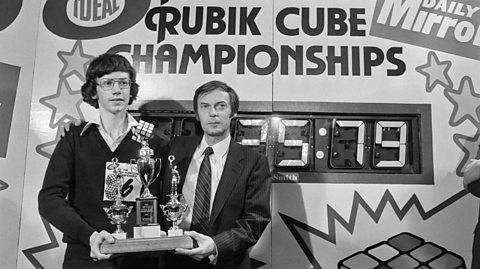
2. A seven-year-old holds the current world record
A Chinese boy called Xuanuyi Geng currently holds the Guinness World Record for the fastest time to solve a 3x3x3 rotating puzzle cube – solving one in 3.05 seconds at an event in China on 13 April 2025.
3. The largest cube is 3 metres tall
The current largest Rubik’s cube is three metres (m) x three metres x three metres and was achieved in Dubai in December 2023. That’s taller than an Asian elephant!
A previous record holder was a British man, Tony Fisher, who made a cube that was 2.022m tall in 2020.
4. The first Rubik’s cube was made with elastic bands
Erno Rubik made his first ever prototype for the Rubik’s cube out of elastic bands, wood and paper clips. He then used coloured stickers to finish the product.
When the puzzle was mass produced, plastic was used instead.
5. Rubik’s cube even had a cartoon made about it
The Rubik’s cube was so popular in the 1980s that a cartoon called ‘Rubik, the Amazing Cube’ was created in America in 1983. The cartoon ran for one season and featured a magic Rubik’s cube that comes alive and has special powers it can use to solve mysteries.
Here's how to solve a Rubik’s cube
Before you start, here are some hacks it’s worth knowing:
- The centre piece on each side of the cube doesn’t move, so that’s the colour you’ll end up with on that side; i.e. if you have a green centre square, that side will end up with nine green pieces in total.
- Each centre square has an opposite, e.g. on the original cube, yellow is on the opposite side to white, red is opposite orange and green is opposite blue (but check your cube’s colours!).
- Cubes are solved layer by layer (rather than solving one coloured face at a time). Think ‘top’, ‘middle’ and ‘bottom’ layers.
- Think of the ‘face’ of the cube as the side you’re working on, ‘edge’ pieces have two colours and ‘corner’ pieces have three colours.
- It helps to name each ‘face’ of the cube, so that you know which bit you’re turning if you follow a tutorial; e.g. front, back, left, right, up or down.
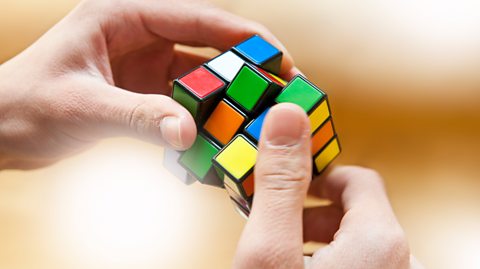
How do I solve a Rubik’s cube?
As we mentioned, there are over 43 quintillion possibilities when it comes to solving a Rubik’s cube, so we can’t name all those here. It involves a bit of experimentation and a lot of patience!
Speedcuber and 3x3 Scottish record holder Johnny Kerlaff says when he’s competing he’s looking for “the quickest way to build the first two layers” and then the last layer “is usually just a sequence of algorithms.”
There’s no cheat's way of learning the algorithms: they’re a sequence of moves you’ll need to practise to get the squares in order.
Still want to try…?
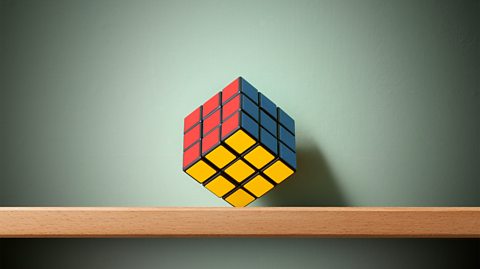
These are seven steps to follow if you’re a beginner:
- Make a white cross on the top face of your cube. Ensure you have two squares of matching colour coming down from the top middle edges of your white face.
- Add the white corners. There are algorithms you can follow online to get the white squares in the right place. You should then have the white face completed.
- With the white face still pointing up, match the corner colours with the centre square colour on each side.
- Create two layers like this, so that the top two layers on each face of your cube are now the same colour.
- Turn your cube ‘upside down’ and create a yellow cross (or whatever colour is opposite to the centre colour you started with). Be careful how you do this (again there are specific algorithms), so you don’t destroy the layers you’ve already done. NB: You may end up with extra yellow squares with your yellow cross – that’s ok as long as you have the cross.
- Then add the yellow corners – there are lots of moves (‘algorithms’) to this part, but don’t despair! There’s a lot of trial and error. Once you have the yellow face completed, match up the other coloured corners with their corresponding centre piece. So, a corner that is yellow, red and green needs to be matched to the red and green sides too.
- Then match up the yellow edges with the corresponding colours on each side.
Still confused? Try these four simple steps to solve a Rubik’s cube.
This article was published in April 2025 and updated in July 2026
