What is Morse code?
Morse code is a method of encoding words that was invented in the 19th Century as a way of transmitting messages over long distances. This was before the era of telephones and way before smartphones!
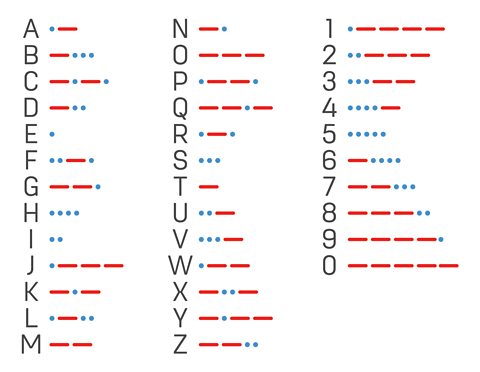
In the 1830s, Americans Samuel Morse and Alfred Vail adapted a telegraph – an early communication system which involved using ‘electrical pulses’ to send messages via electrical wires. They devised a code and a handswitch or ‘key’ that meant messages could be tapped out quickly, and more easily translated back into English at the other end. The code involved sequences of dots and dashes (also known as ‘dits’ and ‘dahs’) to represent each letter of the alphabet.
You could practise doing it now by tapping something out on your desk – e.g. the Morse code for ‘H-E-L-L-O’ is:

The short ‘dots’ are a quick tap or pulse and the longer ‘dashes’ are usually three times as long as the dot.
What was Morse code used for?
“Over the years Morse code played a crucial role in various historical events.” – Ngaire Bushell, HMS Belfast
Morse code was used as a way of sending messages more quickly than by post (which was still delivered on foot or by horse). It was also more accurate than using smoke or flag signals. The code was transmitted at sea and on land for both business, political and personal communications.
Ngaire Bushell is Learning Officer on board HMS Belfast, a former Royal Navy vessel: “Over the years Morse code played a crucial role in various historical events”. She says during World War Two Morse code was used to exchange ”vital information” more quickly, “keeping ships in touch with their home bases and offering the ability to share critical data and intelligence”.
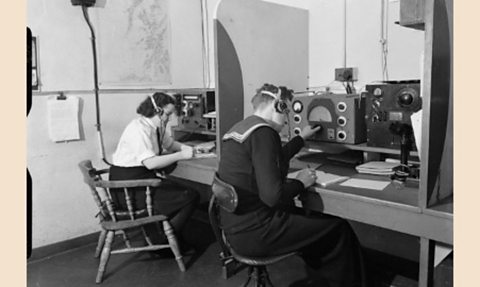 Image source, Credit: Imperial War Museum
Ngaire adds that “enemy aircraft and ships could intercept Morse code messages and work out the exact whereabouts of targets” and therefore, during the war, ships would instead use ‘Aldis lamps’ (very bright lamps on board the ship) or signal flags to communicate via Morse code with friendly ships which were nearby.
According to the Imperial War Museum, during World War Two the British Government also set up the ‘Special Operations Executive’ (SOE) which sent secret agents to countries occupied by Nazi Germany. They would take special radios with them (disguised as suitcases!) to pass useful information back to England via Morse code.
What do we use Morse code for today?
Ngaire explains Morse code ended commercially in the 1990s and nowadays “is mainly used by amateur radio enthusiasts”. However, the invention of a successful telegraph system and subsequently Morse code led to the construction of tens of thousand of miles of telegraph cable – including under the Atlantic Ocean – which were the precursor to today’s telecommunications cables.
How do you learn Morse code?
It takes a bit of practice but learning Morse code is a bit like learning any other language. First of all, you need to know which dits and dahs represent which letters of the alphabet (see the picture above).
Andrew is a Royal Navy veteran, who started to teach himself Morse code aged 13. He joined the Royal Navy at 16, requesting to be a ‘telegraphist’ (someone who uses code, including Morse code, to transmit messages over long distances). He practised Morse code every morning during his year-long training. Ngaire continues: “He started off learning the Morse code for the letters E, I, S, H, T, M and O and the numbers five and zero, because they’re the easiest. By the end of his training Andrew could communicate at 20 words per minute (wpm).”
Andrew reflects: “16-year-olds with youthful brains should be able to learn the Morse code at a good standard within ten weeks. By this time they would know all the letters and numbers and be able to communicate between each other at a slow speed of five to ten wpm.”
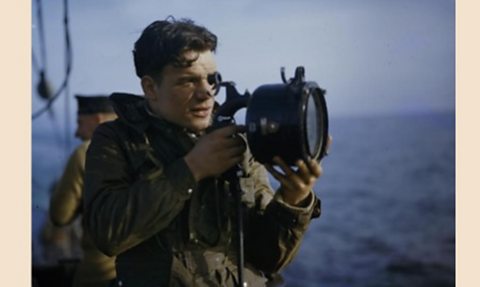 Image source, Credit: Imperial War Museum
Five fun facts about Morse code
The first message transmitted by Samuel Morse in 1844 is reportedly ‘What hath God wrought?’
Queen Victoria sent the first transatlantic telegram via an underwater cable in 1858.
By 1900, following the invention of Morse code, The Eastern Telegraph Company operated a network of over 100,000 miles of undersea cables.
Professional operators can often spot who’s sending a message by the little quirks in their dits and dahs.
'I love you’ in Morse code is:

