Female revolution
Although women hold influential positions in many areas of society, levels of gender equality vary between countries, regions and communities.
Of the estimated 800 million people living in extreme poverty globally, women and girls are disproportionately affected, according to the United Nations.
Over recent decades, changes have taken place in many countries. More girls attend school than in the past, rates of child marriage have fallen in some regions, and laws relating to the rights of women and girls have been amended.
However, challenges remain. Women are underrepresented in many political leadership roles. In some countries social, cultural, economic, or legal factors can affect opportunities available to women and girls.
Suffragettes
The Representation of the People Act was passed on 6 February 1918. This was the first time that some women in the UK were given the right to vote in parliamentary elections. Women had to wait until 1928 before they were granted the same voting rights as men.
The campaign to give women the vote in Britain began in the 19th century. The first petition on women's The right to vote in an election. was presented to Parliament in 1832.
Women campaigned through local women’s suffrage societies. In 1897, Millicent Fawcett brought many of these societies together to form the National Union of Women's Suffrage Societies (NUWSS). Members of the NUWSS were known as the Suffragists.
In 1903, Emmeline Pankhurst and others formed the Women’s Social and Political Union (WSPU) believing that a different approach was needed to achieve women’s suffrage. Members of the WSPU were known as Suffragettes and their motto was "Deeds not words".
The WSPU used a range of campaigning methods, including civil disobedience and public demonstrations. Over time, some members took part in more militant actions, such as property damage, to draw attention to their cause.
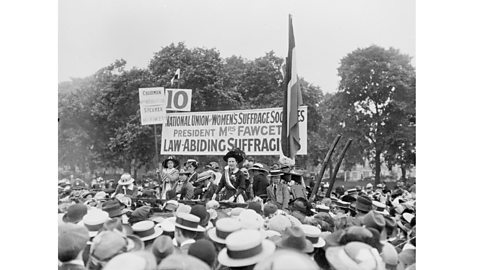
Margaret Haig Thomas was a Welsh suffragette and campaigner for women's voting rights. In 1913, she attempted to set fire to a post box in Newport as part of the suffragette campaign. She was sent to prison but later released after going on hunger strike. She later became Lady Rhondda and was a successful businesswoman and journalist.
Women had still not won the vote by 1914, but the outbreak of the First World War brought significant changes. As many men joined the armed forces, more women took on paid work in a wider range of occupations. They worked in shops, offices, and on farms, and many were employed in munitions factories. Some also served in non-combat roles connected to the war effort.
Malala Yousafzai
Malala Yousafzai was born in Mingora, Pakistan in 1997. In 2008, her life changed when Taliban forces took control of her town in the Swat Valley. They introduced restrictions on daily life and prevented girls from attending school.
In 2009, BBC Urdu posted Malala’s anonymous blog, in which she wrote about:
- life under Taliban rule
- her desire to remain in education
- her wish for all girls to have access to education and the opportunity to learn
She also spoke out publicly about the importance of education for girls despite the risks involved.
In October 2012, Malala Yousafzai was shot and seriously injured while travelling home from school on a school bus. The attack was linked to her public advocacy for girls’ education.
After initially being treated in Pakistan, Malala was flown to a hospital in Birmingham. She was discharged from hospital in January 2013 and remained in the UK with her family. She later studied at Oxford University.
Malala has continued to speak publicly about gender equality and access to education for girls. She co-founded the Malala Fund, a charity that aims to help girls gain access to 12 years of education. The fund works in regions where some girls do not have the opportunity to complete secondary education.
In recognition of her work, she received the Nobel Peace Prize in December 2014 and became the youngest-ever Nobel Prize laureate.
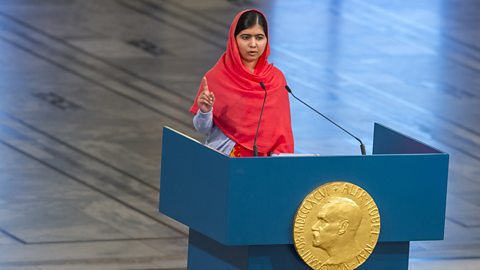
UN targets on gender equality
The United Nations addresses gender inequality through its fifth Sustainable Development Goal. The goal aims to achieve gender equality and increase opportunities for women and girls by 2030.
International commitments on gender equality have been associated with improvements in some areas. According to United Nations data, child marriage rates have fallen in some regions and the proportion of women serving in national governments has increased in recent years.
To help achieve this goal, the United Nations has set a number of targets, including:
- ending discrimination against women and girls
- reducing violence against women and girls, including exploitation
- eliminating harmful practices, such as child, early and forced marriage
- improving access to public services, infrastructure and social protection
- increasing opportunities for women to participate in leadership roles and public life

More on Revolution
Find out more by working through a topic
- count1 of 2