Ex-Olympian Oldham goes 'full circle' for comeback
- Published
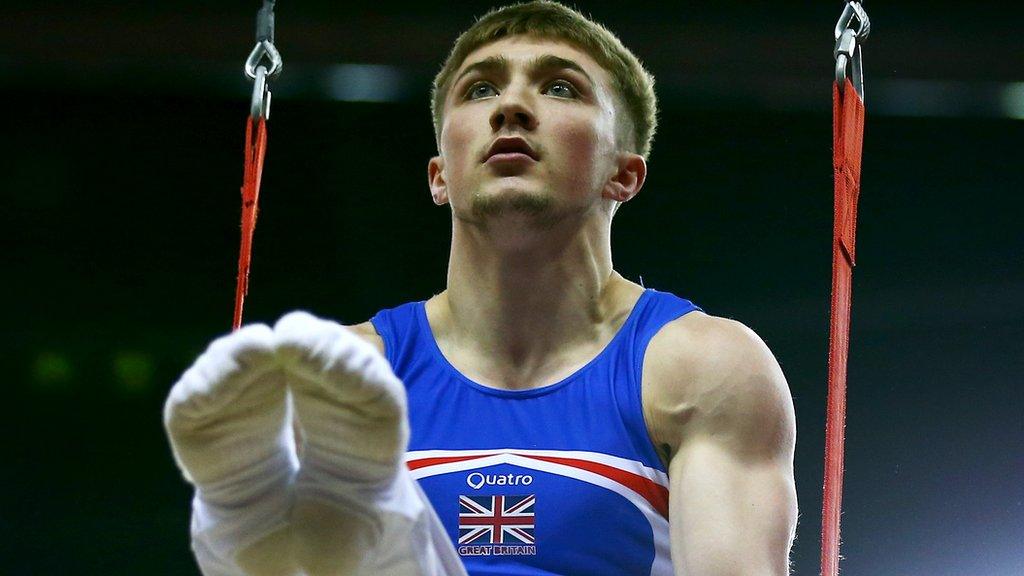
It was five years into his retirement as a gymnast that Olympic bronze medallist Sam Oldham rediscovered a child-like love for sport again.
For that reason, the 33-year-old is coming out of retirement for one weekend only to compete in the British men's artistic club team championships.
For months, Oldham has snatched every opportunity to get back in the gym to train.
And it is nothing like the all-consuming regime that he committed 21 years of his life to in a career that brought a bronze medal in the team competition at London 2012 and Commonwealth gold in the same event two years later.
"I keep my handguards in my bag, and if I've got half an hour and I'm near a gymnastics club, I go in and I swing around the bar and I just love it," Oldham told BBC East Midlands Today.
"Sport can get very cut-throat - it becomes a lot about winning, the medals, getting to the top, what you can earn financially, sponsors and there's a lot of pressure.
"It's nice to go full circle and to go back to being that seven-year-old kid that just loves the feeling of doing gymnastics again."
'Retirement can be isolating'

Oldham admitted that he found it difficult to adapt to retirement
When Oldham retired as a professional athlete, and quit the rigorous routine that the sport demanded of him for more than two decades, he found that it meant a lot more than just leaving a career behind.
As relationships with some of the people closest to him naturally changed, and there was less of the day-to-day interaction with fellow gymnasts and coaches, he admits his mental health deteriorated.
He speaks openly about the struggles and how life after sport felt "isolating" at times.
"It took me a few years to realise what I lost when I retired," he said.
"One of the big things I really struggled with was that my coach Sergey Sizhanov - who is now the head coach of the Irish national team - he was my coach for 21 years and I saw him six hours a day, six days a week and when I stopped gymnastics I stopped seeing him, so I lost my mentor in effect.
"He was a massive support person within my life and I guess the circle of people around me, and that was gone and I lost the community.
"All these people understand me because we've been through something together. There's a bond there, and it can be quite an isolating transition process, retiring as a professional athlete, and then trying to find out where you fit into society afterwards."
'Advice on the other end of the phone was huge'
Oldham was 26 when he lost his place with British Gymnastics, and it was in 2019 that he says he was diagnosed with depression and anxiety.
By the time he retired from the sport in 2021, he was working as a labourer on a building site and training part-time. Still, he recalls it as a "fairytale finish", having claimed gold in the high bars event at the British Championships.
What has brought him back to the sport half a decade later, and the reason he is competing in Basildon, Essex, over the weekend, is to once again compete for the fun of a sport that brought him years of joy before it ever delivered glory or frustration.
And with a fundraising effort, external also part of the appearance - both for Parkinson's UK and the suicide prevention charity, Samaritans, his comeback cameo is of deeply personal significance.
"For me it's two charities I'm really passionate about," Oldham said.
"My father-in-law-to-be, Alistair, is an incredible man and he has Parkinson's. He's become a very important figure in my life.
"Then there is the Samaritans. I've had to call them and and ask for advice in the past. Just being able to do that made the world of difference because at the time I felt pretty helpless.
"Having that advice on the other end of the phone was huge."
If you have been affected by any of the issues raised in this story, help and support is available on the BBC Action Line.
Related topics
- Published18 April 2017
- Published21 April 2013
- Published16 September 2012

