Why are cycling's anti-doping tests being carried out at night?
Night-time tests at the Tour de France are rare
- Published
Drug testing at cycling's biggest race, the Tour de France is in the spotlight, following a series of night-time anti-doping tests on the sport's biggest names.
Yellow jersey leader Tadej Pogacar from Slovenia and his main rival, Jonas Vingegaard, were tested in the middle of the night on Saturday.
The Dane crashed out of the race on the following stage, with some believing his disrupted sleep could have been a factor.
Five teams have reportedly had riders tested between 11pm and 6am, external during the 2026 edition of the race, this is outside the normal testing hours and usually a rare occurrence.
BBC Sport understands there have to be "exceptional circumstances" to justify the effort and that, in these cases, time might have been of the essence with a need for prompt testing.
Some in the paddock say the move is "effective" for a sport which needs to move away from a chequered doping past.
Jonathan Vaughters, now boss of EF-Education Easypost and a former team-mate of the disgraced Lance Armstrong, has spoken in support of the nocturnal tests.
He said on X: "Two am testing is one of the very effective ways to prevent peptide (EPO, HGH) and testosterone micro dosing. If [the] UCI had tested us in 2001 at 2am? We'd all have been suspended and saved the sport 25 years of drama."
Others - including the cyclists' union the CPA - says waking riders in the middle of the night is potentially dangerous and unnecessary.
But the sport's governing body, the UCI, (Union Cycliste Internationale) backed the night tests, stating the "fight against doping is an absolute priority".
It added: "The UCI of course acknowledges that night-time testing can disrupt riders' rest and recovery, and wishes to reiterate that carrying out such controls outside normal hours remains an exceptional measure, reserved for limited and justified circumstances.
"While fully aware of how onerous such a measure is for riders, the UCI nevertheless underscores that these controls serve an overriding interest: the fight against doping."
Evenepoel criticises doping tests as Vingegaard crashes
- Published3 days ago
How common is it to have night-time tests?
For the International Testing Agency - which is responsible for carrying out anti-doping tests on behalf of the UCI - to undertake tests in the middle of the night is rare, and described by many in the paddock as "unusual".
Testing between 11pm and 6am is restricted in France, and the ITA must seek permission to do so - in this case from the Parisian public prosecutors' office.
The specific reason has not been disclosed, and neither have the details of how riders were tested, or where. It is also not known when the results of the tests are to be released.
On Monday, the second rest day of the Tour, all 166 remaining riders were tested, although these were carried out between 8pm and 11pm.
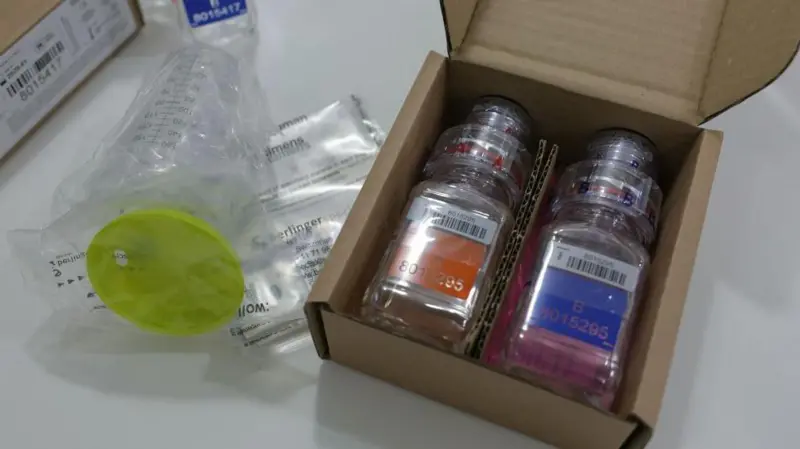
Typically, the ITA will carry out about 600 tests across a three-week Grand Tour, in a process that often takes place after a stage and includes a rider having to give a urine sample while being observed by delegates through a window.

Pogacar was woken up at five o'clock in the morning
What can night tests detect?
To put it simply, the testing could help to combat micro-dosing. This is where tiny amounts of performance-enhancing drugs are ingested but are in and out of the rider's system within a few hours, leaving only a short window for detection.
If a rider knows they have a seven-hour window where they are not normally tested, some believe it could be an opportunity to micro-dose.
Vaughters said: "If you introduce a low enough dose of a peptide hormone, the clearance time can be four hours. If you take it at 11pm, it'll be out of the system at 3am, so it makes a difference."
He added testing technology is evolving quickly but, where riders and teams push the boundaries, doping is always going to be a risk factor.
On night testing, he added: "It sucks if it happened all the time - but it's happening once or twice a year. Listen, it's a great deterrent. One night of lost sleep; lose a little sleep - gain a lot of credibility."
Generally, the days when riders boosted blood values using first EPO and then moved on to blood transfusions (which is why the night-time hotel room is such a taboo backdrop in cycling) are thought to have largely gone from the top of the sport.
Since the 1990s and decade from 2000, when the disgraced once seven-time winner Armstrong tricked the world into thinking he was clean when dominating the sport, the athlete biological passport (ABP) used by Wada is sophisticated enough to pick up seemingly all inconsistencies recorded.
There have been cyclists banned recently but no high-profile names.
The sport's lower-tiers frequently has seen riders busted for being tempted back to EPO and human growth hormones.
The ITA told BBC Sport: "Due consideration has been given to minimise as much as possible the impact testing activities have on riders.
"However, the ITA, on behalf of the UCI, has the responsibility to ensure the effectiveness of the cycling anti-doping program and the integrity of cycling races.
"As such, effective testing must, in limited and justified circumstances, be capable to occur outside standard daytime hours."

Vingegaard was woken at two o'clock in the morning to test before crashing out the next day
Is there a different way to find cheats?
The cyclists' union the CPA is not happy with the current system of testing riders and the potential dangers it puts cyclists in. Their president and former rider Adam Hansen said on X: "Our position is clear that the CPA is extremely disappointed with the current direction of anti-doping in professional cycling.
"Did you know that cyclists are the only athletes in the world who pay out of their own pockets to fund extra doping controls, long-term sample storage and for data analysis?
"This financial burden is a direct consequence of our sport's historical past. While modern cycling is drastically cleaner today, active riders are paying for the mistakes of previous generations. Is that fair?
"Within the SafeR initiative, members frequently claim that crashes happen because riders lose focus or look down at their bike computers. But consider the human cost of the current doping system, think about how you perform at your normal day job after only four hours of sleep, or after being woken up right in the middle of your REM [sleep] cycle at 2am for a blood test.
"We have said, 'quality over quantity'. The riders are directly funding the ITA, and we have repeatedly argued that increasing more tests is not the solution.
"Instead, those funds should be invested in upgrading testing laboratory equipment capable of detecting the absolute smallest traces of banned substances. [This would mean] fewer but more precise tests that catch real cheaters while reducing constant harassment of clean riders."
There are other methods on the horizon, however. The ITA is carrying out a feasibility study into using cyclists' power data as part of its anti-doping strategy.
The Swiss group is working with five teams to gather data with the aim of supporting more traditional methods.
There is some scepticism within cycling about whether such an approach will be of any additional benefit to a sport which has not had a major doping controversy for more than five years.
But while lower-level riders are still being caught and the average speeds in the big races are creeping up, the issue never entirely goes away at a time when cycling, hurt by past scandals, looks to build and maintain a cleaner image.
