Why did England struggle against DR Congo - and what can they learn?
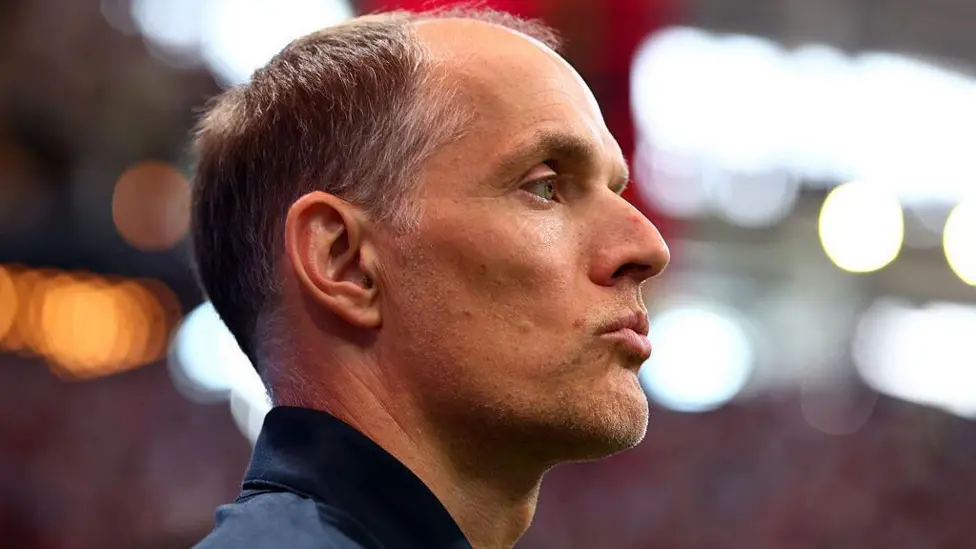
Tuchel's England needed two late Harry Kane goals to overcome DR Congo
- Published
It should not have been so hard for England against the 46th ranked team in the world.
But Sebastien Desabre's remarkably brave DR Congo side caught England manager Thomas Tuchel's team off-guard with a formation shift which preyed on some of their vulnerabilities.
England laboured for much of the game before being rescued by the brilliance of two-goal Harry Kane.
So, with England now facing the massive challenge of playing Mexico at the Azteca Stadium in the last 16, they will need to step it up.
What will they have learned, and where will they need to improve tactically to beat the World Cup hosts?
DR Congo's dangerous build-up mirrors Mexico
DR Congo set up in a 4-4-2 shape rather than their usual 5-3-2, and for more than just defensive reasons.
Their play on the ball was among the toughest tests for Tuchel since the German took charge at the start of last year.
With England intent on pressing high, DR Congo utilised their goalkeeper plus three players centrally in the build-up - outnumbering England's front two in Harry Kane and Jude Bellingham.
The DR Congo full-backs held their positions wide, pulling England wingers Marcus Rashford and Noni Madueke away from the central defenders.

In deep build-up, DR Congo spread their back four across the width of the pitch, using the goalkeeper as an extra outfield player. England's front two were unable to apply any meaningful pressure as a result
This spreading out of the back line made it hard for England to close the distance.
At times it seemed it caught players in two minds as to whether they should press high or hold their position.
Sound familiar?
Well, Mexico employ similar tactics, albeit with a 4-3-3 formation, using width and rotations to pull opponents away from passing lanes.

In a similar manner, Ecuador's front two struggle to stop Mexico progressing play through their wide back four and goalkeeper. Note the Ecuador midfielders pressing aggressively in a man-to-man fashion, something England did not do well against DR Congo
The off-ball movement of DR Congo's midfielders dragged the likes of England midfielders Declan Rice and Elliot Anderson into unfamiliar positions, before attackers dropped unmarked into deeper positions - something striker Raul Jimenez has also done under Mexico boss Javier Aguirre.

Here we see two of DR Congo's midfielders drag England's central midfielders Declan Rice and Elliott Anderson (highlighted in yellow) over to the right side of the pitch. The winger is able to run into the vacated space. In white, we see Nathanaël Mbuku in space
If England are to mitigate some of these problems against Mexico, there are two main options.
The first is to sit off more passively in a compact block, allowing the opposition to have more of the ball but preventing them the space to play through.
The other option is to stick to a high-pressing approach but to tweak how that is executed.
Against teams that build up in a spread-out manner, this is always a tough ask but one solution may be in asking one of the central midfielders to join Kane and Bellingham, pressing man-to-man against the opponents' two centre-backs and defensive midfielder.
This would require one of England's central defenders to step up and fill in the space behind Rice, but Marc Guehi is used to backing up the press in a front-footed manner like this at Manchester City.
It is a game of trade-offs and Tuchel will have to decide whether he opts to drop off or defend more aggressively. What he cannot do is end up in between the two, like England often did on Wednesday.
Genuine superstar Kane produces his biggest England moment
- Published1 July
England's on-ball struggles (and fixes)
How a team defends is not done in isolation. In possession, tactics affect how well a team defends too.
With England having longer spells of possession in the second half, they were able to minimise the impact of DR Congo's build-up play.
This will be a more difficult ask, playing in what is an away game against Mexico.
But, more measured possession in a similar fashion to how DR Congo started the game against England might be a tactic Tuchel's side could look to borrow for their next match.
On the ball, England struggled at times to put together free-flowing attacks against DR Congo's 4-4-2. This followed a pattern set in the group stage in their matches against Ghana and Panama.
Despite this, they did have some reliable methods of attack on which to fall back.
Prior to the tournament, Tuchel was set on attacking down the flanks with what he termed "wide units" - a triangle of full-back, attacking midfielder and winger to rotate between themselves, pulling opponents out of position, before attacking the space that movement opened up.
The idea was to stick to Plan A, hence Tuchel picked like-for-like profiles across the pitch rather than opting for players who change the style of the team.
The only England player who perhaps offers a different dynamic is Eberechi Eze, who came on following a key hydration break.
Acknowledging injuries to his full-backs as well as the underwhelming form of his wide units, Tuchel has attempted to introduce alternative methods of attack in recent games.
This includes attacking through the middle as well as changing who forms the wide units in the hopes of finding relationships that work well.
And he may have stumbled upon combinations that clicked towards the end of Wednesday's game.

This is an example of some of England's good wide play against Croatia in the lead up to their third goal
For England's equaliser, Bukayo Saka expertly drew out DR Congo's full-back. The diagonal run of Eze pulled their central defender with him, and recognising this, Rice made a run from right-back filling in the space that opened up through his movement.
When done quickly and almost telepathically, these wide rotations are very difficult to stop, and it makes sense why Tuchel was so fond of this as his main tactic in the lead-up to the World Cup.

The 'wide unit' of three Arsenal players on the right showed great understanding to combine for the first goal with Eze pulling wide and Rice running into the space ahead
What this did well too was to free up Bellingham to play on the left side of the midfield, a position in which he thrived against Panama, showcasing top-level dribbling quality and strong runs in behind the opposition's right-back.
In the first half of the game against DR Congo, Rice failed to make these runs as naturally, and Bellingham, frustrated by this, actually finished the half moving over to the left side himself.
The tactical tweak to move Rice over to a right-back position and Bellingham to what appeared to be a more natural left-sided midfield role created relationships and conditions that allowed England's top-level talent to play more naturally within the confines of Tuchel's tactical approach.
Mexico are yet to concede a goal in the World Cup, so breaking them down will be a remarkably tough task.
But if England are to do so, leaning into these forming relationships, in which players understand what their team-mates are likely to do, but that are difficult for opponents to read in the moment, will be a key tool.

Bellingham left his right central midfield position to make the diagonal run in behind DR Congo's right-back when Rashford got the ball - the same pattern that resulted in goals for England against Panama. This is one reason this left-sided role suits him
Before the game, Tuchel said not to expect a glamorous performance, and their win against DR Congo definitely was not glamorous.
But through the struggle they faced, they asked tactical questions and found roles and partnerships that appeared to bring out the best in certain players.
England would have wanted to play better than they did, but, looking forward to their match against Mexico, this might have been the preparation they needed.
Related topics
- Published12 July
- Published1 July