Summary

  • The French interior minister says the Gironde wildfire has "a life of its own" and that firefighters are facing an "unprecedented situation"

  • French President Emmanuel Macron has arrived in the Gironde region to meet teams responding to the wildfires

  • People in Bordeaux are growing "anxious and fearful", one resident says, with the blaze around nine miles (15 km) from the outskirts of the city

  • The mayor of Cestas, a town south of Bordeaux, says this "will be the fire of the century", describing the scenes as "catastrophic"

  • One British tourist in Gironde describes "acrid" air and "ash falling from the sky", while fire crews battle flames "leaping several feet into the air", our correspondent reports

  • More than 300,000 people have been evacuated across France and Spain - satellite data shows the fires spreading near Bordeaux and Madrid

  • Record-breaking heat is exacerbating European wildfires, while climate change is making the hotter, drier conditions that allow fires to spread faster and burn more fiercely more likely

  1. Wildfires continue to burn in France and Spainpublished at 19:21 BST
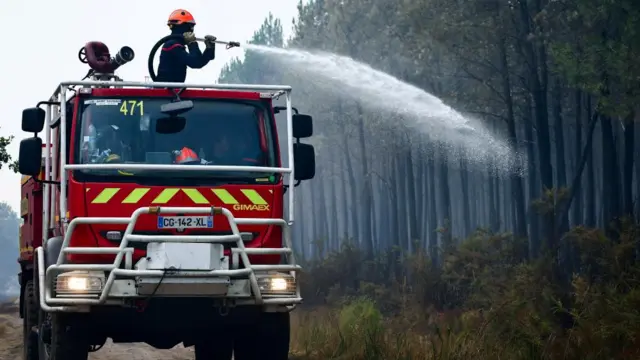
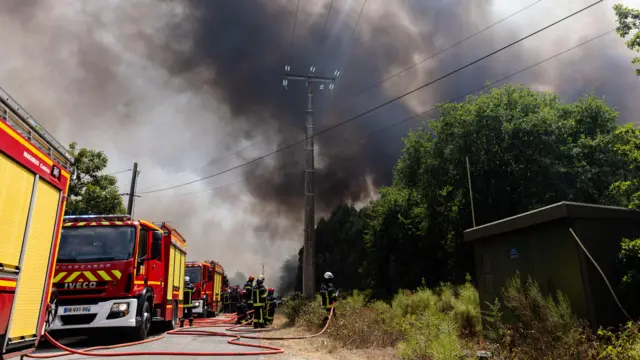
    A fire engine carries out edge protection and mop-up operations on a wildfire in Saint-Jean d'Illac, in the Gironde regionImage source, Reuters

    The wildfire burning in Gironde has a "life of its own," the French interior minister has said, as blazes continue to burn in France and Spain.

    A blazeis now just nine miles (15km) from the outskirts of the city of Bordeaux.

    An estimated 220,000 people have been forced to evacuate in the Gironde region, and about 42,000 hectares have been burnt, with 240 houses destroyed.

    President Emmanuel Macron thanked responders for their hard work on a visit to Bordeaux earlier today, saying "the whole nation is behind you," in comments reported by Reuters.

    In Spain, major fires are burning about 31 miles (50km) west of Madrid.

    About 105,000 people have been evacuated, with an estimated 77,000 hectares affected by fires in the Madrid, Avila and Toledo regions.

    While man-made climate change did not provide the sparks that started these fires, it is making the hotter, drier conditions that allow fires to spread faster and burn more fiercely more likely, our climate editor Justin Rowlatt writes.

    And if you were planning to travel to France or Spain, our business reporter Mitchell Labiak explains everything you need to know.

    • We're pausing our live coverage now, but you can read more about the wildfires in our news story.

  2. Air quality is hit when there are wildfirespublished at 18:56 BST

    Elizabeth Rizzini
    Lead weather presenter

    Air quality is massively impacted by wildfires.

    For a start, whatever is burned will produce fine particles in the atmosphere that can then enter the human body causing short term and long term health impacts.

    It's usually vegetation that burns - trees, bushes, wood etc - and when these are burned pollutants like carbon monoxide, carbon dioxide and nitrogen oxides are released.

    High pressure can often create a temperature inversion.

    This is where a layer of warmer air acts as a lid on a top of cooler air, trapping pollutants near the surface of the Earth, where of course, we breathe the air.

    Wind patterns could then disperse the pollutants across a much wider area than the actual fire itself.

    There aren't only impacts on public health but also on agriculture, crops are damaged and lakes and rivers can turn more acidic damaging their ecosystems.

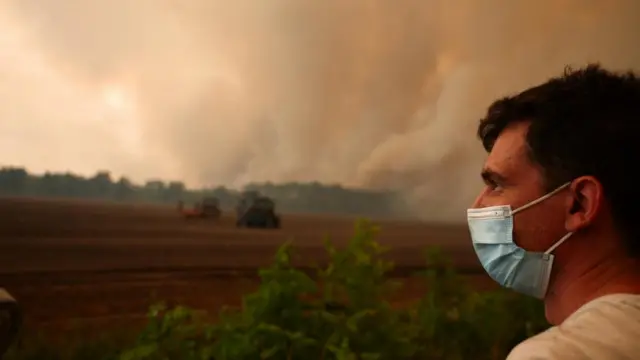
    A man wears a mask, while smoke rises from a wildfire in GirondeImage source, Reuters
  3. Firefighters injured, homes destroyed: Gironde wildfire in numberspublished at 18:39 BST

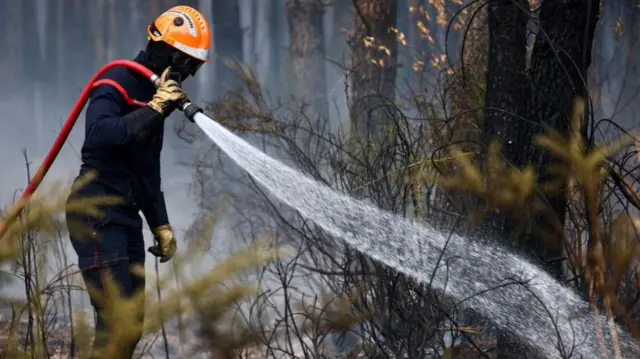
    A firefighter in head to toe black gear is shown hosing down blackened forest.Image source, Reuters

    The Gironde regional government has published some figures on the current status of the wildfire burning west of Bordeaux:

    Estimated burned area: 42,000 hectares

    People evacuated since the fire began: about 220,000

    Resources mobilised:

    • 2,750 firefighters
    • 18 aerial firefighting assets
    • 1,500 military personnel
    • 1,440 internal security personnel

    Firefighters injured since the fire began: 88

    Homes destroyed: 240

    As firefighters continue to battle the blaze, authorities are urging people not to return to the affected area yet.

  4. Emmanuel Macron receives briefing during Bordeaux visitpublished at 18:30 BST

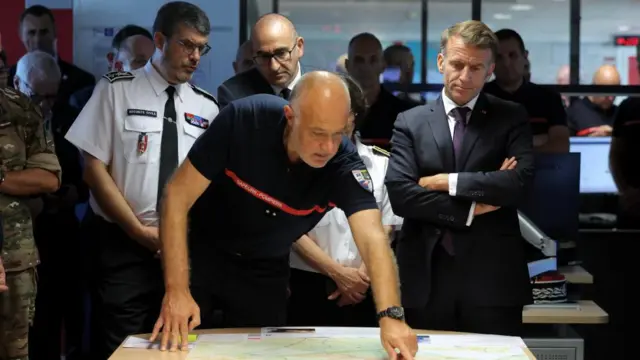
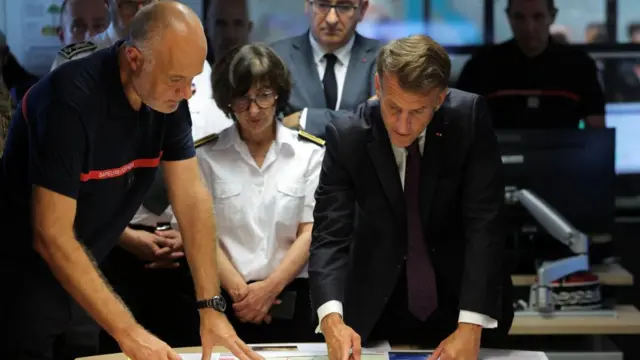
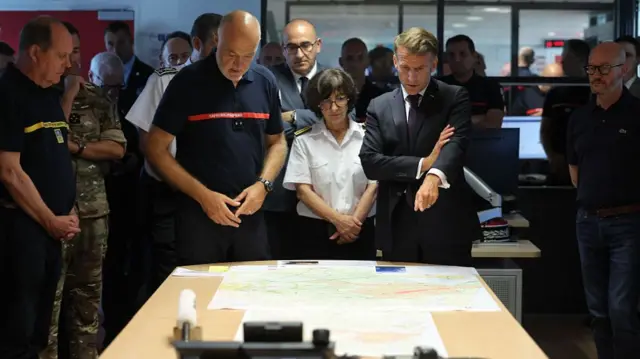
    French President Emmanuel Macron has visited the Departmental Fire and Rescue Operational Centre in Bordeaux this afternoon, as wildfires continue to burn in the Gironde region.

    Interior minister Laurent Nunez also travelled with the president, where they got a briefing from some of those tackling the fires.

    Pictured with them are Gironde's prefect Sophie Brocas, and Marc Vermeulen, who is departmental director of the region's fire service.

    Emmanuel Macron and France's Interior Minister Laurent Nunez attend a situation briefing in the crisis room at the Departmental Fire and Rescue Operational Center (CODIS) in Bordeaux,Image source, Reuters
    Emmanuel Macron attends a situation briefing in the crisis room at the Departmental Fire and Rescue Operational Center (CODIS) in Bordeaux,Image source, Reuters
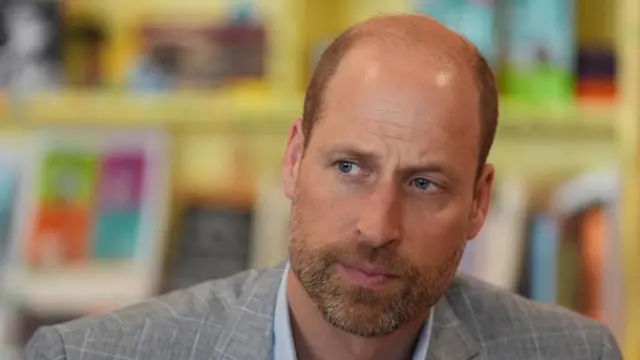
  5. Prince of Wales: Fires 'stark reminder' of challenges of extreme climatepublished at 18:10 BST

    The Prince of Wales is offering thoughts for "everyone affected by the devastating wildfires across France, Spain and the UK".

    In the message, posted on social media and signed "W", he says: "We are deeply grateful to the firefighters, emergency services and volunteers working tirelessly in extraordinarily difficult conditions.

    "These events are a stark reminder of the challenges posed by an increasingly extreme climate and the importance of protecting both people and nature."

    Prince WilliamImage source, PA Media
  6. Gironde residents brace for higher temperatures as crews battle firespublished at 17:57 BST

    Gwyn Loader
    Chief correspondent, Newyddion S4C, in Gironde

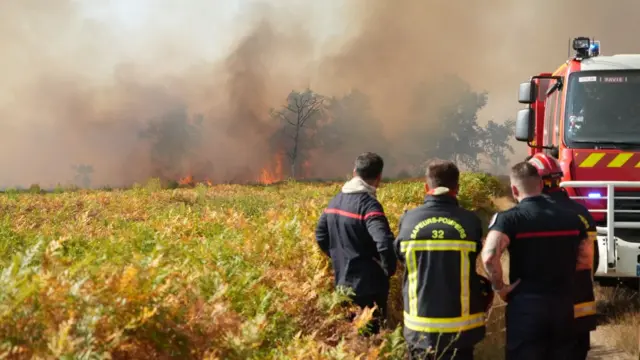
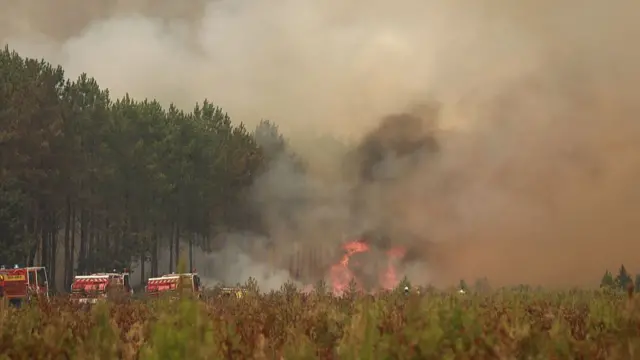
    Firefighters are shown standing in front of scrub beside a fire truck, as flames and smoke billow among trees in the distance.

    To the west of Le Temple, we’ve witnessed fires still raging in the vast countryside of south-west France, flames leaping several feet into the air and thick black smoke clouding the vicinity.

    There are several fire crews battling the flames here and aircraft from Canada have been pulled in to assist, dropping bright red retardant over the burning shrubs.

    This morning did see a little respite, but with no rain forecast over the coming days and temperatures set to reach 40C or higher, locals tell me they are concerned the situation could worsen still this week.

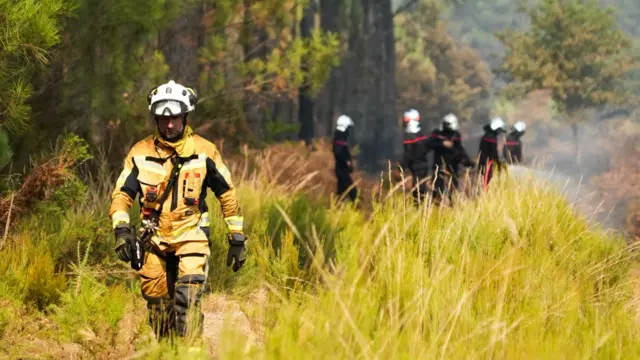
    A firefighter in full protective gear works through scrub in front of burned trees, with five other firefighters in the background.
  7. Macron arrives in Gironde as wildfires continue to burnpublished at 17:45 BST
    Breaking

    Emmanuel Macron looks at maps on a table, flanked by firefighting officials. He is pointing with his left hand.Image source, Getty Images

    French President Emmanuel Macron has arrived in the Gironde region to meet those responding to the wildfires.

    We will bring you more updates on this when we can.

  8. 'There's a thin layer of ash on everything outside'published at 17:32 BST

    Alex Emery
    BBC Your Voice

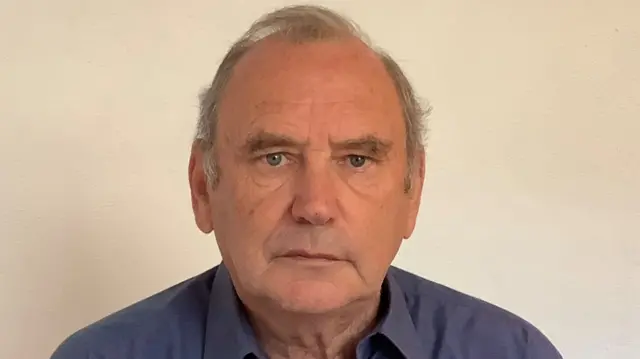
    John Kay is pictured looking at the camera, wearing a blue shirt.

    Retired university professor John Kay has been in touch with the BBC - he moved to the Dordogne in 2011.

    He says although he lives 100km away from Bordeaux, the wildfires are making themselves felt.

    "The sky had a yellowy tinge and there was a strong smell of smoke," he says.

    "There’s been a bit of rain since last night so the smell isn’t as bad, but there’s a thin layer of ash on everything outside.

    "Friends of ours 80km further east from us can even smell the smoke, it’s that strong.

    "This all is trivial compared to the poor people living in Bordeaux. We have a huge amount of forest here so it just takes a few sparks, and it could be bad.

    "Today is a lovely 29C. But everything is very dry, and 41C is predicted for Wednesday."

    A purple horizontal banner with the words 'Your Voice' in white lettering.
  9. Heatwave to move slowly over scorched Europepublished at 17:21 BST

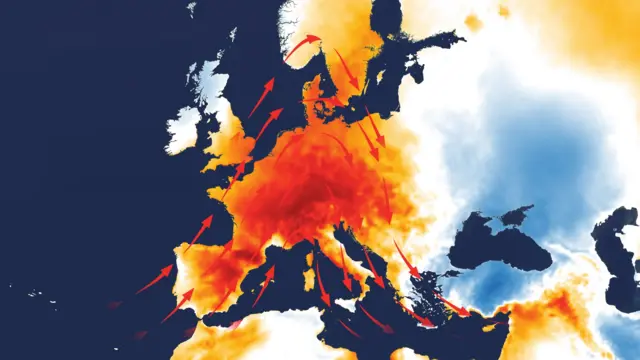
    A map of Europe with red patches and arrows illustrating a heatwave over the west and centre of the continent
    Image caption,

    The coming heatwave will be far more severe in western and southern Europe than in northern countries

    While parts of England are set for a brief heatwave this week, much of Europe will bake in higher temperatures for a longer period of time.

    Temperatures in south-western France and parts of Spain, already scorched by wildfires, will push 40C over the coming days.

    The heatwave is spread widely in western, central and southern Europe, meaning it will pass over the land much more slowly than in northern areas - possibly lasting into next week.

  10. French wildlife centres 'overwhelmed' amid heatwaves says animal charitypublished at 17:01 BST

    Madeleine Lake
    Live reporter

    A hedgehog recovering at a wildlife centre from excessive heat, they are being fed milk through a syringeImage source, Faune Essonne
    Image caption,

    A hedgehog recovering at a wildlife centre from excessive heat

    Heatwaves have pushed France's wildlife rescue centres to "breaking point" says the International Fund for Animal Welfare (IFAW).

    “Exhausted swifts, dehydrated hedgehogs, animals collapsing by roadsides: the centres are overwhelmed, and behind every statistic is an animal in real distress," says programme manager Aurore Morin.

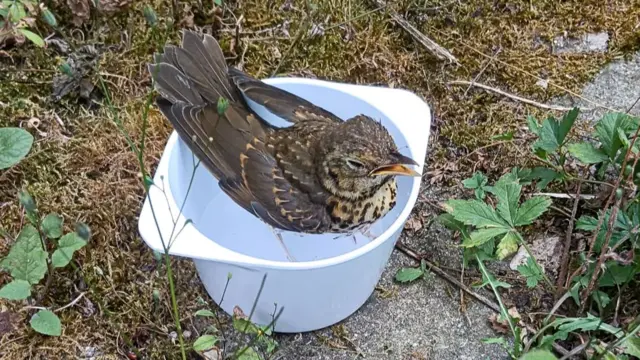
    A song Thrush, cooling down and hydrating after suffering the effects of the heatwaves in France.Image source, Réseau Centres De Soins
    Image caption,

    A song Thrush, cooling down and hydrating after suffering the effects of the heatwaves in France.

    The charity tells me that at least 70% of rescue centres are closed to new admissions because they have reached capacity, with most animals admitted due to the heatwave rather than wildfires.

    The ecological loss, it says, is "irreversible": "Many animals are unable to escape the flames and therefore cannot be rescued."

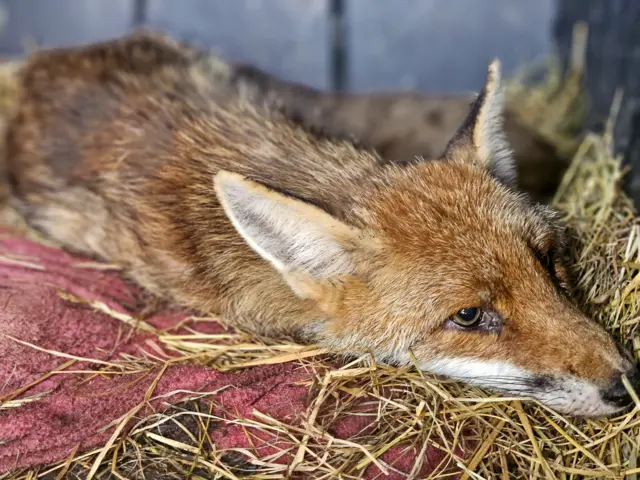
    A fox recovering from excessive heat, lying on a red blanket in hayImage source, Réseau Centres De Soins
    Image caption,

    A fox recovering from excessive heat at a wildlife centre

  11. 'This will be the fire of the century' mayor of town near Bordeaux sayspublished at 16:47 BST

    Firetrucks battle smoke near a line of trees on a roadImage source, EPA/Shutterstock

    Jerome Steffe, the mayor of Cestas, a town south of Bordeaux, says this "will be the fire of the century".

    Speaking to BBC News, he describes how 17,000 residents were evacuated from his town during the night when the fire swelled two days ago.

    So far, he says, the region has seen 42,000 hectares of land burned, and 240 houses destroyed.

    "In my city the situation is really catastrophic," he adds.

    And although the fire is no longer moving as quickly, he says his teams have "won only a small battle" and emphasises that the risk remains from flying embers or a sudden change in wind direction.

    "We put all our energy into creating protective firebreaks," he explains, but admits "we are all scared in front of this situation."

  12. BBC Verify

    Satellite images show wildfire spreading west of Madridpublished at 16:34 BST

    By Barbara Metzler

    BBC Verify has been analysing satellite imagery showing the spread of the wildfire west of Madrid, which has now affected more than 27,000 hectares.

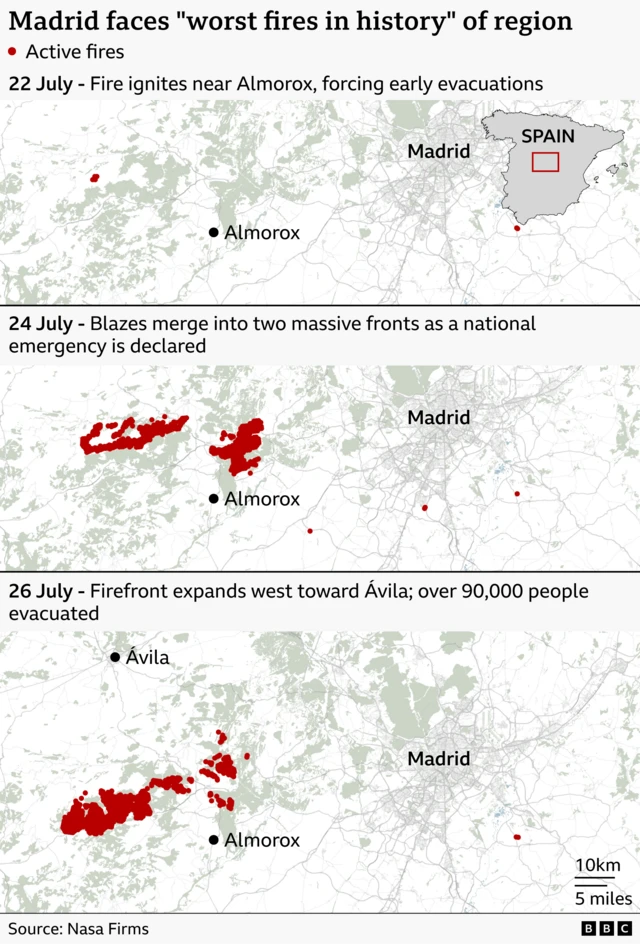
    These satellite images, captured on 24 and 26 July, show how the fire spread over two days after several blazes in the Almorox, Villa del Prado and San Martín de Valdeiglesias areas merged into one large fire.

    The images show the rapid expansion of the burn scar as the wildfire spread.

    This Flourish post cannot be displayed in your browser. Please enable Javascript or try a different browser.

  13. Spain enters fifth day of national emergency - how have the wildfires developed?published at 16:26 BST

    As Europe experienced a serious heatwave, wildfires burned across Spain. But they became a major focus last Thursday, when the country declared a national emergency. Here's how the fires developed:

    22 July

    • Fire ignites near Almorox, near Madrid

    23 July

    • Spain's government declares a national emergency as multiple wildfires burn across the country

    24 July

    • Spanish officials warn that the wildfire near Madrid is "beyond the capacity" of firefighters to contain, after three fires merge into bigger blazes
    • Officials say more than 60,000 people are affected by the fires, with at least 30,000 evacuated and more than 20,000 in lockdown

    25 July

    • At least eight municipalities near Toledo are also ordered to evacuate
    • One civilian is killed in a smaller fire in the Valencia region - the only civilian death reported so far

    26 July

    • Fires continue to spread, with more than 90,000 people evacuated from regions around Madrid and Ávila
    • Firefighters battle a new blaze near the eastern coastal city of Valencia, where about 15,000 people are forced to flee their homes
    Three-panel map infographic titled “Madrid faces ‘worst fires in history’ of region” showing the growth of wildfires west of Madrid between 22 and 26 July. Active fires are marked in red. 22 July: A small cluster of fires appears near Almorox, southwest of Madrid, after a fire ignites and prompts early evacuations. An inset map of Spain shows the affected area’s location. 24 July: The fires expand dramatically into two large fronts west and northwest of Almorox as a national emergency is declared. Several smaller fire hotspots appear elsewhere around the region. 26 July: The firefront spreads further west toward Ávila and becomes a broad, continuous burn area stretching across forested land. The map notes that more than 90,000 people were evacuated. Madrid remains east of the main fire zone. A scale bar shows 10km (5 miles). Source: Nasa Firms
  14. Record-breaking heat exacerbates European wildfirespublished at 16:04 BST

    Elizabeth Rizzini
    Lead weather presenter

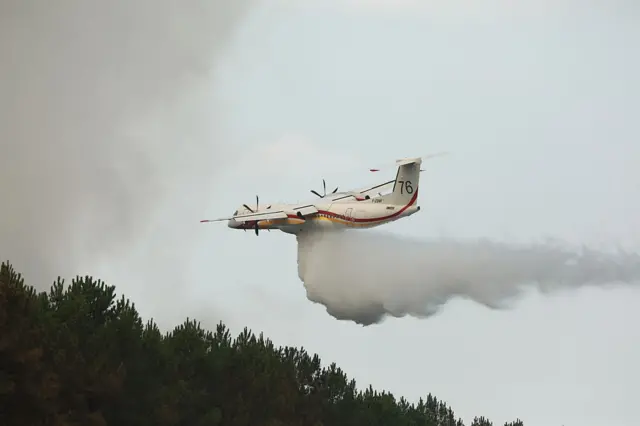
    Specialist aircraft drops water on a fire burning in a forest in south-western FranceImage source, Getty Images

    The hot and dry weather these last couple of months across western Europe has exacerbated the wildfires.

    It was the hottest June on record in France and the second hottest June on record (second to last year) in Spain.

    France recorded only half its monthly rainfall for June and Spain only 39%. In Spain it was the driest June on record.

    July looks like it could be the hottest month ever recorded in Spain but this will be confirmed at a later date.

    Europe is the fastest warming continent on earth according to the World Meteorological Organisation, warming at twice the global average.

  15. BBC Verify

    Satellite data shows smoke from wildfires spreading across Spain and Francepublished at 15:59 BST

    By Barbara Metzler

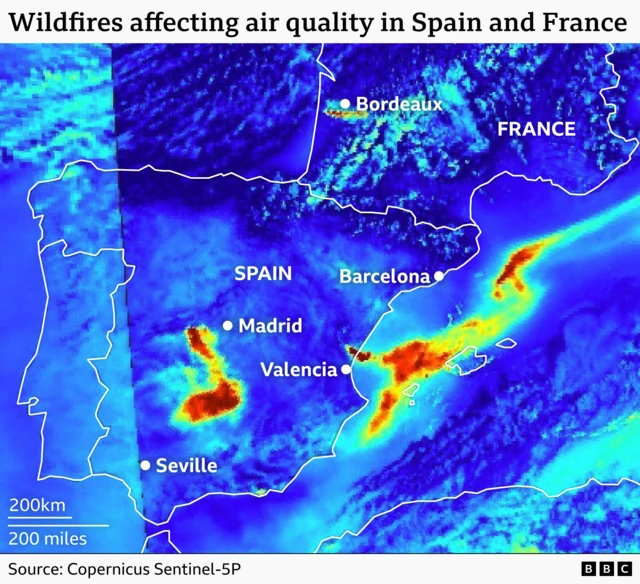
    BBC Verify has been analysing satellite data showing the spread of smoke from the wildfires in Spain and France.

    This image, captured by the Copernicus Sentinel-5P satellite on Sunday, uses the Aerosol Index to detect smoke and other tiny particles in the atmosphere.

    Map of Spain and southern France showing atmospheric aerosol concentrations detected by the Copernicus Sentinel-5P satellite. Colours range from blue (lower aerosol levels) to yellow, orange and red (higher concentrations of smoke and airborne particles). Large red-orange plumes are visible in east-central Spain, south of Madrid, and across the western Mediterranean near Valencia and the Balearic Islands, indicating wildfire smoke affecting air quality. Additional elevated aerosol levels appear near Bordeaux in southwestern France. Major cities including Madrid, Barcelona, Valencia, Seville and Bordeaux are labelled. Title: “Wildfires affecting air quality in Spain and France.” Source: Copernicus Sentinel-5P.

    Red areas indicate higher concentrations of absorbing aerosols which can include wildfire smoke. These tiny particles absorb sunlight, warming the atmosphere and reducing air quality.

    Three prominent plumes are visible over the Iberian peninsula and south-west France with the largest extending from the wildfire west of Madrid. Another is visible near Bordeaux, while a third lies along Spain's east coast near Valencia.

    The map shows how smoke is drifting and highlights areas downwind that may be at greater risk of poorer air quality.

  16. British tourist recalls 'ash falling from the sky' amid French firepublished at 15:50 BST

    Rozina Sini
    BBC Your Voice

    A foggy beach with a smoke cloud in the distanceImage source, James Hillier
    Image caption,

    The beach at Lacanau was 'completely destroyed' by ash from the nearby wildfire

    James Hillier was visiting his son in the seaside commune of Lacanau, in the Gironde department, on Friday, when "the whole town got consumed by smoke".

    He and his wife headed to the beach, which is a popular surfing spot, and found that it had been "completely destroyed".

    "There was ash falling from the sky and I noticed a big lump of it landed on my hand," he tells the BBC.

    The smoke was so heavy that whenever they wiped their garden table clean, it quickly became covered with ash again.

    The couple, from London, left Lacanau on Saturday, only to find the main road to Bordeaux blocked by police, with "endless streams of fire engines" driving past.

    Arriving in Bordeaux, they found a quiet city without many people visiting. "The air was acrid – it stung your eyes and people were wearing masks," Hillier says.

    They have now decided to leave Bordeaux and he says they want to "move up north".

    BBC Your Voice logo
  17. Temperatures to soar beyond 40C in Spainpublished at 15:36 BST

    Elizabeth Rizzini
    Lead weather presenter

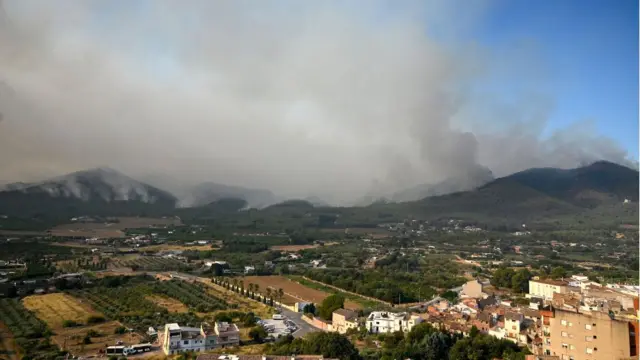
    A town in the foreground in sunshine, with a large cloud of smoke rising from the green hills beyondImage source, Getty Images
    Image caption,

    Fires have been raging near Valencia, on Spain's east coast

    The Spanish Met Office, AEMET, has issued amber alerts for a widespread heatwave until at least Sunday.

    The warning covers south-western and central regions, as well as the Canaries.

    A large area of high pressure will strengthen, with temperatures to rise day on day underneath cloudless skies.

    They will range from 39C to 41C by Wednesday and are expected rise later in the week.

    Temperatures will exceed 40C across the Guadalquivir, Guadiana and Ebro valleys for several consecutive days.

    Friday could be the hottest day of the week, with Cordoba expected to reach 44C, while Toledo, Zaragoza and Ciudad Real could all see temperatures of about 42C.

  18. In pictures: France and Spain continue to tackle raging wildfirespublished at 15:24 BST

    Wildfires continue to cause uncertainty for Spanish and French residents as more than 300,000 people have had to leave their homes.

    Let's take a look at this morning's developments, in pictures:

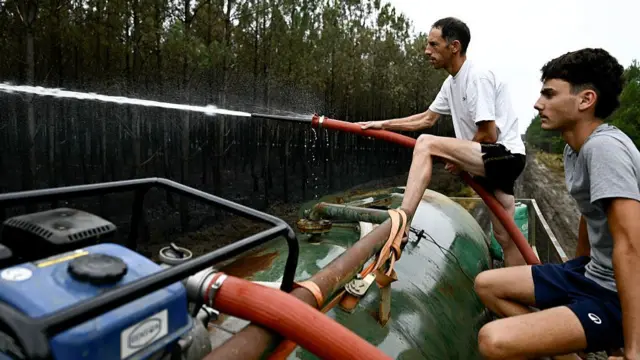
    Farmers spray water on hotspots to help firefighters battle the wildfire in Saint-Jean-d'Illac, west of Bordeaux, on July 27, 2026, during wildfires in the Gironde region, southwestern France.Image source, Getty Images
    Image caption,

    West of Bordeaux, in Saint-Jean-d'Illac, farmers have been helping firefighters tackle blazes in the Gironde region

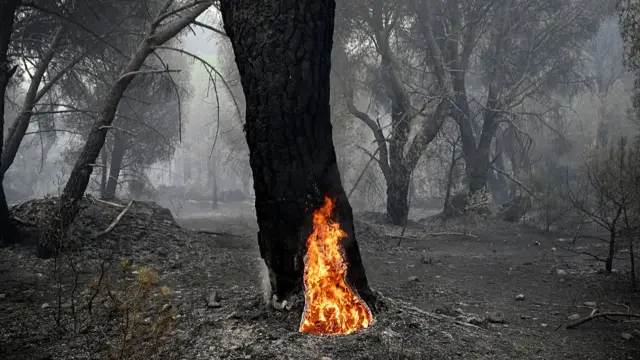
    A large pine tree with its hollowed trunk still burning from the inside, is seen in a scorched forest following a wildfire near La Adrada, 95 kilometres west of Madrid, on July 27, 2026.Image source, Getty Images
    Image caption,

    Further south in Spain, fires scorched and continue to burn through forests in La Adrada, west of Madrid

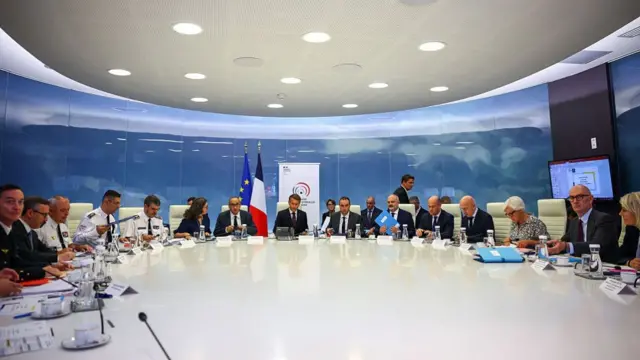
    France's President Emmanuel Macron (C), France's Prime Minister Sebastien Lecornu (C-R), France's Interior Minister Laurent Nunez (C-L) attend a meeting with other members of the cabinet and Civil Security to discuss wildfires in the country, at the Hotel de Beauvau, the French Interior Ministry, in Paris on July 27, 2026.Image source, Getty Images
    Image caption,

    French President Emmanuel Macron has been holding a crisis meeting in Paris to discuss the government's response as wildfires continue to scorch parts of the country

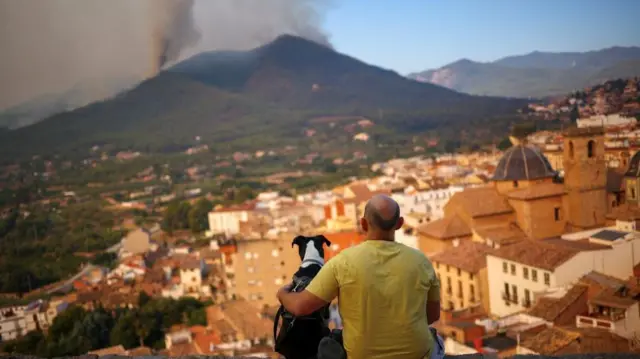
    A man and his dog look at a wildfire in a mountain in Onda, Spain, July 27, 2026.Image source, Reuters
    Image caption,

    Thousands of people have been displaced and while some fires have been contained, hot and dry weather is likely to persist - increasing the risk of other wildfires

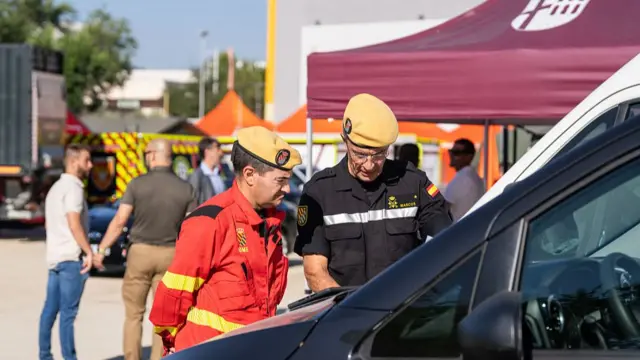
    Two officers from the Military Emergency Unit (UME) are working at the Forward Command Post (PMA) in Navalcarnero, on 27 July, 2026 in Navalcarnero, Madrid, Spain.Image source, Getty Images
    Image caption,

    Spanish PM Pedro Sánchez says more than 150,000 hectares have burned across Spain since January - an area six times larger than during the same period last year

  19. Is climate change to blame?published at 15:13 BST

    Mark Poynting
    Climate reporter

    A massive wildfire struck the Gironde department of southwestern France on July 27, 2026.Image source, Getty Images

    There is no single reason why these fires are so intense, but scientists are very confident that climate change is playing a role.

    Most wildfires are started by humans, whether deliberately or accidentally. But climate change means we're seeing more of the weather conditions conducive to the spread of fires.

    Intense heatwaves – like we have seen repeatedly this summer - draw extra moisture out of soils and vegetation.

    These tinder-dry conditions help fires to spread at speed, especially if winds are strong. This can lead to larger, more intense fires than might have happened otherwise.

    The UN’s climate panel expects these “fire weather” conditions to become even more common in the Mediterranean as the planet continues to warm.

    But there are lots of other factors in addition to climate change. In recent months rainfall has been lower than average across much of south-western Europe - which is thought to be down to natural variability.

    And some researchers have long warned that the Mediterranean’s forests and scrublands are not being properly managed – leaving plenty of vegetation as fuel for fires.

  20. Are you affected by the fires? Have your holiday plans changed?published at 14:55 BST

    Are you a resident or tourist who has been affected by the European wildfires, or did you have plans to visit the area? If it is safe to do so, get in touch.

    You can get in touch in the following ways:

    Please read ourterms & conditions andprivacy policy

    In some cases, a selection of your comments and questions may be published, along with your name and location as provided, unless you request otherwise. Your contact details will never be published.

    A purple horizontal banner shows the words 'Your Voice'