Summary

Media caption,
Watch: Hegseth interrupted several times as he seeks additional Iran war funding
  1. Gillibrand accuses Hegseth of seeking 'unlimited money for bombs'published at 22:35 BST
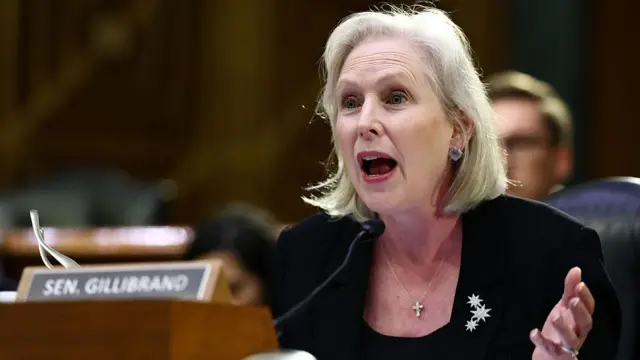
    Senator Kirsten Gillibrand angrily questions HegsethImage source, Finn Gomez/Getty Images

    New York Democratic Senator Kirsten Gillibrand says Hegseth is asking for $1.5tn for a war the president has said has already been won, and angrily accuses the Trump administration of prioritising the war in Iran over the health and wellbeing of Americans.

    She says the administration is seeking "unlimited money for bombs" from Congress, while American citizens cannot afford "feed their families".

    Hegseth says the administration does not seek "unlimited bombs".

    "I'm asking for the right bombs at the right time," he says, calling the request a "generational" upgrade to US fighting capabilities.

    Gillibrand, raising her voice, asks when the war will end.

    Hegseth responds: "We're staying laser-focused on the objectives. You're trying to make campaign commercials."

  2. Committee mostly divided on party linespublished at 22:25 BST

    Max Matza
    Reporting from Washington

    The hearing seems to be - somewhat predictably - divided along party lines, after nearly three hours of testimony.

    Democrats are accusing the Trump administration of seeking funds for a variety of conservative priorities, beyond simply the war in Iran - which the Democrats oppose.

    Republicans appear to have shown more support for the funding request, although they have also questioned how long the operation against Iran will take to complete.

    Republicans are currently preparing a $95bn (£71bn) budget package to fund the military, and for other White House priorities. Congress is expected to begin voting on the budget request as soon as this week.

  3. US fighting war 'differently' to previous 'stupid wars' - Hegsethpublished at 22:11 BST

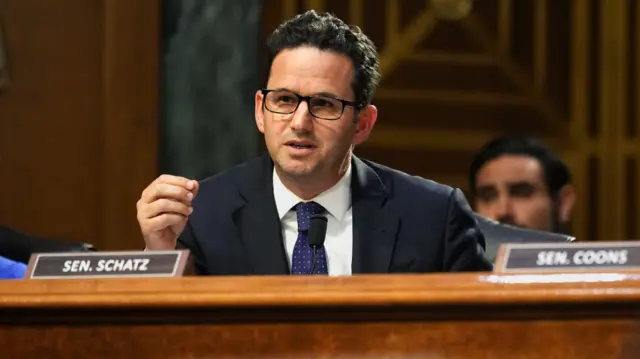
    Brian Schatz, Democratic representative for Hawaii, starts by expressing his "deepest condolences" to Lt Tyler James Feehan, the Hawaii native who was among the US service personnel killed in an Iranian strike on Jordan over the weekend.

    Schatz goes on to say that the stated objectives of the war at the outset were regime change, eliminating conventional missile capability, preventing nuclear capability and opening up the Strait of Hormuz.

    He says none of these objectives have been achieved in full and that "the Strait of Hormuz was open before this war started".

    "Tell my constituents why this war is going so well," he asks Hegseth.

    Hegseth mentions the wars in Iraq and Afghanistan, and says Trump's policy was to no longer fight "stupid wars like that again", which is why the US has not been trying to "re-make Iranian society".

    Instead, he says the US is - "in a realist, Ameirca first way" - ensuring Iran never has a realistic path to a nuclear bomb.

    "President Trump ran on fighting wars differently, and we're doing so overwhelmingly," he says.

    U.S. Senator Brian Schatz (D-HI) speaks during a Senate Appropriations Committee hearing on U.S. President Donald Trump's supplemental funding request for the Department of Defense, in Washington, D.C., U.S., July 21, 202Image source, Reuters
  4. Caine says targets determined by 'robust' review processpublished at 21:51 BST

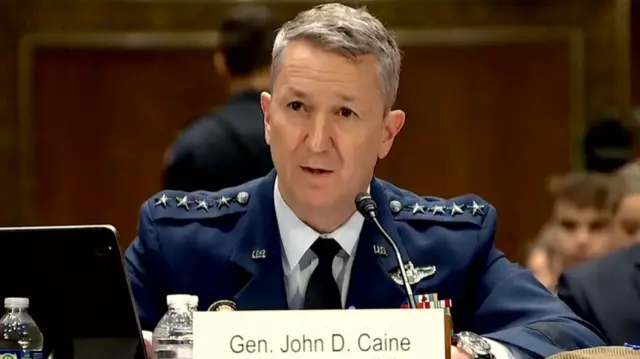
    Caine speaks to the committeeImage source, Reuters

    Democrat Jeff Merkley asks Chief of Staff Dan Caine about whether the US has targeted a civilian desalination plant, and other civilian infrastructure in Iran.

    Caine says he's "not aware of those as being particular targets", or those reports.

    Merkley then asks Caine if he can assure the public that civilian infrastructure won't be targeted, even in retaliatory strikes.

    Caine says there is a "robust" review system in place to decide on targets.

    Merkley demands to know whether the US will attack infrastructure needed for "civilian survival". He points out that such attacks violate international law.

    "It follows the law," Caine says about the strikes, adding that there "a lot of lawyers" involved in the targeting process. When asked if he will get back to the committe on whether a desalination plant was targeted, Caine says he will.

  5. Hegseth says Iran would likely 'try to impose their will' on Strait of Hormuz if US withdrawspublished at 21:45 BST

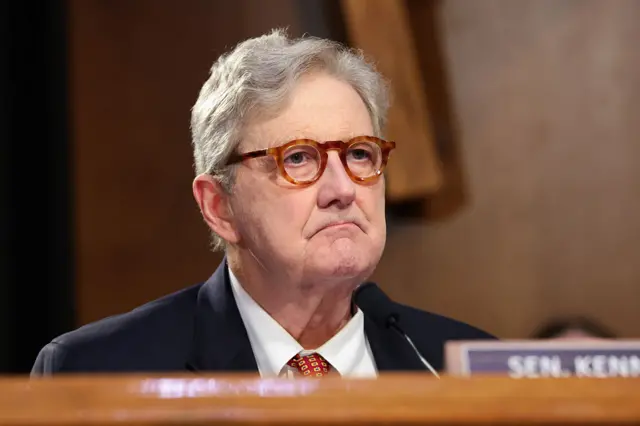
    Republican Senator John Kennedy asks Caine about ending the blockade on Iranian ports and bringing US troops home: "What would be the consequences of that?"

    Caine says he assesses Iran "will continue to be a challenge moving forward" but he will not say if Iran will put tolls on the Strait of Hormuz, explaining the question involves a hypothetical scenario.

    "I'm not trying to get you in trouble. I know your advice to the president is private," Kennedy says. "But this is as serious as four heart attacks and a stroke. Now, what happens if we come home and end the blockade to the world?"

    Caine answers: "Iran has the potential to continue to be a threat and we will need to prepare military options."

    Kennedy turns to Hegseth for an answer.

    "The likely outcome is they would try to impose their will on the waterway in ways that the world would not like," says the defence secretary.

    Close up of glasses-wearing Kennedy frowningImage source, Getty Images
  6. 'No realistic outcome in sight,' Democrat sayspublished at 21:30 BST

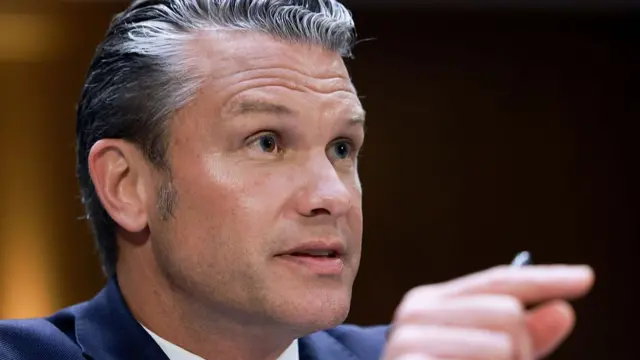
    Hegseth tells lawmakers that the commander in chief of the US military deserves praise "for having the courage to ensure that crazy Islamists can't have a nuclear weapon to hold us at issue".

    "He should be praised for starting a war without authority? Creating a situation where the world economy is suffering tremendously?" Democrat Jack Reed shoots back at Hegseth. "And we have no outcome - at least no realistic outcome in sight."

    Closeup of Hegseth as he holds his hand up, pinching his forefinger and his thumbImage source, Getty Images

    Hegseth is not given the chance to respond as Reed moves on to ask Caine if the military anticipates escalation to ground combat.

    Caine says "it would be unhelpful for me to opine on hypotheticals" but the military always develops "an unbelievable amount of options".

  7. Analysis

    Even if Hegseth gets the votes, he'll have to wait until after summer recess for fundspublished at 21:25 BST

    Gary O'Donoghue
    Chief North America correspondent, reporting from Washington DC

    The war in Iran has cost the US $37.5bn (£28bn) so far, up around $8bn (£6bn) since the last figure given by the Pentagon, according to update we've just heard from Defence Secretary Pete Hegseth.

    While some of that figure funds the continuation of the war into September, Hegseth - speaking to senators on the Appropriations Committee - is also asking for a further $87bn (£65bn) for his department, with $67bn (£50bn) of that destined for operations in the Middle East.

    Most Democrats are opposed to the supplemental funding request, and there is unhappiness in Republican ranks too.

    Some of the so-called fiscal hawks in the GOP want offsets – in other words, cuts elsewhere – before agreeing.

    Either way, the House leaves town on Thursday and it and the Senate are not back in session together until September, so even if Republicans can muster the votes, it’s going to be a couple of months before Hegseth can get his money.

  8. Trump posts about recent US conflict death tolls during hearingpublished at 21:17 BST

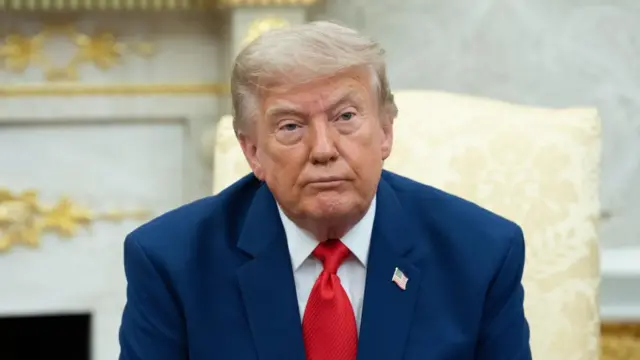
    A file photo of Trump sitting in the Oval OfficeImage source, AARON SCHWARTZ/POOL/EPA/Shutterstock

    With the hearing ongoing, Trump - who is not present at the hearing - has taken to his social media site to make a point about the war against Iran.

    Trump's post on Truth Social lists recent US wars and how long they took to end and how many US soldiers died.

    His post in its entirety says:

    "Afghanistan War: 20 years, 2,000 DEAD.

    Iraq War: 9 years, 4,600 DEAD.

    Vietnam War: 19 years and 5 months, 58,220 DEAD.

    Korean War: 3 years and 1 month, 36,574 DEAD.

    Venezuela War: 1 day, 0 DEAD.

    Iran Military Conflict: 4 months, 18 DEAD."

  9. Funding request 'does not make a lot of sense' - senior Democratpublished at 21:03 BST

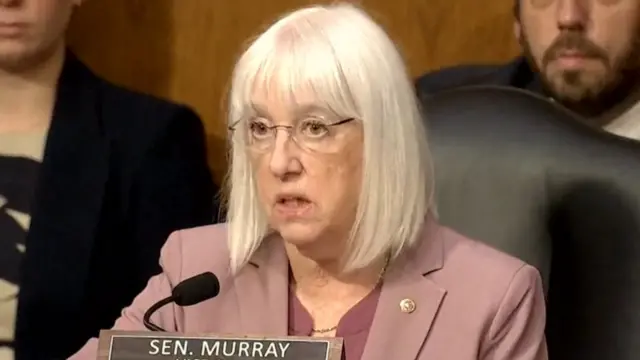
    Before the question on the costs of the Iran war that we brought you in our previous post, it was the turn of the most senior Democrat on the committee, Patty Murray, to ask questions.

    She says the funding request "does not make a lot of sense" and asks why the money is needed.

    Murray says this request has been sold as an emergency request for funds, but accuses the administration of attempting to "skirt the normal appropriations process".

    She says it includes $800m (£598m) for the National Guard to patrol Washington DC, more than $1 billion (£750m) for the Army to patrol the US's southern border, and $900m (£672m) to support "illegal boat strikes in the Caribbean".

    Hegseth replies, saying the "gross negligence" of the Biden administration means the department is having to "re-establish deterrence".

    Murray interjects, asking how the administration can claim to have destroyed Iran's capabilities when they are currently firing missiles at US assets.

    Hegseth says the amount of damage the US military has inflicted has left Iran "in the worst place they have ever been".

    He adds they have destroyed some of Iran's capabilities, but the regime has also hidden some underground.

    "That's what terror regimes would do, so I will acknowledge they still have capabilities, no doubt," he says.

  10. Hegseth says Iran war has cost $37.5bn so farpublished at 20:56 BST
    Breaking

    Hegseth is asked by Democratic Senator Dick Durbin if he has an estimate for how much the war in Iran has cost so far.

    Hegseth says that it has cost about $37.5bn (£28bn).

    The figure had not previously been announced by Pentagon officials.

  11. Current and future training would be curtailed without funds - Hegsethpublished at 20:51 BST

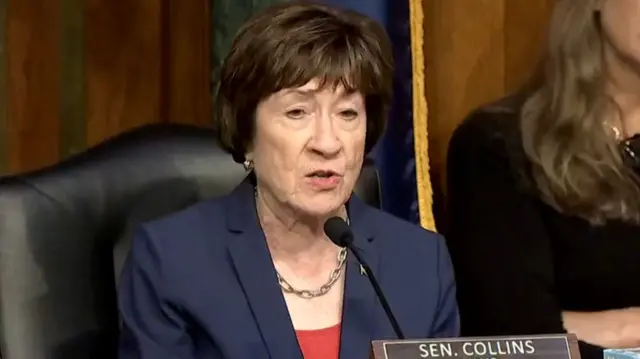
    Senator Collins, as the committee's chairwoman, begins questioning Hegseth over what the impact would be if the budget needs were not met.

    Hegseth says current and future training for military members would need to be curtailed without funds.

    He again blames the previous Biden administration, saying it didn't fund the military to the appropriate levels, gave away weapons to Ukraine, and delayed important maintenance.

    If approved, the funding will be a "generational investment" that will make sure the US avoids "playing catch-up" and keeping the US military ahead of others.

  12. Agriculture secretary backs Department of Defensepublished at 20:38 BST

    Next up is Secretary of Agriculture Brooke Rollins.

    She’s not here to talk about the war, but to ask for funding for US farmers.

    But she starts by saying her department is joining today with the US Department of War "in a fight for America".

    "After all, defending America's ability to feed and fuel and clothe herself is defending America full stop," she adds.

  13. The armed forces are US's 'greatest insurance policy', says Dan Cainepublished at 20:31 BST

    Caine speaks into a mic that's propped up on a desk in front of him as he sitsImage source, Reuters

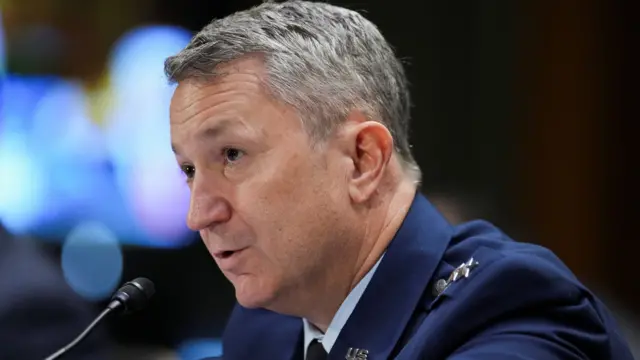
    After Hegseth finished his testimony, Joint Chiefs of Staff Chair Gen Dan Caine says "the character of war is changing" and that this means the country needs to arm the US military.

    He says advances in AI have delivered technical advantages but also strategic vulnerabilities.

    The modern battlefield stretches from the seabed to cyberspace "at the same time" and "we must be prepared to fight across all of them", Caine says.

    The armed forces are America's "greatest insurance policy", he adds.

  14. Money will be used to 'reinforce peace through strength'published at 20:26 BST

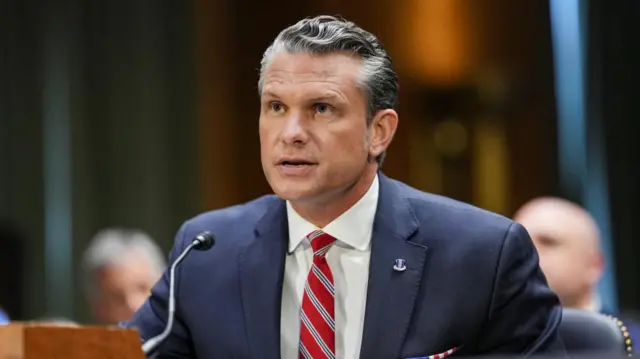
    Secretary Hegseth says every dollar appropriated will be used to build the "lethality" of the US military force and will "reinforce peace through strength".

    He says the previous Biden administration had left the country with a "disaster" in budget management, and the "war fighters" need the money to keep the country safe.

  15. Soldiers' pay threatened without extra funding - Hegsethpublished at 20:22 BST

    Hegseth speakingImage source, Reuters

    Hegseth goes on to say the funding request is coming at an urgent time.

    He says "we have to prepare for war" in order to maintain peace.

    Hegseth says critical investments need to be made to prevent adversaries from outpacing the US.

    "Without these funds, we face critical shortfalls that threaten our ability to also simply pay our service members, rapidly replenish equipment and munitions, and sustain vital operations without disruption," he adds.

  16. Hegseth begins speaking - but soon interrupted several timespublished at 20:19 BST

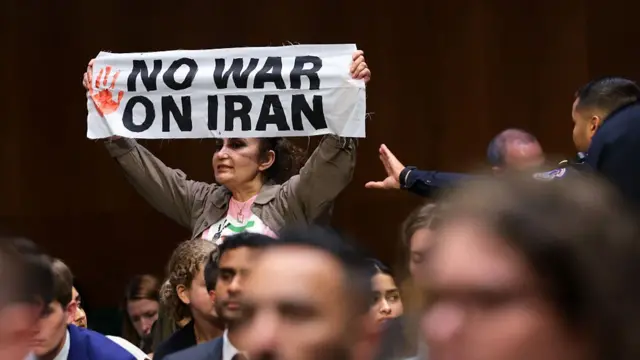
    A woman holds up a banner that says "no war on Iran" with a red hand on itImage source, Getty Images

    Hegseth begins his testimony by saying "we live in a dangerous world" and it requires bold and swift action.

    But he’s quickly interrupted by people shouting from the crowd, who protest against the war in Iran.

    Chairwoman Collins pauses the hearing and tries to resume proceedings, but to no avail.

    She then bangs her gavel and calls for order in the room, urging the Capitol Police to remove the protesters disrupting the hearing.

    Hegseth then continues.

    Media caption,

    Watch: Hegseth interrupted several times as he seeks additional Iran war funding

  17. National security and food security go hand in hand, says Mike Roundspublished at 20:07 BST

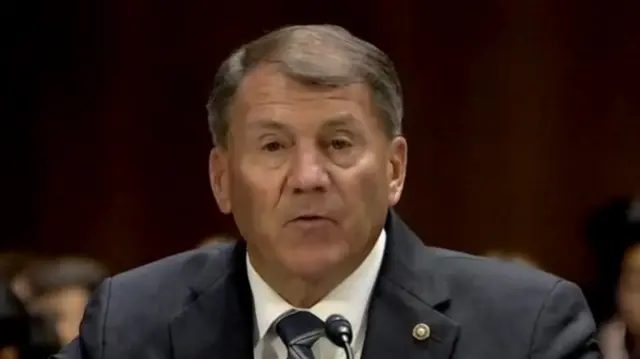
    Rounds speaks and looks into the cameraImage source, Reuters

    As we’ve mentioned earlier, the committee is hearing requests for additional funding not just for the US military but for farmers as well.

    We’ve just heard from Republican South Dakota Senator Mike Rounds, who says national security and food security go hand in hand.

    He says the Trump administration’s funding requests come at a "critical time" for farmers as fertiliser and fuel prices surge as a result of the war, before urging the committee to support the White House’s request.

    "Protecting America's food supply, energy supply, and national defence are not separate priorities," he says. "They reinforce one another."

  18. Murray says Trump 'started a war of his own choosing'published at 19:51 BST

    Murray speaks into a small mic as she sits on a black leather chair in front of two people sitting behind herImage source, Reuters

    Vice chairperson Patty Murray is up next.

    The Democrat starts by calling the US military one of "the greatest meritocracies in the free world" and says "we need to make sure it stays that way".

    She criticises the Trump administration for going to war with Iran without congressional approval, saying the president "started a war of his own choosing".

    Trump did not make a case to the American people and the cost has been "catastrophic", she says, acknowledging the deaths of 17 US service members in battle.

    "We owe all of them and their families a debt of gratitude we can never repay," Murray says.

  19. Chairperson says funding 'critical' to protecting USpublished at 19:45 BST

    Collins speaking into a small mic propped up on a desk in front of her while she is sitting in a black leather chairImage source, Reuters

    Senate Appropriations Committee chairperson Susan Collins opened the hearing by saying the supplemental funding being requested by the Department of Defense is "critical" to protecting US's national security.

    The Republican representative from Maine says there are "divergent views" on the committee over the war on Iran, but says the "fact remains" that there are "must pay bills and urgent requirements" facing the department.

    She says the funds are required to "deter and defend against potential aggressors worldwide".

    Collins says some requirements, such as munitions shortfalls, have been "well known" to the committee for some time, and that before Iran there was bipartisan support to address them.

    "Congress has the responsibility to ensure that [US service personnel have] the tools, the training and the support they need to accomplish their missions," she says.

  20. Hearing begins nowpublished at 19:37 BST

    Lawmakers on the Senate Appropriations Committee have begun their hearing.

    Facing questions are Defence Secretary Pete Hegseth, Chairman of the Joint Chiefs of Staff Dan Caine, and Agriculture Secretary Brooke Rollins.

    You can watch live at the top of this page - and we’ll also bring you the key points here as text updates.

    • As a reminder, a small part of the funding under scrutiny today is for other measures, including $11bn for US farmers